
Dallas Cowboys vs Philadelphia Eagles Match Player Stats: Prescott’s Milestone and Pickens’ 146 Yards

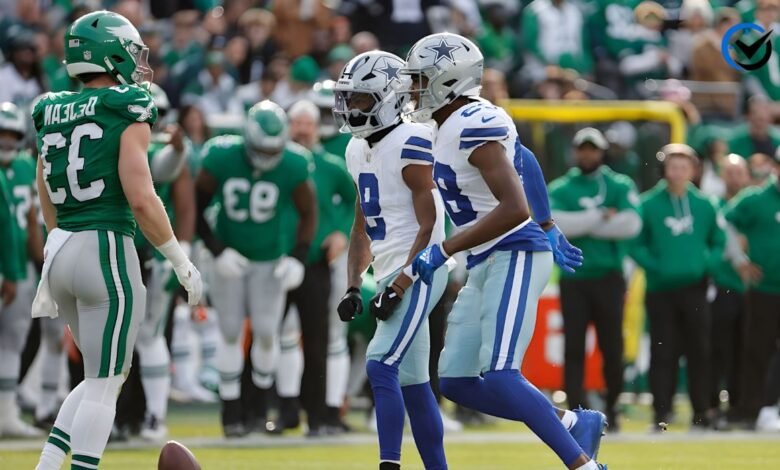
Dallas’ 24–21 victory over Philadelphia on November 23, 2025, combined a franchise passing milestone with a comeback from three touchdowns behind. At AT&T Stadium in Arlington, Texas, Dak Prescott became the Cowboys’ career passing leader, while George Pickens finished with 146 receiving yards. Yet those headline numbers explain only part of the result. Philadelphia built a 21–0 lead before its offense stopped scoring, and Dallas needed contributions from its defense, supporting receivers, and kicking unit to recover. This breakdown examines that specific Week 12 meeting, connecting the individual statistics to the scoring sequence and the plays that decided the game.
How a 21–0 Lead Became a 24–21 Dallas Win
Philadelphia controlled the early scoreboard through Jalen Hurts, who threw a touchdown to A.J. Brown and added two rushing scores. His second rushing touchdown made it 21–0 with 11:32 remaining in the second quarter. Dallas finally answered through Pickens shortly before halftime, cutting the deficit to 21–7. The Cowboys then scored seven points in the third quarter and ten in the fourth, while the Eagles added none. Across the full game, Dallas produced 473 net offensive yards against Philadelphia’s 339. That 134-yard advantage helps explain the comeback, but the score remained tied until the final kick because several Dallas opportunities ended without points.
Prescott Passes Tony Romo in Career Passing Yards
Prescott entered the game needing 160 passing yards to move beyond Tony Romo’s franchise total of 34,183. He reached halftime with 159 yards, leaving the two quarterbacks level in career passing yardage. A nine-yard completion to Pickens on Dallas’ first offensive play of the second half moved Prescott ahead. By the finish, his 354-yard performance had raised his career total to 34,378, which was 195 yards above Romo’s mark. These are the totals at the end of this game, rather than a current career update. The milestone concerns regular-season passing yards, so it should be distinguished from playoff totals, touchdown records, and single-season achievements.
Comparing Prescott and Hurts Beyond the Final Score
Prescott completed 23 of 36 passes for 354 yards, two passing touchdowns, and one interception, finishing with a 103.2 passer rating. Hurts completed 27 of 39 throws for 289 yards, one passing touchdown, and no interceptions, with a 99.2 rating. Hurts had the better completion percentage, approximately 69.2% against Prescott’s 63.9%, but Prescott generated more yards per attempt: about 9.8 against 7.4. Both quarterbacks also contributed rushing touchdowns, with Hurts scoring twice and Prescott once. Their lines show different strengths. Philadelphia’s quarterback protected the ball through the air, while Dallas’ quarterback created more passing yardage despite completing fewer throws and making an interception.
Why Pickens’ Nine Catches Were So Important
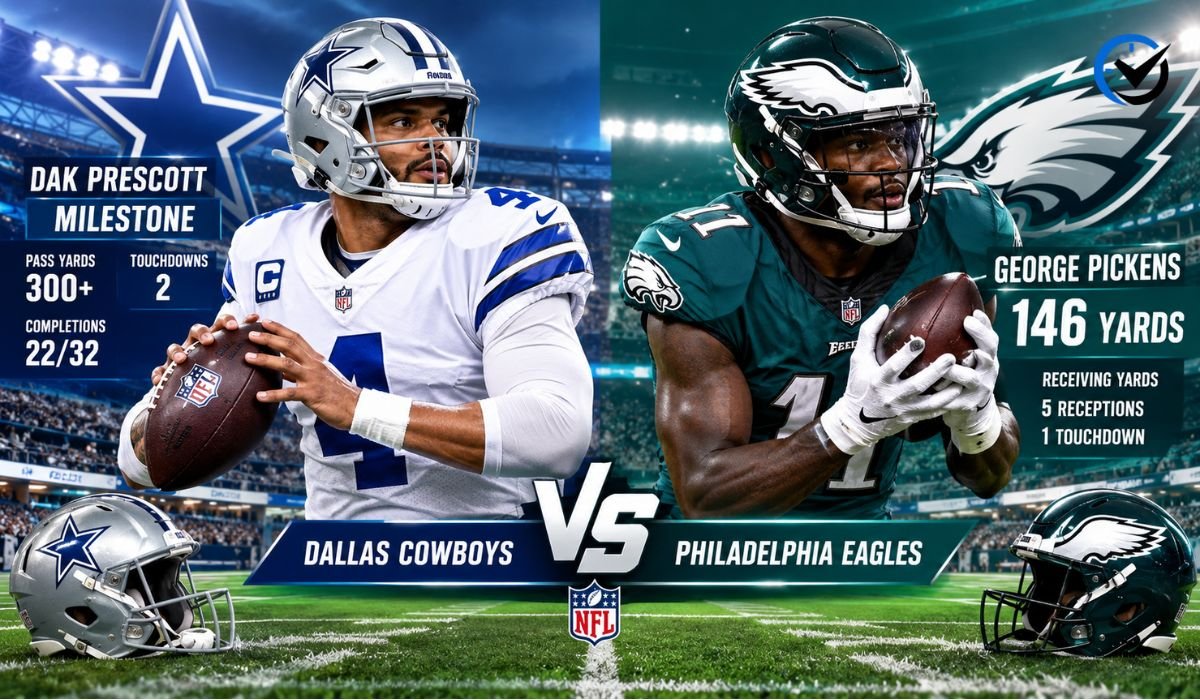
Pickens caught nine passes for 146 yards and one touchdown, averaging approximately 16.2 yards per reception. His one-yard scoring catch put Dallas on the board with 21 seconds left before halftime. Later, his 43-yard reception helped set up Prescott’s tying rushing touchdown. Pickens also caught a 24-yard pass during the final possession, moving the Cowboys from Philadelphia’s 46-yard line to its 22. That sequence shows why his contribution extended beyond the receiving total. He supplied a short scoring catch, a major gain that helped erase the deficit, and a late completion that shortened the winning field-goal attempt. Each served a different purpose within the comeback.
The Receiving Contributions Around Pickens and Brown
CeeDee Lamb finished with four catches for 75 yards, including a 48-yard gain during Dallas’ third-quarter touchdown drive. Jake Ferguson added five receptions for 60 yards and converted a crucial late third down with a 19-yard catch. KaVontae Turpin contributed another 48 yards on one reception, while Brevyn Spann-Ford scored on his only catch, a four-yard touchdown. Philadelphia also had meaningful production from its receivers. Brown led the Eagles with eight catches for 110 yards and a touchdown, while DeVonta Smith added six receptions for 89 yards. Their combined 199 receiving yards demonstrate that Philadelphia’s passing attack produced substantial gains even though the team failed to score after halftime.
Javonte Williams Gives Dallas the Stronger Ground Game
Javonte Williams carried 20 times for 87 yards, averaging 4.35 yards per attempt. Dallas finished with 125 rushing yards overall, with Malik Davis adding 24 on three carries. Philadelphia managed 63 rushing yards, and Saquon Barkley gained only 22 on ten attempts, an average of 2.2. Hurts led the Eagles in rushing with 33 yards and scored both of their rushing touchdowns. The important distinction is between rushing and overall offensive contribution: Barkley also caught seven passes for 52 yards. Dallas limited his carries effectively, but he remained involved as a receiver. Williams’ workload, meanwhile, gave the Cowboys another source of offense alongside their larger passing gains.
Dallas’ Defense Changes the Game Without an Interception
Dallas held Philadelphia scoreless after its third touchdown, with later sequences producing five punts, two lost fumbles, and a missed field goal. Sam Williams forced Barkley’s fumble, which Kenneth Murray recovered. Alijah Clark later forced a fumble on Xavier Gipson’s punt return, with long snapper Trent Sieg recovering near the Eagles’ goal line. Neither takeaway produced immediate Dallas points, but both interrupted Philadelphia’s chance to regain control. Osa Odighizuwa then sacked Hurts for a 13-yard loss on a late third down, helping force the punt before the winning drive. Dallas’ defense intercepted no passes, showing how sacks, possession changes, and repeated stops contributed to the result.
Third Downs and Red-Zone Results Explain the Close Margin
Both teams converted five of 12 third-down opportunities, a matching rate of 41.7%. Philadelphia was more efficient inside the opponent’s 20-yard line, scoring touchdowns on all three red-zone visits, while Dallas scored touchdowns on three of five. The Cowboys also failed on both fourth-down attempts. An early Turpin fumble and Prescott’s end-zone interception prevented promising possessions from becoming points, and Dallas later failed to score after recovering Gipson’s fumble near the goal line. Those missed chances explain why a clear yardage advantage did not create a comfortable victory. Dallas needed sustained offensive production because Philadelphia had converted its early scoring opportunities more cleanly and defended several dangerous situations.
Aubrey Finishes a Drive Built by Several Players
Brandon Aubrey made a 42-yard field goal as time expired, completing a nine-play, 49-yard Dallas drive that began with 1:35 remaining. Ferguson’s third-down reception and Pickens’ subsequent gain were the central passing plays, but the possession also required ball security and clock management. Ferguson fumbled on its opening play, yet the ball went out of bounds and Dallas retained possession. Aubrey had missed from 51 yards earlier, so the winning kick completed a mixed kicking performance rather than a flawless one. Philadelphia’s Jake Elliott missed his only field-goal attempt, from 56 yards. In a three-point game, the outcome depended on creating a manageable final kick and then converting it.
Final Thoughts
Prescott’s record and Pickens’ receiving total provide the clearest entry points into this Cowboys–Eagles game, but the result came from several connected contributions. Dallas generated more offense, kept running the ball, and prevented Philadelphia from adding to its early lead. The Eagles still produced three touchdowns through Hurts and strong receiving totals from Brown and Smith, while their defense stopped Dallas in important situations. The fairest reading combines those strengths with the failures that followed. A career milestone identifies Prescott’s place in franchise history; the receiving gains, defensive stops, and final field goal explain why that milestone came during a Dallas victory.
Frequently Asked Questions
1. Which Cowboys–Eagles game does this article cover?
It covers the regular-season game played on November 23, 2025, at AT&T Stadium in Arlington, Texas. Dallas won 24–21 in Week 12. The date identifies the meeting behind Prescott’s milestone and Pickens’ 146-yard performance. Statistics from another Cowboys–Eagles game should not be mixed into this breakdown, even when the same players appear in both box scores.
2. What exactly was Prescott’s milestone?
Prescott became Dallas’ leader in regular-season career passing yards by moving beyond Tony Romo’s 34,183. He finished that day with 34,378. It was a cumulative franchise record, built across seasons, rather than a record for passing yards in one game. The distinction matters because a career total measures sustained production and playing time, not just the quality of one performance.
3. Why do Prescott’s passing yards differ from Dallas’ net passing yards?
Prescott received credit for 354 passing yards, while Dallas recorded 348 net passing yards. The six-yard difference came from the loss on his one sack. Team net passing statistics subtract sack yardage, while the quarterback’s individual passing total reflects completed passes. This explains the two figures without suggesting that one is an incorrect version of the other.
4. What share of Dallas’ passing yards came through Pickens?
Pickens’ 146 receiving yards represented approximately 41.2% of Prescott’s 354 passing yards. That proportion shows how much completed-pass yardage went through one receiver. It does not mean Pickens produced 41.2% of Dallas’ entire offense, because the team also gained rushing yards. Nor does it give him sole credit for those gains, which required blocking and accurate throws.
5. Did Pickens lead the game in receptions as well as receiving yards?
Yes. Pickens led both teams with nine receptions and 146 receiving yards. Brown was closest in catches with eight, although he finished with 110 yards. Reception counts show how often a player caught a pass, while yardage reflects the distance gained. Pickens led in both measures in this matchup, rather than simply gaining the most yards through fewer catches.
6. Was Barkley held to only 22 total offensive yards?
No. His 22 yards were his rushing total. He added 52 receiving yards, giving him 74 yards from scrimmage. Separating those categories avoids understating his involvement in Philadelphia’s offense. Dallas restricted his ground production, but the Eagles continued to use him on passing plays. His lost fumble occurred after a reception, so his receiving contribution needs separate consideration.
7. Why does Hurts have three touchdowns but only one passing touchdown?
Hurts threw one touchdown pass to Brown and scored twice by running the ball himself. That gave him three touchdowns accounted for, split between passing and rushing. A passing touchdown credits the quarterback for the throw, while a rushing touchdown credits the player who carries the ball into the end zone. The categories describe different scoring actions.
8. Did Dallas win the turnover battle?
No. Both teams committed two turnovers. Dallas lost Turpin’s fumble and threw one interception, while Philadelphia lost fumbles by Barkley and Gipson. The timing differed: Dallas’ mistakes came before halftime, and Philadelphia’s came in the fourth quarter. Equal turnover totals therefore do not mean equal effects on the game, although the Cowboys did not turn either recovered fumble into immediate points.
9. Which Eagles defender led the team in tackles?
Zack Baun led Philadelphia with nine combined tackles, consisting of three solo tackles and six assists. He also recovered Turpin’s fumble. Combined tackles add a player’s solo stops and assisted stops together, so they differ from a solo-tackle total. A high combined count indicates frequent involvement, but it cannot alone establish that a defender had the strongest overall performance.
10. Was the comeback the largest in Cowboys history?
The 21-point recovery tied Dallas’ largest comeback. The Cowboys had previously overcome a 21-point deficit against the St. Louis Rams in September 2014, winning 34–31. In this Eagles game, the relevant deficit was 21–0 during the second quarter. The 21–7 halftime score describes a later stage of the comeback, when Dallas had already reduced the gap.
Recommended: Detroit Tigers vs Seattle Mariners Timeline: From 1977 to a 15-Inning ALDS Decider


One Comment