Detroit Tigers vs Seattle Mariners Timeline: From 1977 to a 15-Inning ALDS Decider

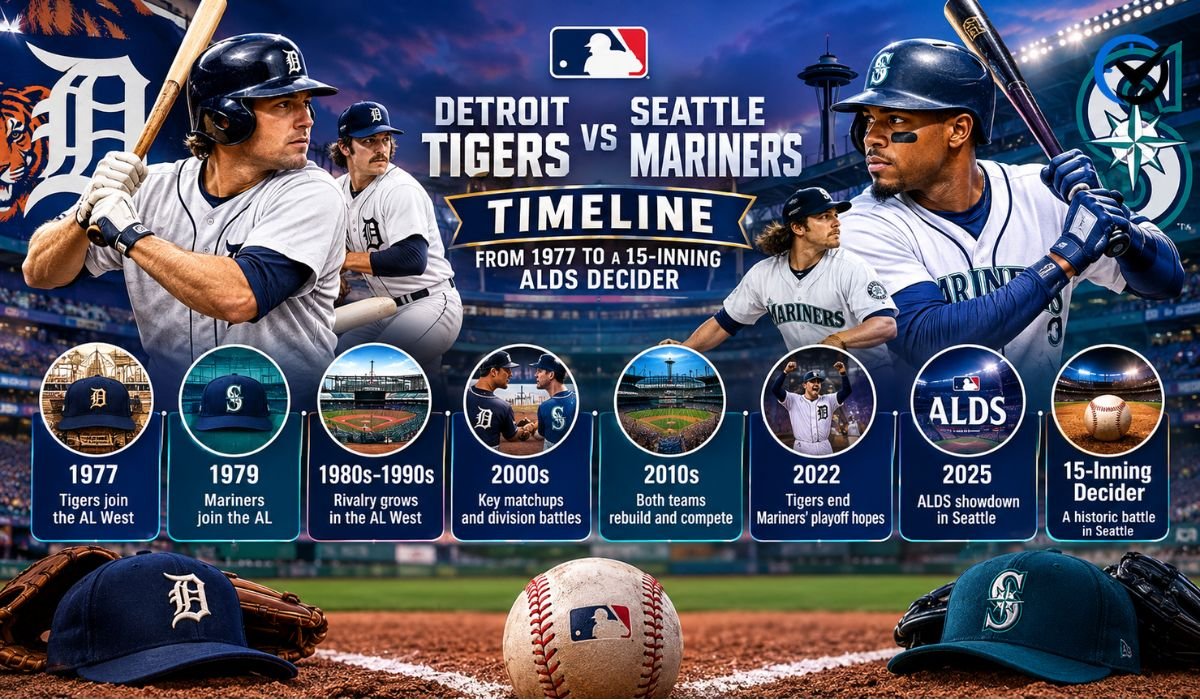
The Detroit Tigers vs Seattle Mariners Timeline begins with an expansion team visiting Tiger Stadium in 1977 and reaches a major turning point in October 2025. Along the way, the clubs produced two memorable no-hitters, exchanged an important player, and traded control of their regular-season meetings. Their first postseason series finally brought that long history into an elimination setting, ending with Seattle winning a 15-inning Game 5. This account follows selected milestones through that decider, explaining what happened and why each event matters. It also separates individual pitching achievements, season-series results, and playoff outcomes, which tell different parts of the story and should not be treated as interchangeable records.
1977: The First Meeting at Tiger Stadium
Seattle and Detroit first played on May 27, 1977, during the Mariners’ inaugural major league season. Seattle won 2–1 at Tiger Stadium before 44,207 spectators, with Glenn Abbott earning the victory and Mark Fidrych taking the loss. The visitors also won the next two games, 3–1 and 6–4, completing a three-game sweep. That strong introduction did not mean Seattle controlled every subsequent meeting: the Mariners finished their first season with a narrower 6–5 advantage against Detroit. These opening results establish the starting point of the matchup. They also show the difference between winning one series decisively and holding only a small advantage across an entire season of games.
1990: Randy Johnson Throws Seattle’s First No-Hitter
On June 2, 1990, Randy Johnson gave the matchup its first major pitching landmark. The Seattle left-hander held Detroit without a hit in a 2–0 victory at the Kingdome, recording the first no-hitter in Mariners history. Johnson struck out eight, walked six, and threw 138 pitches across nine innings. Those walks matter when describing the achievement: this was a no-hitter, rather than a perfect game, and Detroit still had opportunities to reach base. Johnson prevented those chances from becoming runs. His performance gave Seattle a lasting franchise milestone while placing the Tigers on the receiving end of a result remembered far beyond that year’s regular-season standings.
2004: Carlos Guillén Moves From Seattle to Detroit
The clubs’ shared history also includes an important transaction. On January 8, 2004, Seattle traded shortstop Carlos Guillén to Detroit for Ramón Santiago and minor league infielder Juan González. Guillén quickly became a productive addition for a Tigers team rebuilding after a 43–119 season. In 2004, he batted .318 with 20 home runs and 97 runs batted in, earning his first All-Star selection. Detroit improved to 72–90, although that improvement involved more than one player or transaction. The trade belongs in this timeline because it directly connected the organizations and helped reshape Detroit’s lineup. It illustrates how a relationship between clubs can matter between their scheduled games, through decisions that influence several subsequent seasons.
2021: Spencer Turnbull Gives Detroit Its Own No-Hitter
Detroit reversed the no-hitter storyline on May 18, 2021, when Spencer Turnbull shut out Seattle 5–0 at T-Mobile Park. He struck out nine, walked two, and completed the game with 117 pitches, including 77 strikes. It was the eighth no-hitter in Tigers history and their first since Justin Verlander’s 2011 performance against Toronto. Turnbull finished by striking out Mitch Haniger, with catcher Eric Haase receiving the final pitch. The performance was a clear individual achievement supported by defense, including Jeimer Candelario’s difficult stop at third base. Placed beside Johnson’s 1990 outing, it gives the matchup an unusual symmetry: each franchise recorded a significant no-hitter against the other, both played in Seattle.
2024: Detroit Wins Five of Six Meetings
The Tigers held a clear advantage in 2024, winning five of their six games against the Mariners. Detroit took two of three in Seattle on August 6–8, then swept the return series at Comerica Park on August 13–15. The home series opened with a 15–1 Tigers victory, followed by much tighter 3–2 and 2–1 wins. Javier Báez supplied the decisive two-run homer in the eighth inning of the finale. These results show why a season record needs some context: Detroit won through both heavy scoring and late breakthroughs in close games. The sweep also formed part of the Tigers’ late-season recovery, although six head-to-head games alone cannot explain an entire playoff push.
2025: The Matchup Reaches the Postseason
Seattle reversed the regular-season balance in 2025, taking four of six meetings, including a three-game sweep in Detroit before the All-Star break. The Mariners finished 90–72, won the American League West, and earned a first-round playoff bye. Detroit finished 87–75 and advanced by defeating Cleveland in a three-game Wild Card Series. Their resulting American League Division Series was the first postseason meeting between the clubs. Seattle hosted Games 1, 2, and 5, while Detroit hosted Games 3 and 4. Unlike an ordinary season series, this best-of-five contest had an immediate consequence: the first team to win three games would advance, and the other team’s season would end.
Games 1 and 2: Close Scores, Different Winners
Detroit won the opener 3–2 in 11 innings on October 4, 2025. Zach McKinstry’s run-scoring single broke the tie, giving the visiting Tigers an early series advantage. Seattle answered with a 3–2 victory on October 5, but the scoring followed a different pattern. Jorge Polanco hit two solo home runs against Tarik Skubal before Detroit tied the game in the eighth on Spencer Torkelson’s two-run double. Julio Rodríguez then doubled home Cal Raleigh in the bottom of that inning to restore Seattle’s lead. The split left the series level at one win each. Both games ended with the same score, yet their decisive moments came through different hitters and different pitching situations.
Games 3 and 4: Detroit Forces a Decider
Seattle moved ahead with an 8–4 win at Comerica Park on October 7. Raleigh, Eugenio Suárez, and J.P. Crawford homered, while Logan Gilbert allowed one run over six innings and struck out seven. Detroit faced elimination the next day and initially fell behind 3–0, but its offense recovered for a 9–3 victory. Riley Greene, Báez, and Gleyber Torres hit home runs, with Báez driving in four runs overall. The Tigers’ response tied the series at two games apiece and sent both teams back to Seattle. This middle portion of the series demonstrated the limits of drawing conclusions from one game: Seattle’s comfortable win created an opportunity to advance, but Detroit’s comeback kept the contest alive.
Game 5: Skubal’s Strikeouts and Carpenter’s Home Run
The deciding game began on October 10 with Skubal delivering one of the postseason’s outstanding pitching performances. He struck out 13 over six innings, allowed two hits and one run, and issued no walks. His seven consecutive strikeouts established a postseason record, while the total of 13 set a record for a winner-take-all playoff game. Seattle starter George Kirby also kept the scoring low. After Javier Báez doubled to open the sixth, Kerry Carpenter hit a two-run homer off reliever Gabe Speier to put Detroit ahead 2–1. Seattle stayed alive when pinch-hitter Leo Rivas singled home the tying run in the seventh. That hit removed Detroit’s advantage and set up eight more innings before the winning run arrived.
The 15th Inning: Polanco Sends Seattle to the ALCS
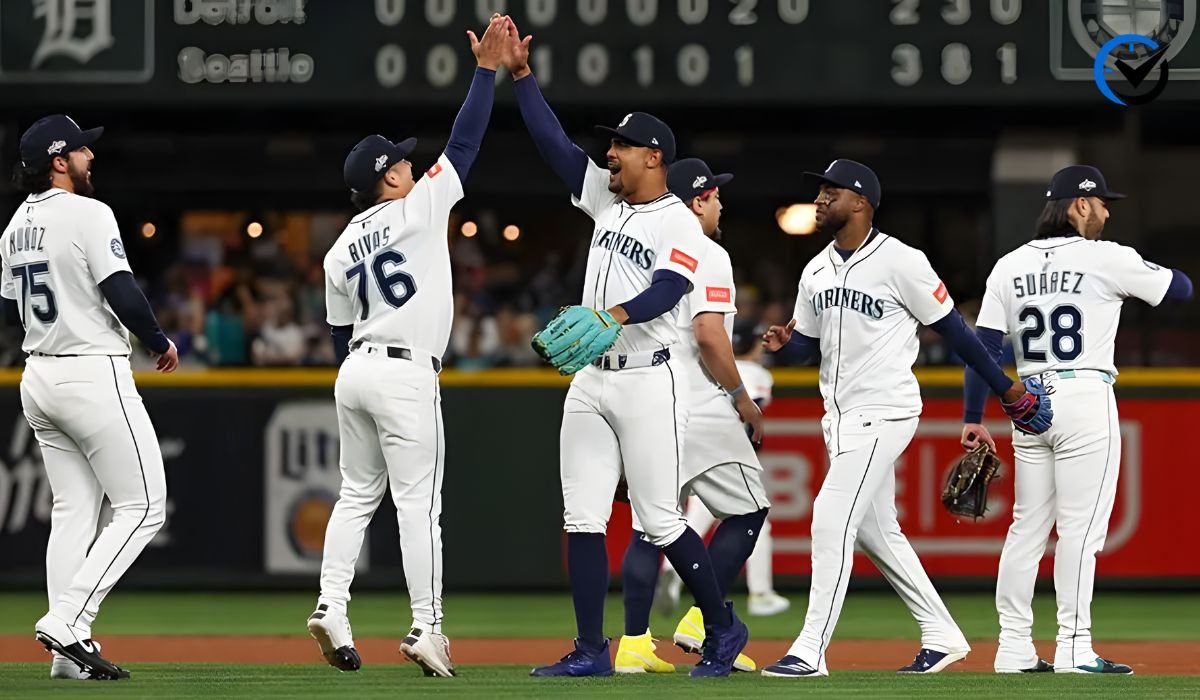
The game remained tied until the bottom of the 15th, when Seattle loaded the bases with one out against Tommy Kahnle. Polanco singled into right field, scoring Crawford and giving the Mariners a 3–2 victory. The game lasted four hours and 58 minutes and became the longest winner-take-all postseason contest by innings. Seattle won the series three games to two and reached the American League Championship Series for the first time since 2001. The pitching effort stretched well beyond the usual relievers: Gilbert and Luis Castillo appeared from Seattle’s rotation, while Detroit used Jack Flaherty in relief. Their involvement shows how an elimination game can change normal roles when protecting a single run becomes the immediate priority.
Final Thoughts
The Tigers–Mariners history becomes more meaningful when its milestones are placed in order. Seattle’s first visit established the matchup, Johnson and Turnbull added lasting pitching achievements, and the Guillén trade connected the clubs through roster building. Their contrasting 2024 and 2025 results show how quickly an advantage can shift as teams change. The first postseason series then gave every win a different weight, with Detroit extending the contest before Seattle prevailed in the 15th inning. That finish does not erase either club’s earlier achievements. It adds a decisive playoff chapter to a history built over decades, giving fans a clear endpoint for this account and several earlier moments worth understanding on their own terms.
Frequently Asked Questions
1. Are the Tigers and Mariners division rivals?
They play in the same league but different divisions: Detroit in the American League Central and Seattle in the American League West. Their meetings therefore lack the frequency of divisional matchups. The history is better understood through particular games, season series, and their 2025 playoff meeting.
2. Why does this timeline begin in 1977?
The Mariners began major league play in 1977, making that the earliest possible season for this pairing. Detroit already had an established baseball history. Starting with Seattle’s arrival keeps the account focused on games between these two franchises rather than unrelated events from either city’s past.
3. How is a season series different from a playoff series?
A season series combines the regular-season games played between two clubs during one year. A playoff series is a separate competition with advancement at stake. Detroit’s 2024 advantage and Seattle’s 2025 playoff victory belong to different categories and should remain separate when comparing results.
4. What does ALDS mean?
ALDS stands for American League Division Series. In the 2025 format, a team needed three wins in a maximum of five games to advance. The winner moved to the American League Championship Series, where a World Series place was at stake; winning the ALDS alone did not secure that place.
5. Why was the deciding game played in Seattle?
Seattle entered the series as the higher seed and held home-field advantage. The schedule assigned the Mariners the first two games and a possible fifth game, with the middle two in Detroit. The final venue was predetermined, rather than chosen after the series reached two wins apiece.
6. Were Johnson’s and Turnbull’s no-hitters perfect games?
Neither was a perfect game because both pitchers allowed walks. A no-hitter concerns whether the opponent records a hit, while a perfect game requires preventing every opposing batter from reaching base. That distinction allows both outings to be described accurately without diminishing their significance.
7. Why did extra innings start without an automatic runner?
The automatic runner on second base applied to regular-season extra innings, but it was not used in the 2025 postseason. Each extra inning in the decider began with empty bases. Teams therefore had to create their scoring opportunities through batting and baserunning, without an automatically placed runner.
8. Was Game 5 the longest postseason game ever?
Its record applied specifically to winner-take-all postseason games. Longer playoff contests had already occurred, including Seattle’s 18-inning loss to Houston in 2022. A game can clinch a series without being winner-take-all: that term means both clubs face elimination, which was true of the 2025 decider.
9. What made Polanco’s single a walk-off hit?
A walk-off hit gives the home team the winning run in its final turn at bat, immediately ending the game. Polanco’s single brought Crawford home with the score tied in the 15th. Once that run counted, Detroit had no further opportunity to bat or answer it.
10. Why are innings and strikeouts listed separately?
They describe different parts of a pitching performance. Innings show how much of a game a pitcher completed; strikeouts show how many batters he retired that way. Skubal’s 13 strikeouts reflected his effectiveness, but he pitched only six innings, leaving the later outcome dependent on additional players.
Recommended: Phoenix Mercury vs Las Vegas Aces Timeline: From Las Vegas’ Debut to the WNBA Finals