
Clippers vs Denver Nuggets Match Player Stats: Mathurin’s 38 Points and Full Breakdown

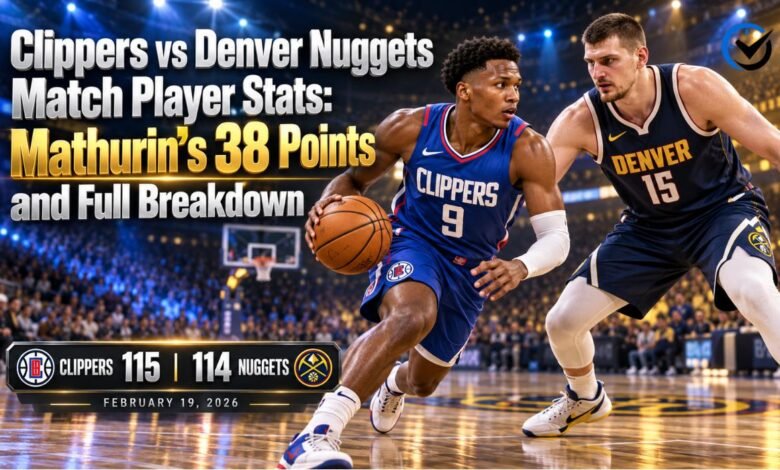
Bennedict Mathurin turned his first home appearance with the Los Angeles Clippers into a 38-point performance on February 19, 2026. Los Angeles beat the Denver Nuggets 115–114 at Intuit Dome in Inglewood, California, with the result uncertain through the final free throw. Mathurin led all scorers, but the game tells a wider story. Denver had stronger three-point production, Nikola Jokić controlled much of the rebounding, and several Clippers contributed through passing, interior scoring, and late defensive plays. This breakdown examines the player numbers, quarter scores, and closing possessions that explain how Los Angeles survived a narrow finish.
How the Lead Changed Across Four Quarters
The Clippers led 25–24 after the first quarter, but Denver won the second period 28–20 to take a 52–45 halftime advantage. Los Angeles responded by outscoring the Nuggets 33–25 in the third, moving ahead 78–77. Both teams then scored 37 points in the fourth, preserving that one-point difference. Denver’s largest lead was 10 points, while the Clippers never led by more than five. There were 13 lead changes and eight ties. Los Angeles erased that 10-point deficit over the last 4:52 of the third quarter with a 14–3 run. That recovery set up a fourth quarter in which neither team could protect a comfortable advantage.
Mathurin’s 38 Points Came From More Than Outside Shooting
Mathurin finished with 38 points, five rebounds, four assists, and three steals in 33 minutes and 49 seconds. He made 12 of 22 field-goal attempts, including two of six three-pointers, and converted 12 of 13 free throws. His overall shooting percentage was 54.5%, while his free-throw accuracy reached 92.3%. The scoring mix matters: 20 points came from two-point baskets, six from threes, and 12 from the foul line. He therefore produced a major offensive night without relying on unusually high three-point accuracy. His free throws supplied nearly one-third of his points, and his passing and steals added value beyond scoring. Three turnovers also belong in the assessment, although they did not outweigh his offensive contribution.
Leonard and Jones Supplied Essential Scoring Support
Kawhi Leonard contributed 23 points, four rebounds, and three assists on eight-of-18 shooting. He made only one of seven three-point attempts, but his six successful free throws helped maintain his scoring output. Derrick Jones Jr. added 22 points, three rebounds, and one assist, shooting seven of 15 overall and six of seven at the line. Together with Mathurin, they produced 83 of the Clippers’ 115 points, or approximately 72.2% of the total. Their contributions were different: Leonard provided another established scoring option, while Jones delivered timely fourth-quarter baskets. Jones scored on consecutive drives before making a three-pointer with 2:50 remaining. That outside basket gave Los Angeles a 104–102 lead during a stretch when every successful possession changed the situation.
Collins, Dunn, and Lopez Filled Different Roles
John Collins recorded 11 points, 12 rebounds, four assists, and three blocks, making five of his 10 shots. His 11 defensive rebounds helped finish Denver possessions without allowing another attempt. Kris Dunn scored just two points but collected eight rebounds, supplied eight assists, and recorded two steals in 29 minutes and 24 seconds. Brook Lopez added eight points, six rebounds, two assists, one steal, and one block. Ranking players only by points would miss substantial parts of the Clippers’ performance. Collins contributed across the frontcourt, Dunn helped move the ball, and Lopez supplied interior finishes. Lopez’s lone block also arrived during a critical late possession, when Denver still had a chance to win.
The Clippers’ Bench Advantage Was Substantial
Los Angeles received 49 points from its reserves, compared with 29 for Denver. Mathurin supplied most of that difference, but other bench players contributed. Nicolas Batum scored six points by making two of three three-pointers. Yanic Konan Niederhäuser added four points and four rebounds, while Jordan Miller scored one point and delivered four assists without a turnover. Isaiah Jackson did not score but recorded a steal. Denver’s starting five outscored the Clippers’ starters 85–66, so bench production helped Los Angeles balance the overall scoring. These totals identify scoring contributions, although they do not establish which players performed better during particular matchups or shared minutes.
Jokić Dominated the Rebounds but Had Shooting Difficulties
Jokić led Denver with 22 points, 17 rebounds, and six assists in 36 minutes and seven seconds. Fifteen of his rebounds came on the defensive end, helping prevent repeated Clippers attempts. His scoring efficiency was less convincing: he made nine of 22 field-goal attempts, missed all six three-pointers, and converted four of seven free throws. Six turnovers added another cost to an otherwise productive statistical line. Still, he remained central to Denver’s late offense, including the inside basket that tied the score at 107 with 46.2 seconds remaining. The balanced reading is that Jokić contributed heavily through rebounding and scoring around the basket while leaving opportunities unused from outside, at the foul line, and through lost possessions.
Murray’s Contributions Extended Beyond the Final Miss
Jamal Murray finished with 20 points, eight rebounds, eight assists, two steals, and one block. He shot five of 15 from the field, including two of five three-pointers, and made eight of 10 free throws. His eight assists matched Dunn’s total and led Denver, while his rebounding supported Jokić. Four turnovers and a 33.3% field-goal rate limited his efficiency. The final missed free throw became the defining image, but it should not erase his other contributions. Murray generated points directly, created baskets for teammates, and kept Denver within reach. His complete line provides a fair assessment of a productive evening that also included missed opportunities.
Denver Received Production From Several Other Players
Cameron Johnson and Julian Strawther each scored 18 points, although their methods differed. Johnson made six of 12 shots and all four free throws. Strawther’s six baskets were all three-pointers; he finished six of 10 from beyond the arc and supplied nearly half of Denver’s 13 successful threes. Bruce Brown added 19 points, five rebounds, and six assists off the bench while shooting six of nine overall. Christian Braun recorded seven points, three assists, and three steals. Jonas Valančiūnas contributed six points, four rebounds, and two steals, while Tim Hardaway Jr. and Spencer Jones scored two points each. This distribution shows that Denver’s offense received meaningful support beyond Jokić and Murray, even though some rotation players struggled to convert their attempts.
Shooting Percentages Explain the One-Point Margin
The Clippers made 41 of 87 field-goal attempts, compared with Denver’s 39 of 86. Denver gained a 15-point advantage from three-pointers, making 13 to Los Angeles’ eight. The Clippers offset that difference with 33 two-point baskets against Denver’s 26, a 14-point advantage, and two additional made free throws. Los Angeles went 25 of 30 at the line, while Denver finished 23 of 31. Those differences combine to produce the final one-point margin. Both teams collected 45 player rebounds, so total rebounding alone does not explain the result. Los Angeles also led 58–50 in paint points and 14–9 in second-chance points. Those categories describe scoring already included in the totals, so they should not be added again as separate advantages.
The Closing Possessions Required More Than Free Throws
After Jokić tied the score at 107, Mathurin made two free throws with 35.6 seconds left. Lopez blocked a Jokić layup, and Collins secured the rebound. Jones made two free throws before Murray answered with a dunk. Lopez dunked off a Mathurin pass, then Murray hit a three-pointer with 11 seconds remaining. Mathurin’s two free throws at 9.1 seconds established a 115–112 lead. Jones then fouled Murray on a three-point attempt with 0.9 seconds left, giving Denver three free throws and a chance to force overtime. Murray made the first two and missed the third; Collins gathered the rebound as time expired. The ending involved reliable foul shooting, a defensive stop, rebounding, and a costly foul, with the outcome depending on the entire sequence.
Final Thoughts
Mathurin’s scoring was the clearest individual difference, but several connected contributions secured this win. Los Angeles overcame weaker three-point shooting by producing more two-point baskets and converting more free throws, while Collins, Dunn, and Lopez supplied work beyond their scoring totals. Denver received balanced offensive support and strong rebounding from Jokić, yet missed chances throughout the game mattered alongside Murray’s final attempt. The Clippers improved to 27–28, while the Nuggets fell to 35–21. These numbers describe this specific regular-season meeting. They show why a useful player-stat breakdown should connect shooting, passing, defense, and timing to explain how a close result developed.
Frequently Asked Questions (FAQs)
1. Which Clippers–Nuggets game does this article cover?
It covers the February 19, 2026 regular-season meeting at Intuit Dome, which the Clippers won 115–114. Identifying the date matters because the teams have also met in playoff series and other regular-season games, with different rosters, scores, and leading performers.
2. Did Mathurin start the game?
No. Mathurin entered as a reserve and played 33 minutes and 49 seconds. A bench designation identifies how a player begins the game, rather than limiting his role. His playing time exceeded that of several Clippers starters, and he was involved in the decisive possessions.
3. How do Mathurin’s shooting totals add up to 38 points?
His 12 made field goals included 10 two-point baskets and two three-pointers. Those shots produced 26 points. Adding his 12 successful free throws gives 38. Three-pointers are included within total field goals, so counting them again as additional baskets would inflate his scoring total.
4. Did Jokić record a triple-double?
No. He reached double figures in points and rebounds but finished with six assists. A triple-double requires at least 10 in three statistical categories. His performance was a double-double, and he needed four more assists to reach a triple-double through points, rebounds, and assists.
5. Which team moved the ball better according to assists?
Denver finished with 29 assists, compared with 27 for the Clippers. That small advantage indicates more Denver baskets received an assist credit, but it does not settle overall offensive quality. Shooting accuracy, turnovers, free throws, and unassisted scoring also affect how effectively an offense performs.
6. Why did some Clippers starters have negative plus-minus figures?
Plus-minus measures the team’s scoring difference while a player is on the court. A team can win overall while losing the minutes played by particular starters. Teammates, opponents, and substitution patterns influence this number, so a negative figure does not independently establish that a player performed poorly.
7. Why do Clippers turnover totals differ between box scores?
The individual player entries add up to 12 turnovers, while the official team total is 14. The difference includes team turnovers that are not assigned to a player, such as a shot-clock violation. Denver’s total was 17, so comparing equivalent totals is essential when assessing possession control.
8. Which important players were unavailable through injury?
Denver was without Aaron Gordon and Peyton Watson, both with hamstring injuries. Darius Garland was unavailable for the Clippers because of left-toe injury management, and Bradley Beal was also inactive with a left-hip injury. These absences provide lineup context without establishing what the result would have been with everyone available.
9. Was this Mathurin’s first appearance for the Clippers?
It was his first home appearance, but his third game for Los Angeles. He had arrived from the Indiana Pacers in a trade-deadline deal. Calling it his Clippers home debut is accurate; calling it his first Clippers game would confuse two different milestones.
10. Did the crowd cause Murray to miss his last free throw?
Murray took the final free throws in front of Intuit Dome’s fan section known as The Wall. That describes the setting, but it does not prove the crowd caused his miss. The confirmed outcome is that he converted two of three attempts, leaving Denver one point short.
Recommended: Dallas Cowboys vs Philadelphia Eagles Match Player Stats: Prescott’s Milestone and Pickens’ 146 Yards

One Comment