
FundFireInsight.com: Exploring Private Credit, AI Financing, and Institutional Capital

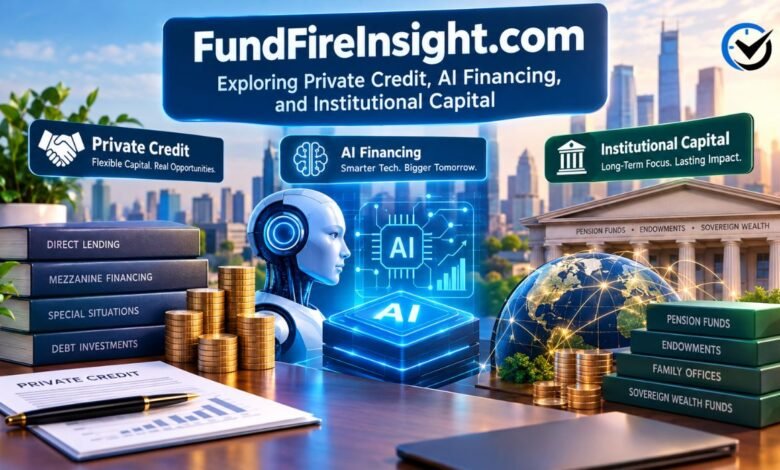
FundFireInsight.com presents itself as a finance publication covering markets, investing, business, banking, personal finance, and economic developments. One article promoted under its name connects institutional capital with private credit, infrastructure, AI financing, and data centers. These subjects belong together because technology growth requires funding far beyond software development. Buildings, electricity networks, equipment, and borrowing arrangements all influence whether that growth becomes commercially useful. For readers, the value of examining this coverage lies in understanding those connections and recognizing the different risks behind investments that share a familiar technology theme.
The three terms in this article describe different parts of the same financial system. Private credit concerns lending arranged outside traditional public debt markets, usually through specialized investment funds. AI financing concerns the money needed to develop and operate artificial intelligence businesses and infrastructure. Institutional capital describes money managed by organizations such as pension funds, insurers, and sovereign wealth funds. A single data center project might bring all three together, but that does not make every participant’s investment equivalent. Understanding who supplies the money, what they own, and how they expect repayment makes financial coverage easier to assess.
What the Publication Covers
A public introduction published under the brand in September 2026 describes a broad finance media publication with news, explainers, and analysis. Accessible older articles include coverage of FTSE option writing, corporate gearing ratios, and Singapore mortgage restrictions. That mix gives useful context: the publication’s documented subjects extend beyond institutional investing. Its name also resembles FundFire, an institutional investment publication associated with FT Specialist. Similar wording should not be treated as evidence of shared ownership. The available descriptions establish an intended publishing focus, but they do not independently establish the quality of every article or imply that the website manages investments.
How Institutional Capital Shapes Financial Markets
Institutional investors manage money against specific obligations. A pension fund must support retirement payments, while an insurer must remain able to meet claims. Their investment choices therefore depend on expected returns, available cash, risk limits, and the timing of future payments. Some can commit part of their portfolios to assets held for many years, helping finance businesses and infrastructure with long development periods. A commitment can involve transferring money in stages as suitable investments become available. However, a long investment horizon does not remove the need for cash today. Committees also assess fees, borrowing, concentration, and manager oversight. Coverage of institutional capital becomes more useful when it explains these constraints alongside the size of an investment.
Private Credit: What the Lending Model Involves
Private credit usually involves a fund negotiating loans directly with businesses. Borrowers may seek funding for acquisitions, expansion, refinancing, or other needs that require tailored terms. The lender examines the company’s finances and negotiates pricing, repayment conditions, and contractual protections called covenants. In its May 2026 assessment, the Financial Stability Board estimated private credit assets at approximately $1.5 trillion to $2 trillion at the end of 2024. That dated range helps show the sector’s scale without pretending that every market estimate measures the same thing. Some totals include different strategies or committed money that has not yet been invested.
For lenders, a high interest rate is only useful if the borrower can pay it. Many direct loans have floating rates, meaning their interest costs change with a benchmark rate. Consider a hypothetical company with $100 million of borrowing. If its annual rate rises from 9% to 11%, annual interest increases from $9 million to $11 million, before fees or principal repayments. That extra $2 million must come from somewhere in the business. Strong credit analysis examines cash generation, existing debts, customer stability, and repayment options. It also asks whether loan protections remain meaningful when earnings fall or refinancing becomes difficult. Reported interest income should be separated from returns after defaults, fees, and the fund’s own financing expenses.
Liquidity and Valuation Deserve Separate Attention
Liquidity means how readily an investment can be converted into cash. A private loan may generate interest while remaining difficult to sell, and the fund holding it may restrict withdrawals. Valuation is a separate question: determining what that loan is worth. Because private loans often trade infrequently, reported values can rely on estimates rather than recent transactions. A smooth performance chart can therefore reflect infrequent repricing as well as economic stability. Readers should distinguish income payments, estimated asset values, and actual withdrawal rights. A fund offering periodic repurchases may still limit how much investors can withdraw when requests exceed its available capacity. A withdrawal limit alone does not establish that the underlying borrowers have defaulted.
AI Financing Reaches Beyond Technology Shares
AI financing supports several business models. A young software company may raise equity, giving investors an ownership stake whose value depends on future business performance. An established company may finance spending through cash generated from operations, borrowing, or bond issuance. A data center developer may combine investor equity with loans to build facilities and purchase equipment. Each arrangement creates different claims on future cash flows and different exposure to failure. Financial coverage should explain the borrower or business, the use of the money, and the repayment plan. Saying an investment is linked to AI tells readers little about these essential details.
The distinction between infrastructure and computing equipment is particularly important. A building and its supporting systems may serve customers for many years, while processors can face rapid technological change. Their useful commercial lives need not match. A financing plan that assumes strong equipment values far into the future deserves careful examination. Customer contracts can improve revenue visibility, but their value depends on payment reliability, termination provisions, and the services promised. Land ownership, electrical access, and tenants’ ability to pay can matter as much as the number of installed processors. Announced capacity also differs from facilities that are completed, connected, and ready to serve customers. Construction delays, unused space, or costly upgrades can change a project’s economics even when overall demand for computing continues to rise.
Why Electricity Changes the Investment Case
Power availability links AI investment to energy infrastructure. The International Energy Agency estimated that global data centers consumed about 415 terawatt-hours of electricity in 2024, approximately 1.5% of worldwide electricity use. Its 2025 assessment projected around 945 terawatt-hours by 2030 in its base case. This is a scenario, not a guaranteed outcome, and it includes data centers serving digital activities beyond AI. The financial implication is practical: developers need electricity supply, grid connections, cooling, and reliable equipment. A project can have interested customers yet struggle to operate on schedule if power is unavailable. Energy demand measures consumption; it does not directly measure investor returns or establish that every planned facility will be profitable. Investors must examine local constraints alongside global demand projections.
Where the Investment Themes Overlap
The article about institutional capital promoted by FundFireInsight.com highlights connections among private credit, infrastructure, AI financing, and changing financing needs. One useful way to examine that connection is to follow a hypothetical investor’s exposures. A pension fund might own technology shares, lend through a credit fund, and hold an interest in data center property. These positions look different but could depend on the same customers or spending cycle. Diversification requires understanding those shared dependencies, not simply counting investment categories. Overseas projects add currency and legal complexity. Currency movements can change the value of overseas income when converted into an investor’s home currency. Readers should ask whether several apparently separate investments rely on one assumption about demand, financing costs, or electricity access.
Final Thoughts
The strongest reason to explore this publication’s financial themes is to understand how capital reaches businesses and infrastructure. Private credit explains one lending channel, AI financing reveals the costs behind technological growth, and institutional investing shows how large pools of savings support those activities. Their connections create useful questions about cash flow, repayment, valuation, and concentration. The website’s public descriptions provide context for its coverage, while individual articles still need to earn readers’ confidence through clear explanations and verifiable facts. A reader gains more from following the funding and examining the assumptions than from treating a popular investment theme as a prediction of returns.
Frequently Asked Questions (FAQs)
1. What is FundFireInsight.com?
It describes itself as a digital finance publication covering money, markets, companies, and economic developments. Publicly promoted content includes an institutional-capital article discussing private credit and AI infrastructure. Its stated role is publishing general information and education. Reading an article does not create an investment account or establish a professional advisory relationship.
2. Is it the same publication as FundFire?
The names are similar, but FundFire is an institutional investment publication associated with FT Specialist. A similarly named website should be assessed through its own ownership and editorial information. Shared wording alone cannot establish affiliation, and any claimed connection would require explicit confirmation from the organizations involved.
3. What does institutional capital mean?
It means money managed by organizations rather than individual investors acting on their own. Pension funds, insurance companies, endowments, and sovereign wealth funds are examples. Their decisions reflect obligations, governance rules, and portfolio limits. Their scale can influence financing conditions, but it does not make every allocation successful.
4. How does private credit differ from private equity?
Private credit generally involves lending money and expecting interest and repayment under agreed terms. Private equity involves acquiring ownership, with returns linked to the business’s value and eventual distributions or sale. Both can be illiquid. Their economic exposure differs because a lender’s repayment claim and an owner’s residual interest are distinct.
5. Why would a business choose a private lender?
A borrower may value a customized repayment schedule, reliable transaction funding, or negotiations with a small group of lenders. These features can suit acquisitions or companies whose circumstances do not fit standard bank products. They do not automatically make borrowing cheaper. Pricing, covenants, fees, and refinancing conditions all shape the overall cost.
6. Can investors withdraw from private credit funds whenever they want?
Withdrawal arrangements depend on the investment vehicle. Some funds hold investor capital for years; others permit limited repurchases at scheduled intervals. A repurchase window does not guarantee that every requested withdrawal will be completed. Investors need to understand the fund’s documents, including limits, notice periods, pricing arrangements, and possible restrictions.
7. Does AI financing only support start-ups?
It also supports established companies and physical assets needed to deliver computing services. Funding can reach data centers, processors, electricity infrastructure, and related operations. Equity investors and lenders may therefore encounter the same broad technology theme through very different businesses. The recipient’s revenue model matters more than the label attached to it.
8. Why does electricity matter to data center financing?
Electricity influences operating costs, available computing capacity, and the date a facility can begin serving customers. A delayed grid connection can postpone revenue while construction and financing costs continue. Power agreements also need scrutiny because pricing, supply reliability, and contract length affect whether projected operating margins remain achievable.
9. Are all AI infrastructure investments exposed to the same risks?
No. A construction project faces completion and funding risks, while an operating facility faces customer, maintenance, and utilization risks. Equipment financing adds exposure to technological change and resale values. Investors also receive different contractual rights. Comparing projects requires examining their development stage, assets, customers, financing structure, and expected sources of repayment.
10. How should readers evaluate financial analysis on the website?
Check whether an article distinguishes historical facts, estimates, forecasts, and hypothetical examples. Look for dated figures, clearly identified businesses, and explanations of downside risks. Financial analysis is more useful when its assumptions can be examined. If a conclusion depends on continued growth or cheap financing, consider what changes when that assumption fails.
Recommended: Global Trader Programme in Singapore: Tax Rates, Eligibility, and Qualifying Income





One Comment