
Texas Rangers vs Houston Astros Match Player Stats: 2023 ALCS Game 7 and García’s Two Homers

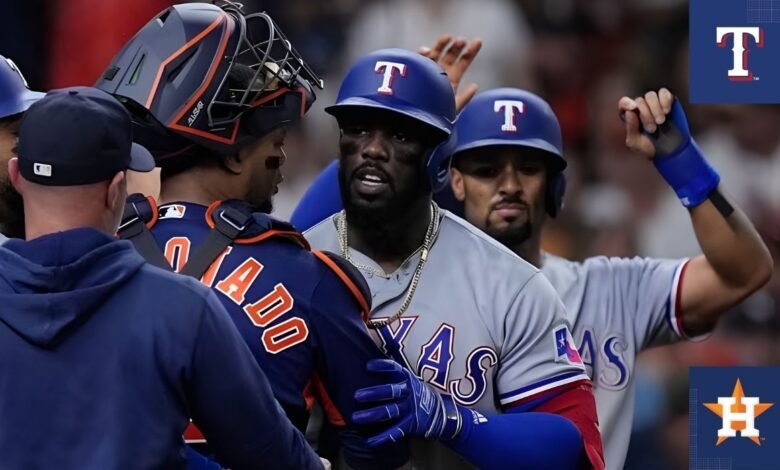
Adolis García gave the Texas Rangers a decisive advantage in Game 7. On October 23, 2023, Texas defeated the Houston Astros 11–4 in the deciding game of the American League Championship Series at Minute Maid Park. García delivered four hits, two home runs, and five runs batted in as the Rangers secured their place in the World Series. This Texas Rangers vs Houston Astros Match Player Stats review examines the individual performances, pitching decisions, and scoring sequences behind that result. The numbers reveal why a game with relatively similar hit totals ended with a seven-run gap.
A Deciding Game With a World Series Place at Stake
The teams entered Game 7 tied at three wins each in a series where home advantage had offered little protection. Texas won the opening two games in Houston, lost the next three in Arlington, and returned to Houston facing elimination. A 9–2 victory in Game 6 kept the Rangers alive and set up the deciding contest. Their subsequent win completed a 4–3 series victory, with the visiting team winning every game. For Texas, the reward was its first American League pennant since 2011. For Houston, the defeat ended its attempt to return to the World Series as the defending champion.
What the Team Box Score Shows
Texas collected 15 hits in 42 at-bats, while Houston recorded 12 hits in 38 at-bats. Their single-game batting averages were .357 and .316, but those figures miss a crucial difference. The Rangers hit four home runs, compared with two for the Astros, and scored in five separate innings. Houston left 11 runners on base; Texas stranded nine. Neither team committed a recorded error. The result therefore cannot be explained simply by poor fielding or an inability to make contact. Texas combined extra-base power with productive hits when runners were available to score.
Adolis García’s Complete Game 7 Batting Line
García finished 4-for-5 with three runs scored, five RBIs, two home runs, and a stolen base. His two singles and two homers produced 10 total bases, the number of bases credited through hits. That measures the value of his four hits. He supplied four of Texas’ 15 hits and drove in five of its 11 runs, approximately 45% of the team’s scoring. That RBI share does not mean he created every scoring opportunity himself; teammates had to reach base for his singles to drive them home. His performance combined individual power with effective use of those opportunities.
How García’s Two Home Runs Changed the Score
García’s first homer came against Hunter Brown in the third inning and increased the Rangers’ lead from 3–1 to 4–1. His second came against José Urquidy in the eighth, taking the score from 10–3 to 11–3. Both were solo home runs, so they accounted for two of his five RBIs. Their timing matters, too. The first provided additional separation while Houston remained close enough to threaten. The second extended an already substantial lead. Treating both as equally decisive would overlook the larger contributions of his run-scoring singles and Texas’ four-run fourth inning.
Seager, Carter, and Garver Supplied More Than Support
Corey Seager went 3-for-5 with two runs scored, one RBI, and a walk. His first-inning solo homer gave Texas its initial lead, while his double added another extra-base hit later. Evan Carter contributed one hit in four at-bats, but that hit was a two-run double. He also walked, scored twice, and stole a base. Mitch Garver finished 1-for-3 with a run and an RBI, delivering a run-scoring single during the opening inning. Those batting lines need context. Carter’s single hit drove in two runners, while Seager’s production helped create opportunities across multiple innings.
The Fourth Inning Put Texas in Control
The fourth inning turned a 4–2 contest into an 8–2 Rangers lead. Facing J.P. France, Carter delivered a double that scored two runs, followed by García’s single that brought home two more. Texas therefore gained four runs without a home run in that inning, an important counterpoint to the attention surrounding García’s two blasts. The rally combined baserunners with consecutive productive swings rather than relying only on solo power. Nathaniel Lowe later added a two-run homer against Bryan Abreu in the sixth. Those two scoring sequences created much of the cushion that Houston struggled to reduce during the remaining innings.
Scherzer, Montgomery, and the Rangers’ Relief Plan
Max Scherzer started for Texas but lasted only 2⅔ innings, allowing four hits, two runs, and two walks while striking out two. Manager Bruce Bochy then called on Jordan Montgomery, who supplied 2⅓ scoreless innings with three hits allowed, no walks, and one strikeout. Josh Sborz, Aroldis Chapman, and José Leclerc handled the final four innings, allowing two additional runs between them. Texas used five pitchers overall and recorded only four strikeouts, so this was not a performance built around overpowering every hitter. Montgomery’s contribution mattered because it stopped Houston from adding runs immediately after Scherzer’s departure and carried the game through the fifth inning.
Houston’s Pitching Changes Could Not Contain the Lineup
Cristian Javier’s start lasted just one-third of an inning. He allowed four hits, a walk, and three earned runs before Houston had recorded a second out. Phil Maton completed the inning without further damage, and Brown allowed one run over the next two innings. France then surrendered five hits and four runs in two-thirds of an inning, creating another major setback. Houston ultimately used eight pitchers, who collectively allowed 15 hits, four walks, and 11 earned runs. The early exit did not settle the game. Texas kept scoring against later pitchers, preventing Houston’s changes from producing a sustained recovery.
The Astros’ Strongest Hitters and Missed Opportunities
Yordan Alvarez went 3-for-4 with a triple, a walk, and an RBI, yet never scored. José Altuve finished 2-for-5 with two runs and a solo homer, while Alex Bregman went 2-for-4 with a walk, two runs, and a solo homer. José Abreu added two hits and an RBI. Together, those four hitters supplied nine of Houston’s 12 hits and all four RBIs. The rest of the lineup combined for three hits in 20 at-bats. Houston’s leading hitters produced consistently, but the rest of the lineup could not match them. The 11 stranded runners underline the missed scoring opportunities.
Final Thoughts
The Rangers’ Game 7 victory came from several performances working together. García delivered the standout batting line, Seager opened the scoring, Carter helped break the game open, and Montgomery supplied scoreless relief when Houston still had opportunities to respond. The Astros produced 12 hits, but their offense left too many runners without a route home while their pitchers conceded repeated scoring rallies. Reading the result through hits alone would miss those differences. The clearest explanation combines the quality of Texas’ contact, the timing of its scoring, and its ability to protect an expanding lead.
Frequently Asked Questions (FAQs)
1. Who won the 2023 ALCS Game 7, and what was the final score?
The Texas Rangers defeated the Houston Astros 11–4 and won the American League Championship Series four games to three. The victory secured the American League’s place in the World Series for Texas. Winning the World Series required a separate victory over the National League champion. Game 7 decided which of these two Texas teams would advance to that final round.
2. Did García’s two home runs produce all five of his RBIs?
No. Both home runs were solo shots, giving García two RBIs. His first-inning single drove in one runner, and his fourth-inning single brought home two more. That distribution is useful because a headline centered on his home runs can hide the importance of his other hits. Three of his five RBIs came from singles with teammates already on base, rather than from his two home runs.
3. Why was Adolis García named the ALCS Most Valuable Player?
García’s impact extended across the series rather than resting on one excellent evening. He finished the ALCS with five home runs and 15 RBIs, setting a record for RBIs in a single postseason series. Game 7 added five RBIs to that total and helped Texas finish the comeback. The award recognized his overall contribution against Houston, including the power and run production that supported the Rangers throughout the series.
4. Why did Jordan Montgomery receive the pitching win instead of Max Scherzer?
Scherzer exited before completing five innings, leaving him ineligible for a starter’s win in this nine-inning game. Montgomery received the win after his scoreless relief appearance. The official scorer determines the winning reliever when the starter leaves too early with a lead that the team retains. This distinction explains why starting the deciding game and pitching effectively for part of it did not automatically give Scherzer the win.
5. What do pitching figures such as 2.2 and 2.1 innings mean?
These figures count completed innings and additional outs, not decimal fractions. Scherzer’s 2.2 means two innings plus two outs, or 2⅔ innings. Montgomery’s 2.1 means two innings plus one out, or 2⅓ innings. Together, they recorded 15 outs and covered five innings. Reading the notation correctly prevents mistakes when adding pitching workloads or comparing how much of the game each pitcher actually handled.
6. Did every Rangers starter record a hit in Game 7?
Eight of the nine starting hitters recorded at least one hit. Leody Taveras was the exception, finishing 0-for-5. Jonah Heim supplied two hits, while Marcus Semien and Josh Jung each had one. Pinch hitter Travis Jankowski also added a hit after entering the game. This spread of contributions matters because García led the offense, but Texas repeatedly reached base through other positions in the batting order.
7. Which players besides García hit home runs?
Seager and Lowe each homered for Texas, completing the Rangers’ four-home-run total. Seager’s shot came in the first inning, while Lowe’s two-run homer arrived in the sixth. Bregman and Altuve supplied Houston’s two homers in the third and ninth innings. Five different players therefore hit the game’s six home runs. Only García hit more than one, which explains the special attention given to his power display.
8. Did defensive errors explain the Astros’ defeat?
No errors were recorded for either team, and all 11 runs charged to Houston’s pitchers were earned. The box score points toward pitching difficulties and uneven scoring production. However, an error total is a limited measure of defense. It does not describe every positioning decision or difficult chance, so zero errors should not be treated as proof of flawless fielding.
9. When and where was the deciding game played?
Game 7 took place on October 23, 2023, at Minute Maid Park in Houston, Texas. The recorded attendance was 42,814, and the game lasted three hours and 20 minutes. Some reports appeared on October 24 because they were published after the evening contest. For historical accuracy, October 23 remains the game date, while the later date reflects publication timing rather than a different Rangers–Astros meeting.
10. Why do some box scores show 20 RBIs beside García’s five?
The five represents García’s RBIs in Game 7. A parenthetical 20 in the postseason box score represents his accumulated RBIs through that stage of the playoffs, including earlier rounds. His ALCS-only total was 15. These numbers describe different spans of games and should not be combined or substituted for one another. Similarly, season or postseason batting averages displayed beside a player’s line are not necessarily his average for that single game.
Recommended: Milwaukee Brewers vs St. Louis Cardinals Match Player Stats: Key Player Performance Analysis





One Comment