
Chicago Bears vs Philadelphia Eagles Match Player Stats: Complete Game Analysis

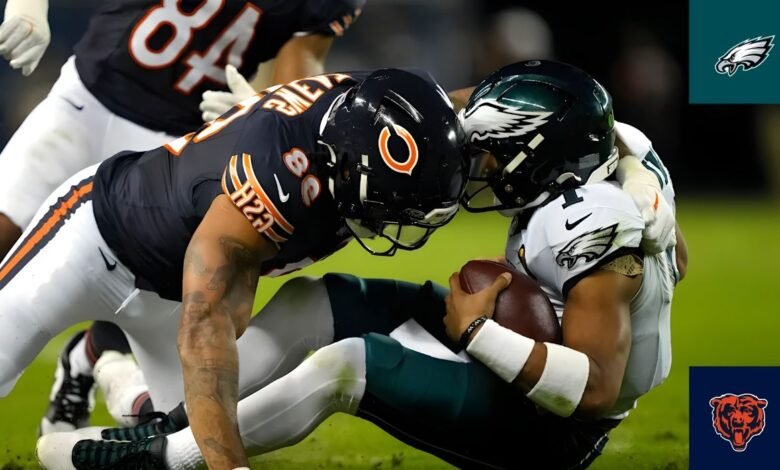
The Chicago Bears beat the Philadelphia Eagles 27–7 at Soldier Field on September 28, 2026. The game’s player stats show how Chicago’s passing game, timely defensive stops, and strong second-half performance shaped the result. Case Keenum threw for 247 yards and two touchdowns, while the Bears held Philadelphia to 248 total yards.
This analysis covers the passing, rushing, and receiving numbers, along with the turnovers and scoring sequence behind the final score. It focuses on the September 2026 matchup so the statistics are not confused with those from earlier meetings between the teams.
Game Overview
Chicago finished with 375 total net yards, compared with Philadelphia’s 248. The Bears also held the ball for 36 minutes and 53 seconds, more than 13 minutes longer than the Eagles. That extended possession time gave Chicago more chances to score and kept Philadelphia’s offense off the field.
The Bears’ advantage came from several areas rather than one overwhelming statistical category. Keenum led an efficient passing effort, and Chicago’s receivers made important gains after the catch. The defense also forced three turnovers, helping the Bears control the game after Philadelphia had made it close before halftime.
How the Score Developed
Chicago opened the scoring with an eight-yard touchdown pass from Keenum to Luther Burden III. Cairo Santos added a 29-yard field goal in the second quarter, putting the Bears ahead 10–0. Philadelphia answered with a one-yard rushing touchdown by Jalen Hurts, making the score 10–7 at halftime.
Santos extended Chicago’s lead with a 48-yard field goal in the third quarter. Keenum then connected with Kalif Raymond for a 41-yard touchdown, and Keenum added a one-yard rushing score in the fourth. The Bears scored 17 unanswered points after the Eagles’ touchdown, turning a close first half into a clear win.
Case Keenum’s Passing Performance
Keenum completed 24 of 34 passes for 247 yards, two touchdowns, and no interceptions. His 70.6% completion rate reflected steady accuracy, and the two touchdown passes gave Chicago a reliable way to build its lead. He also avoided the turnover that could have given Philadelphia a short field.
The touchdown throws went to Burden and Raymond. Keenum’s night was notable because he was starting in place of Chicago’s usual quarterback, but the numbers show a composed performance rather than a high-risk one. He spread the ball among several receivers and helped the offense sustain long drives.
Jalen Hurts and the Eagles’ Passing Game
Hurts completed 16 of 25 passes for 153 yards, with no passing touchdowns and one interception. His 64% completion rate was respectable, but Philadelphia did not generate enough explosive passing plays to keep pace with Chicago. The interception came on a fourth-down attempt late in the third quarter.
Hurts did contribute Philadelphia’s only touchdown, running the ball one yard into the end zone just before halftime. Backup quarterback Andy Dalton recorded no completions on one attempt and threw an interception while Hurts was being evaluated. That turnover added to the difficulty of Philadelphia’s effort to recover from its early deficit.
Chicago’s Leading Receivers
Raymond led the Bears with six catches for 90 yards and a touchdown. His 41-yard scoring reception was the game’s longest touchdown play and gave Chicago a 20–7 lead. The play combined a well-placed throw with space for Raymond to advance the ball after the catch.
Burden caught seven passes for 61 yards and a touchdown, leading Chicago in receptions. His opening score gave the Bears an early advantage and helped establish a productive role in the offense. Rome Odunze added three catches for 44 yards, while tight end Colston Loveland had four receptions for 31 yards.
Chicago’s Rushing Numbers
D’Andre Swift led Chicago’s rushers with 20 carries for 84 yards, averaging 4.2 yards per attempt. He did not score, but his steady gains helped the Bears maintain possession and keep the offense balanced. Swift also caught two passes for four yards, giving him a small contribution in the passing game.
Kyle Monangai carried 10 times for 31 yards, while Burden gained seven yards on one attempt. Keenum added four carries for six yards and a touchdown. His rushing score came from the one-yard line in the fourth quarter, capping a 13-play drive and extending the lead to 27–7.
Philadelphia’s Rushing Leaders
Saquon Barkley was Philadelphia’s leading rusher, finishing with 15 carries for 82 yards. He averaged about 5.5 yards per carry, but the total was not enough to keep the Eagles’ offense moving consistently. Barkley’s longest run covered 17 yards, and he also had one reception for minus two yards.
Hurts carried four times for 25 yards and scored Philadelphia’s only touchdown. His running ability helped the Eagles finish a late second-quarter drive, but the team struggled to turn its ground production into more points after halftime. Tank Bigsby also had a costly fumble that Chicago recovered near the Eagles’ end zone.
Eagles Receiving Leaders
DeVonta Smith led Philadelphia with six receptions for 65 yards. His longest catch went for 30 yards, but he did not score. The Eagles needed more gains through the air, particularly after Chicago began limiting Barkley’s rushing impact in the second half.
Other Philadelphia receivers had modest totals. D. Wicks caught two passes for 32 yards, and M. Lemon had three catches for 29 yards. Will Shipley added one reception for 11 yards. The distribution shows that Hurts connected with several targets, but no Eagles receiver reached 70 yards or scored a receiving touchdown.
Defensive Plays and Turnovers
Chicago’s defense made three takeaways and did not give the ball away, a 3–0 turnover margin. The takeaways included Bigsby’s lost fumble and interceptions thrown by Hurts and Dalton. Those plays gave the Bears extra possessions and helped prevent Philadelphia from building momentum.
T.J. Edwards intercepted Hurts on a fourth-down pass late in the third quarter. Chicago then put together a long scoring drive that ended with Keenum’s rushing touchdown. The Bears also capitalized on Dalton’s interception in the red zone earlier in the game. These moments mattered because Philadelphia was still within reach before Chicago pulled away.
Team Statistics That Explain the Result
The Bears’ 375 yards came from 247 passing yards and contributions on the ground. Philadelphia totaled 248 yards, including 153 passing yards from Hurts. Chicago’s 36:53 time of possession compared with Philadelphia’s 23:07, giving the Bears a clear advantage in control of the game.
Penalties also favored Chicago. Philadelphia was flagged 10 times for 61 yards, while the Bears had five penalties for 45 yards. Penalties can extend an opponent’s drive or erase a useful play, and the Eagles’ higher total added to the pressure on an offense that was already managing turnovers and limited scoring chances.
Final Thoughts
The player stats from this game point to a complete Chicago performance. Keenum delivered two passing touchdowns without an interception, Raymond and Burden provided the scoring catches, and Swift helped the Bears keep the offense moving. Chicago’s defense sealed the advantage by forcing three turnovers and holding Philadelphia to seven points.
For the Eagles, Barkley’s 82 rushing yards and Hurts’ touchdown run were bright spots, but the team could not sustain its offense after halftime. The 27–7 result reflected Chicago’s stronger possession time, better turnover margin, and ability to convert key drives into points.
Frequently Asked Questions
1. Who won the Chicago Bears vs. Philadelphia Eagles game?
The Chicago Bears won 27–7 at Soldier Field on September 28, 2026. Chicago led 10–7 at halftime and scored 17 points in the second half without allowing another Eagles score.
2. How many passing yards did Case Keenum record?
Keenum threw for 247 yards, completing 24 of 34 attempts. He had two touchdown passes and no interceptions, then added a one-yard rushing touchdown in the fourth quarter.
3. What were Jalen Hurts’ passing stats?
Hurts completed 16 of 25 passes for 153 yards, with no passing touchdowns and one interception. He also rushed for 25 yards on four carries and scored Philadelphia’s only touchdown.
4. Who led the Bears in receiving yards?
Kalif Raymond led Chicago with 90 receiving yards on six catches. He also caught a 41-yard touchdown pass from Keenum in the third quarter.
5. Who led the Eagles in receiving yards?
DeVonta Smith led Philadelphia with 65 yards on six receptions. He did not score a touchdown, and no Eagles receiver reached 70 yards in the game.
6. How many rushing yards did Saquon Barkley have?
Barkley rushed for 82 yards on 15 carries, averaging about 5.5 yards per carry. He also caught one pass for minus two yards.
7. Which Bears player scored the opening touchdown?
Luther Burden III scored the game’s first touchdown on an eight-yard pass from Keenum. The score capped Chicago’s opening drive and gave the Bears a 7–0 lead.
8. How did Chicago’s defense affect the outcome?
Chicago forced three turnovers while committing none. The takeaways included a fumble recovery and two interceptions, which helped the Bears control possession and keep Philadelphia from building a comeback.
9. What was the turnover margin?
The Bears won the turnover battle 3–0. Philadelphia lost a fumble and threw two interceptions, while Chicago did not turn the ball over.
10. What were the teams’ total net yards?
Chicago finished with 375 total net yards, while Philadelphia had 248. The Bears also held the ball for 36:53, compared with the Eagles’ 23:07.
Recommended: Kansas City Chiefs vs Dallas Cowboys Match Player Stats: Key Performers and Box Score

One Comment