
Kansas City Chiefs vs Dallas Cowboys Match Player Stats: Key Performers and Box Score

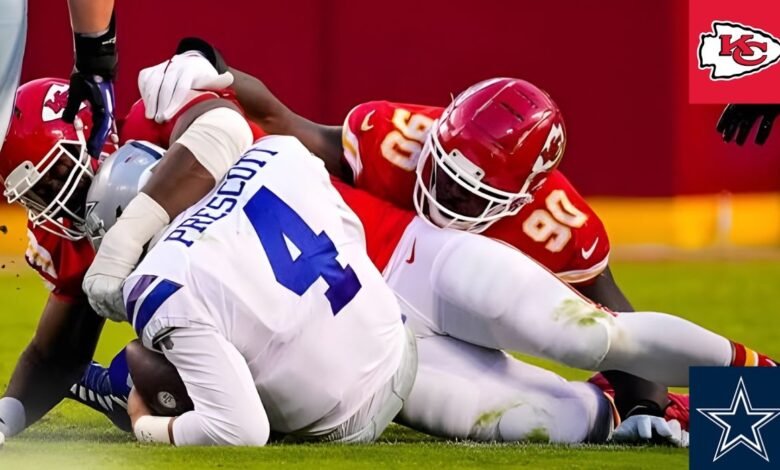
The Kansas City Chiefs and Dallas Cowboys met on Thanksgiving Day, November 27, 2025, at AT&T Stadium in Arlington, Texas. Dallas won 31–28 in a closely contested game that featured four touchdown passes by Patrick Mahomes, a strong passing performance from Dak Prescott, and several key plays in the fourth quarter. This recap covers the player statistics and team numbers from that specific matchup, including passing, rushing, receiving, defense, and special teams.
Game Overview
The final score was Dallas Cowboys 31, Kansas City Chiefs 28. Kansas City opened with a 14-point first quarter, but the Cowboys answered with a touchdown and then took control in the middle quarters. Dallas led 20–14 entering the fourth. The Chiefs briefly moved ahead late, but the Cowboys responded with a touchdown and two-point conversion before adding a field goal. Kansas City scored once more, but Dallas held its three-point advantage.
The scoring pattern shows how the game changed over time. Kansas City’s offense was most productive early and late, scoring 14 points in both the first and fourth quarters. The Chiefs were held scoreless in the second and third. Dallas built its lead more steadily, with 7 points in the first quarter, 10 in the second, 3 in the third, and 11 in the fourth. That third-quarter field goal mattered because it gave Dallas a cushion before the final exchanges.
Patrick Mahomes’ Passing Performance
Patrick Mahomes completed 23 of 34 passes for 261 passing yards, four touchdowns, and no interceptions. He averaged 7.7 yards per attempt and finished with a 129.7 passer rating. His four scoring passes kept Kansas City within reach throughout the game, even as the offense struggled to score during the second and third quarters. Mahomes also ran three times for 30 yards, adding another way to extend plays and move the chains.
Mahomes’ line was efficient, but it did not tell the whole story of Kansas City’s offensive output. He was sacked three times for a loss of 18 yards, and the Chiefs finished with 243 net passing yards. The distinction between passing yards and net passing yards matters: the first measures yards gained through completed passes, while the second accounts for yards lost on sacks. His touchdown production was excellent, but Dallas’ pressure and the Chiefs’ quiet middle quarters limited the team’s overall scoring.
Dak Prescott’s Passing Performance
Dak Prescott completed 27 of 39 passes for 320 yards, two touchdowns, and one interception. He averaged 8.2 yards per attempt and recorded a 100.4 passer rating. Prescott was not sacked, which helped Dallas preserve its passing yardage and sustain drives. His 320 yards were the highest passing total in the game, and his ability to distribute the ball to several receivers helped the Cowboys answer Kansas City’s late scoring pushes.
The interception came early and gave Kansas City an opportunity to score, but Prescott recovered by leading a composed offense. Dallas generated 457 total yards, including 320 net passing yards, and converted nine of 16 third downs. That production helped the Cowboys control possession for 30 minutes and 54 seconds. Prescott’s performance was less touchdown-heavy than Mahomes’, but his passing volume and steady drive management were central to the Dallas victory.
Kansas City’s Leading Receiver
Rashee Rice led the Chiefs in receiving, catching eight passes for 92 yards and two touchdowns on 12 targets. His longest reception covered 28 yards. Rice was Mahomes’ most productive target in the red zone, and his two scoring catches accounted for half of the quarterback’s touchdown passes. He also had one fumble, which he recovered himself, so it did not become a turnover.
Rice’s role was important because he provided Kansas City with a reliable option across the middle and near the goal line. Eight catches gave him a high share of the team’s 23 completions, while his 92 yards led all Chiefs receivers. Still, his production was not enough to offset the Cowboys’ stronger total yardage and late-game execution. The receiving numbers also show how much Kansas City relied on a small group of pass catchers for its scoring.
Dallas’ Leading Receiver
CeeDee Lamb topped the Cowboys’ receiving chart with seven catches for 112 yards and one touchdown on nine targets. His average was 16 yards per reception, and his longest catch went for 51 yards. Lamb’s combination of steady catches and a long gain helped Dallas stretch the field. His touchdown gave the Cowboys an important scoring answer in a game where Kansas City’s offense was capable of scoring quickly.
Lamb’s performance stood out for both volume and efficiency. He produced more receiving yards than any other player in the game while catching seven of the nine passes directed his way. His 112 yards represented more than one-third of Dallas’ 320 passing yards. The 51-yard reception also gave the Cowboys a major gain that changed field position and kept the Kansas City defense from focusing only on short passes.
George Pickens and Other Dallas Targets
George Pickens caught six passes for 88 yards on 13 targets. He did not score, but his 39-yard long reception and repeated involvement gave Prescott another deep threat. Pickens also had a fumble that Dallas recovered, so it did not result in a turnover. His target total was the highest among Cowboys receivers, reflecting how often Prescott looked his way, even when the connection did not produce a catch.
Jake Ferguson added five receptions for 36 yards, while Ryan Flournoy caught three for 34. KaVontae Turpin had two catches for 28 yards, and running back Javonte Williams added three receptions for 21 yards and a touchdown. These contributions gave Dallas several options beyond Lamb and Pickens. Spreading the ball helped the offense remain balanced and made it harder for Kansas City to concentrate its coverage on one receiver.
Other Kansas City Receiving Contributions
Xavier Worthy finished with four catches for 61 yards, averaging 15.3 yards per catch. His longest reception was 42 yards, the longest catch by a Kansas City player in the game. Travis Kelce caught five passes for 45 yards and a touchdown, while Hollywood Brown added two catches for 20 yards and a score. Those touchdown catches helped Mahomes distribute scoring production across the receiving group.
Kareem Hunt caught one pass for 22 yards, and Isiah Pacheco had two receptions for 17 yards. Jared Wiley caught one pass for four yards, while JuJu Smith-Schuster was targeted once but did not record a reception. Kansas City completed passes to seven players, but Rice, Worthy, and Kelce accounted for most of the team’s receiving yardage. That mix gave Mahomes options, though Dallas kept the Chiefs from building consistent scoring drives in the middle of the game.
Kansas City’s Rushing Numbers
Kareem Hunt led Kansas City in rushing with 14 carries for 58 yards, an average of 4.1 yards per attempt. Mahomes added 30 yards on three carries, while Isiah Pacheco gained 16 yards on three attempts. Worthy rushed twice for 13 yards, and Rice had one carry for two yards. As a team, the Chiefs ran 23 times for 119 yards, averaging 5.2 yards per carry, but they did not score a rushing touchdown.
The team average suggests that Kansas City found some useful gains on the ground, but its rushing production was spread across several players and did not lead to a touchdown. Hunt handled the largest share of the carries, while Mahomes’ scrambles added meaningful yardage. The Chiefs’ ability to gain 119 rushing yards helped balance the passing attack, yet Dallas still outgained Kansas City overall by 95 yards.
Dallas’ Rushing Numbers
Javonte Williams carried the ball 17 times for 59 yards, averaging 3.5 yards per attempt. Malik Davis had only three carries but made the most of them, gaining 47 yards and scoring a touchdown. His 43-yard run was the longest rushing play of the game. Turpin added 33 yards on three carries, while Prescott lost two yards on three rushing attempts. Dallas finished with 137 rushing yards on 26 attempts.
Davis’ touchdown run was one of the game’s defining plays because it turned a short rushing line into a major contribution. Williams supplied the steady workload, while Turpin gave the offense another change of pace. Dallas averaged 5.3 yards per carry as a team, slightly above Kansas City’s 5.2. The Cowboys’ rushing total was not built around one player alone; it combined Williams’ volume with Davis’ explosive run and Turpin’s occasional carries.
Defensive Contributions and Pressure
Kansas City’s defense recorded one interception, with Jaylen Watson returning it 14 yards. Nick Bolton led the Chiefs with 11 total tackles, while Chamarri Conner made nine and Trent McDuffie recorded seven. Kansas City did not record a sack, despite registering six quarterback hits. That pressure disrupted some plays, but the defense was unable to bring Prescott down and did not force a second turnover.
Dallas’ defense recorded three sacks and four tackles for loss. Jadeveon Clowney led the Cowboys with six tackles and two sacks, while DeMarvion Overshown and Shavon Revel Jr. also finished with six tackles apiece. Dallas had nine quarterback hits, helping to limit Kansas City’s ability to maintain a smooth rhythm. The Cowboys did not intercept Mahomes, but their pass rush contributed to the three sacks that reduced Kansas City’s net passing yardage.
Special Teams and Kicking
Brandon Aubrey made all three of his field-goal attempts for Dallas, including a long of 49 yards, and converted both extra points. He scored 11 points, making him a major contributor to the final margin. Harrison Butker made all four extra points for Kansas City but did not attempt a field goal. In a game decided by three points, Aubrey’s field goals were a key part of Dallas’ scoring total.
Returners also added useful field position. Turpin returned five kickoffs for 118 yards, averaging 23.6 yards per return. For Kansas City, Tyquan Thornton returned five kickoffs for 107 yards, while Nikko Remigio and Brashard Smith each had one return. Neither team scored on a return. The return numbers did not decide the game on their own, but they contributed to where each offense began its drives.
Team Statistics and What They Show
Dallas finished with 457 total yards on 65 plays, averaging 7.0 yards per play. Kansas City recorded 362 yards on 60 plays, averaging 6.0 yards per play. The Cowboys gained 137 rushing yards and 320 net passing yards; the Chiefs had 119 rushing yards and 243 net passing yards. Dallas also converted nine of 16 third downs, while Kansas City converted five of 13. Those differences point to Dallas’ greater consistency across the full game.
Possession time was relatively close, with Dallas holding the ball for 30:54 and Kansas City for 29:06. The Cowboys did more with their possessions, particularly on third down and through explosive gains. Kansas City’s interception of Prescott gave it a turnover advantage, but Dallas’ offense compensated by avoiding sacks and producing more total yards. The box score therefore reflects a close game in the final score, but a measurable edge for Dallas in yardage and drive efficiency.
Why the Fourth Quarter Mattered
The fourth quarter featured the game’s most consequential sequence. Kansas City scored to take a brief lead, but Dallas answered with a touchdown pass to Williams and a successful two-point conversion to Pickens. Aubrey then added a field goal, increasing the lead to three points. Mahomes connected with Brown for another touchdown, but the Chiefs could not regain possession for a final scoring chance. Dallas’ response to Kansas City’s late lead proved decisive.
That sequence highlights the difference between scoring quickly and controlling the game’s final possession. Kansas City’s offense showed it could produce touchdowns in short order, but Dallas answered with a sustained response and then protected its advantage. A late third-down conversion helped the Cowboys keep the ball and run down the remaining time. The final score was close, yet Dallas made the key plays needed to close out the game.
How to Read the Box Score
A box score can show both individual totals and how those totals contributed to the team result. For example, Mahomes’ 261 passing yards describe his completed passes, while Kansas City’s 243 net passing yards reflect the loss from sacks. Similarly, receiving targets show how often a player was thrown to, while receptions indicate completed catches. In this game, Pickens’ 13 targets and six catches offer a different picture from Lamb’s seven catches on nine targets.
Team statistics also need context. Dallas’ 457 total yards and 31 points suggest an effective offense, but the Chiefs’ four passing touchdowns show that Kansas City remained dangerous. Dallas’ advantage came from a broader combination of passing, rushing, third-down success, and field goals. Looking at only the final score, or only one star player’s line, would miss how the matchup developed. The full box score helps explain both the close finish and Dallas’ statistical edge.
Final Thoughts
The November 27, 2025, matchup ended with a 31–28 Dallas victory, shaped by strong passing from both quarterbacks and timely plays from the Cowboys’ offense. Mahomes threw four touchdown passes without an interception, while Prescott delivered 320 yards and two touchdowns. Lamb led all receivers with 112 yards, Rice scored twice, Davis broke a 43-yard touchdown run, and Aubrey made three field goals. Dallas’ edge in total yards, third-down conversions, and fourth-quarter execution made the difference.
Frequently Asked Questions
1. Who won the Chiefs vs. Cowboys game?
The Dallas Cowboys defeated the Kansas City Chiefs 31–28 on November 27, 2025. Dallas won at AT&T Stadium after answering Kansas City’s fourth-quarter lead with a touchdown and a two-point conversion.
2. How many passing yards did Patrick Mahomes have?
Mahomes threw for 261 yards, completing 23 of 34 attempts. He recorded four touchdown passes and no interceptions, and he added 30 rushing yards on three carries.
3. How many passing yards did Dak Prescott have?
Prescott passed for 320 yards on 27 completions from 39 attempts. He threw two touchdown passes and one interception and was not sacked during the game.
4. Who led the game in receiving yards?
CeeDee Lamb led all players with 112 receiving yards. He caught seven passes on nine targets, including a 51-yard reception and one touchdown.
5. Which Chiefs player had the most receiving yards?
Rashee Rice led Kansas City with 92 receiving yards on eight catches. He also scored two touchdowns, giving him the most receiving scores for the Chiefs.
6. Who had the longest rushing play?
Malik Davis had the longest run of the game, a 43-yard touchdown for Dallas. He finished with 47 rushing yards on three carries.
7. How many total yards did each team gain?
Dallas gained 457 total yards, while Kansas City recorded 362. Dallas’ total included 320 net passing yards and 137 rushing yards.
8. Did either team record an interception?
Yes. Kansas City cornerback Jaylen Watson intercepted Prescott and returned the ball 14 yards. Dallas did not intercept Mahomes.
9. Who scored the most points for Dallas?
Brandon Aubrey scored 11 points for Dallas by making three field goals and two extra points. His three successful field goals helped the Cowboys maintain their lead.
10. Why did Dallas win despite Mahomes’ four touchdown passes?
Dallas gained more total yards, converted more third downs, avoided sacks, and made the key plays late. Its touchdown response and field goal in the fourth quarter secured the three-point win.
Recommended: Chicago Bears vs Buffalo Bills Match Player Stats: Full Box Score and Leaders


One Comment