
Boston Celtics vs Knicks Match Player Stats: Brunson and Anunoby Lead a 119–81 Game 6 Win

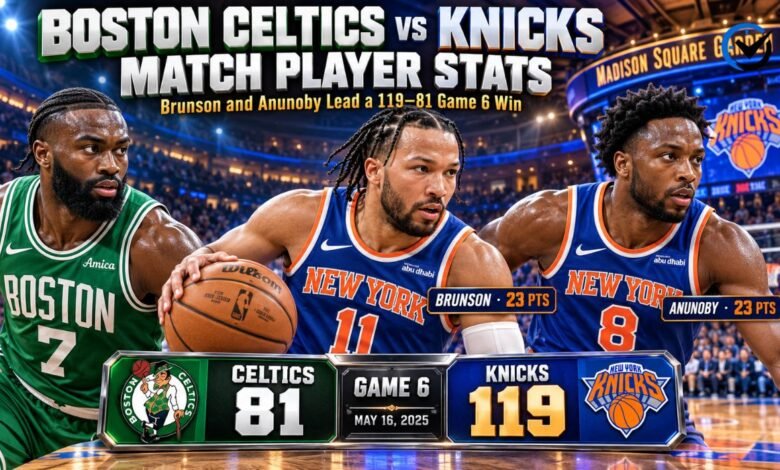
The New York Knicks defeated the Boston Celtics 119–81 at Madison Square Garden on May 16, 2025, closing their Eastern Conference semifinal series with a 4–2 victory. Jalen Brunson and OG Anunoby shared the scoring lead, but this was a much broader team performance. Four Knicks scored at least 21 points, Josh Hart recorded a triple-double, and New York controlled the rebounding battle. This Boston Celtics vs Knicks Match Player Stats breakdown explains the individual numbers, the decisive second quarter, and the reasons Boston’s title defense ended in a game that became one-sided well before the final buzzer.
How Game 6 Became a Blowout
New York led 26–20 after the opening quarter, when Boston still had a manageable deficit. The second period changed the game: the Knicks outscored the Celtics 38–17 and entered halftime ahead 64–37. Boston made only six of its 19 shots in that quarter, while New York converted 14 of 24. The Knicks then won the third quarter 28–20, extending their advantage to 92–57. Their largest lead reached 41 points. The quarter scores matter because they show that the result was built through sustained control, particularly before halftime, rather than a late scoring burst against reserve players.
Jalen Brunson’s Efficient Scoring and Playmaking
Brunson finished with 23 points, six rebounds, and six assists in 34 minutes and 31 seconds. He made eight of 14 field goals, including three of eight three-pointers, and converted all four free throws. His 57.1% shooting from the field gave New York efficient production without requiring an unusually large number of attempts. He also committed only two turnovers. Brunson scored nine points in the second quarter while making all four of his shots during that period. That contribution helped the Knicks expand their lead, while his overall assist total reflected his involvement in creating opportunities for teammates.
OG Anunoby’s Scoring and Defensive Contribution
Anunoby matched Brunson with 23 points and added nine rebounds, two assists, two steals, and two blocks. His shooting line was seven of 18 from the field, four of 13 from three-point range, and five of five at the foul line. Unlike Brunson, he did not have an especially efficient night from outside, but he supplied value across several categories. Anunoby scored 11 points in the third quarter, helping New York maintain its separation after halftime. His combination of rebounding and defensive plays also shows why evaluating his performance through shooting percentage alone would miss a substantial part of his contribution.
Mikal Bridges and Karl-Anthony Towns Add Scoring Depth
Mikal Bridges scored 22 points on nine-of-15 shooting and made four of six three-pointers. He added four rebounds, three assists, a steal, and two blocks. Karl-Anthony Towns contributed 21 points and a team-leading 12 rebounds, shooting eight of 20 overall and four of four from the line. Towns made only one of six three-point attempts, so his scoring came mainly from two-point baskets and free throws. Together, these performances gave New York two additional threats beyond its leading scorers. Bridges supplied accurate perimeter shooting, while Towns combined interior scoring with the defensive rebounding needed to finish possessions.
Josh Hart’s Triple-Double Connects the Offense
Hart recorded 10 points, 11 rebounds, and 11 assists in just under 33 minutes. His triple-double meant he reached double figures in three statistical categories, and the distribution of those numbers captures his role particularly well. He attempted only eight field goals, making three, while leading both teams in assists. Eight of his rebounds came on defense and three on offense. With Brunson, Anunoby, Bridges, and Towns providing most of the scoring, Hart could contribute through passing and possession recovery. His performance illustrates how a player can influence a decisive playoff win without taking many shots or leading the scoring list.
Miles McBride and Mitchell Robinson Influence the Bench Minutes
Miles McBride supplied 10 points on four-of-seven shooting, including two of five from three-point range. All 10 points came in the second quarter, making his bench scoring especially timely. He also recorded two rebounds, an assist, a steal, and a block. Mitchell Robinson scored only one point but collected four rebounds, including two offensive boards, and registered a steal in 13 minutes and 30 seconds. New York outscored Boston by 20 points during his minutes. That figure describes the team’s results with him playing; it should not be treated as proof that he personally created the entire advantage.
Jaylen Brown Leads Boston but Faces Heavy Pressure
Brown led the Celtics with 20 points, six rebounds, and six assists. He made eight of 20 field goals, three of nine three-pointers, and one of two free throws. His first quarter was much stronger than the rest of his evening: he scored 13 points in the opening period and had 18 by halftime. Brown added only two points afterward, committed seven turnovers overall, and fouled out in the third quarter. His line shows both his importance to Boston’s remaining offense and the limitations of looking only at points. The turnovers and foul trouble reduced the value of his early scoring.
Boston’s Supporting Players Cannot Sustain the Offense
Derrick White finished with eight points on three-of-11 shooting, while Jrue Holiday managed four points on one-of-eight shooting. Together, they made four of 19 attempts, leaving Boston short of reliable backcourt production. Al Horford added 10 points and made two of four three-pointers. Starting center Luke Kornet recorded five points, five rebounds, an assist, and a block. Kristaps Porzingis had four points and five rebounds in 11 minutes and 29 seconds. Payton Pritchard scored 11 points off the bench and supplied four assists without a turnover, but he was scoreless at halftime, when Boston’s deficit had already reached 27.
Shooting, Rebounding, and Extra Opportunities Explain the Margin
New York shot 46.2% from the field, compared with Boston’s 36.0%, and made 16 three-pointers to the Celtics’ 12. The Knicks also converted 19 of 21 free throws, while Boston made seven of 10. Rebounding provided another clear advantage: New York collected 55 boards against Boston’s 36, including a 15–9 edge on offense. Those extra opportunities helped produce a 25–11 advantage in second-chance points. The Knicks also led 48–34 in paint scoring and 23–8 in fast-break points. These categories overlap, so they should not be added together, but each identifies a different feature of New York’s control.
Tatum’s Absence and the Series Context
Jayson Tatum did not play after rupturing his right Achilles tendon in Game 4. His absence removed a major scorer and playmaker, making Boston’s circumstances meaningfully different from those of a full-strength team. Still, the Celtics had won Game 5 by 127–102 without him, so his injury alone cannot explain the Game 6 margin. White, Brown, and the remaining rotation had already shown they could produce a competitive response. New York’s ability to limit those players, recover missed shots, and generate efficient offense deserves separate attention. This result reflected both Boston’s reduced options and the Knicks’ much stronger execution that night.
Final Thoughts
Game 6 was decided by the combined weight of efficient scoring, rebounding, timely bench contributions, and Boston’s offensive difficulties. Brunson and Anunoby led the scoring, but Bridges, Towns, Hart, and McBride gave the result its depth. The Celtics’ injury circumstances matter, as do Brown’s early production and the team’s failure to build on it. Read together, the player statistics show why New York advanced: it received useful contributions across its rotation while preventing Boston’s remaining core from sustaining the offense required to keep the series alive.
Frequently Asked Questions
1. Was this a regular-season game or a playoff game?
This was Game 6 of the 2025 Eastern Conference semifinals, the second round of the NBA playoffs. New York entered with a 3–2 series lead and needed one more win to advance. Boston needed a victory to force Game 7. That context made the result decisive for both teams, rather than simply another game affecting regular-season standings.
2. Who shared the Knicks’ scoring lead?
Jalen Brunson and OG Anunoby each scored 23 points. Their totals were equal, but their routes were different: Brunson made eight baskets and four free throws, while Anunoby made seven baskets and five free throws. Anunoby’s additional three-pointer balanced the difference. Their supporting statistics also differed, with Brunson supplying more assists and Anunoby contributing more rebounds and defensive events.
3. How many Knicks scored in double figures?
Six Knicks reached at least 10 points: Brunson, Anunoby, Bridges, Towns, Hart, and McBride. The five starters combined for 99 of New York’s 119 points. Four starters exceeded 20 points, which helps explain why Boston could not resolve its defensive problems simply by containing one scorer. McBride’s second-quarter production added another source of offense during the game’s decisive stretch.
4. Was Hart’s triple-double historically significant?
Yes. It was Hart’s first career playoff triple-double and the Knicks’ first postseason triple-double since Walt Frazier in 1972. That distinction refers specifically to playoff games, not regular-season performances. Hart achieved it through points, rebounds, and assists, showing how his contribution extended across scoring, securing possession, and helping teammates finish plays.
5. Why do some accounts show different turnover totals?
The individual player totals add up to 15 turnovers for Boston and 14 for New York. The official report also lists one Boston team turnover, bringing the Celtics’ full total to 16. A team turnover is not assigned to an individual player. This distinction explains why adding player rows can produce a different number from the complete team total.
6. Did the Knicks win because of three-point shooting alone?
No. New York made four more three-pointers, creating a 12-point advantage from those baskets, but the final margin was 38. The Knicks also made 12 more free throws and seven more two-point field goals. Those scoring differences account for the remaining 26 points. Rebounding and defensive pressure helped create the conditions behind that wider scoring advantage.
7. What does a player’s plus-minus mean?
Plus-minus records the change in the team’s score relative to its opponent while a player is on the court. Brunson finished at plus-30, meaning New York outscored Boston by 30 during his minutes. It is a lineup result, not a direct measure of individual ability. Teammates, opponents, substitutions, and game conditions all affect the number, particularly in a blowout.
8. Were Boston’s bench scoring totals better than New York’s?
Boston’s reserves scored 34 points, compared with 20 from New York’s bench. However, the Celtics’ starters were outscored 99–47. Several Boston reserves played after the game had become heavily one-sided, so the bench totals do not show that Boston’s rotation performed better when the outcome was competitive. Timing and role are essential when comparing these numbers.
9. Why did Boston’s shooting percentage matter so much?
Boston made 31 of 86 field goals, meaning 55 attempts missed. Its 12-of-40 three-point line also left 28 missed shots from beyond the arc. Misses do not automatically create easy opponent baskets, but they give the defense chances to secure possession and attack. With New York also winning the rebounding battle, Boston struggled to recover enough of those opportunities.
10. What did the win mean for New York?
The Knicks advanced to the Eastern Conference finals for the first time since 2000 and moved on to face the Indiana Pacers. The victory also ended Boston’s defense of its 2024 championship. It secured a conference-finals place, rather than a championship, so the achievement is best understood as completing a significant playoff round with another series still ahead.
Recommended: Clippers vs Denver Nuggets Match Player Stats: Mathurin’s 38 Points and Full Breakdown





One Comment