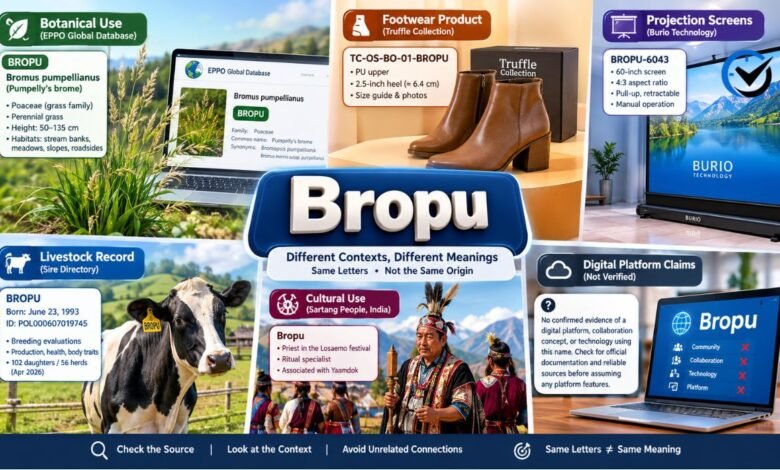
Bropu has several documented uses, depending on where it appears. In a plant database, it identifies a species of grass. In commercial listings, it forms part of the codes for footwear and projection screens. A livestock directory uses it as an animal’s name, while research on the Sartang people of India uses the term for a priest. These examples belong to different systems. Finding the same letters in each place does not establish a shared origin, a single organization, or one meaning that applies everywhere.
That distinction makes the topic easier to understand. A reader examining a botanical record needs information about a plant, while someone checking an equipment catalog needs a model specification. Cultural writing requires another approach because the surrounding language and community matter. This guide explains the strongest documented contexts, what each occurrence tells us, and where interpretation should stop. It also addresses claims about digital platforms, which should be checked separately from the scientific and commercial records. The goal is to help you recognize the relevant meaning without confusing unrelated names or inventing connections.
Why Context Changes the Meaning
A useful starting point is to distinguish a name from a code and a word. A name identifies an individual, such as an animal in a breeding directory. A code points to a record or product within a particular system. A word used by a community can describe a role with meaning in that language or tradition. These categories behave differently. A database identifier does not need a dictionary definition, and a product label does not automatically create a new material or technology. Look first at what the term identifies, then examine the information attached to it.
The dates also show why one origin story would be misleading. The botanical name Bromus pumpellianus was published in 1888. A dairy animal carrying the five-letter name was born in 1993, and the associated EPPO plant code was created in October 1996. Each date describes a different event: publication of a scientific name, birth of an animal, or creation of a database identifier. None establishes when every use of the letters began. Commercial catalog entries and cultural terminology need their own histories, rather than being fitted into a timeline borrowed from an unrelated record.
The Botanical Code and Its Plant
In the EPPO Global Database, BROPU is the code associated with Bromus pumpellianus, commonly called Pumpelly’s brome. EPPO is the European and Mediterranean Plant Protection Organization, and its database records scientific names, common names, and taxonomic information. The plant belongs to Poaceae, the grass family. This use is precise: the code directs readers to a particular taxonomic entry. The record also includes alternative scientific names, including Bromopsis pumpelliana and Bromus inermis subsp. pumpellianus. Those names help readers connect records that use different classifications without assuming that every unfamiliar name describes a completely separate plant.
The grass itself has a recognizable biological context. North American botanical descriptions identify it as a perennial, meaning it lives for more than two years, and usually describe underground stems that support spreading growth. These stems, called rhizomes, allow shoots to emerge away from the original stem, so a patch can contain several connected shoots. The Burke Herbarium’s description gives stem heights of 50–135 centimeters, or about 1.6–4.4 feet. Recorded habitats include stream banks, lake shores, meadows, grassy slopes, and roadsides. The U.S. Forest Service also discusses its value as forage. These details concern the organism behind the identifier. They do not turn the short code into a gardening product, a seed brand, or a universal agricultural term.
Its Commercial Uses in Product Catalogs
A separate example appears in Truffle Collection’s listing for brown PU ankle boots. The product identifier contains TC-OS-BO-01-BROPU, and a size-specific SKU adds a further suffix. The retailer describes a PU upper and a 2.5-inch heel, approximately 6.4 centimeters. Here, the surrounding details establish a footwear context. PU refers to polyurethane, a synthetic polymer used in many manufactured materials. The code belongs to this listing; it should not be treated as a standard name for all brown synthetic footwear. For a buying decision, the stated materials, measurements, size guide, and product photographs provide more useful information than the short label alone.
Burio Technology uses the same letter sequence in pull-up projection-screen model numbers. Its BROPU-6043 listing describes a 60-inch screen with a 4:3 aspect ratio, while related listings identify 80-inch and 100-inch versions. A 4:3 image has four units of width for every three units of height; the diagonal measurement alone does not describe its shape. The manufacturer describes a screen that rises from a portable base and retracts into its case. These are equipment identifiers, and the numbers help distinguish catalog models. A shopper should assess the screen size, image proportions, carrying arrangement, and operating mechanism against the intended room and projector. Similar lettering in a boot listing has no bearing on screen performance, just as a projector specification says nothing about footwear quality.
A Historical Name in Dairy Breeding
Livestock records provide another documented occurrence. A sire directory identifies an animal named BROPU, born on June 23, 1993, with the international identifier POL000607019745. The surrounding entries concern breeding evaluations, including production, health, and body characteristics. In this setting, the term is an individual animal’s name. The international number is useful for confirming identity across records because a short name alone may be insufficient. Evaluation figures also need their dates and measurement systems. An old birth date does not prevent an animal from appearing in a later evaluation, and the presence of a directory entry is not an endorsement of its breeding value.
A Priest’s Role in Sartang Traditions
The cultural use deserves particular care. An ethnographic paper about the Sartang people of Rahung village in Arunachal Pradesh identifies a Bropu as a priest within the Losaemo festival. Its account describes ritual specialists alongside the Maasi, a selected adolescent participant, and other people with ceremonial responsibilities. Priests conduct rites connected with local beliefs about protection and community welfare. The paper also describes particular priests associated with a ceremonial location called Yaamdok. This is a community-specific use, grounded in the account of that setting. It should not be expanded into a general philosophy or presented as a meaning shared by unrelated cultures.
Assessing Claims About Digital Platforms
Some online articles portray the name as a digital community, a collaboration concept, or an emerging technology. The documented uses discussed here do not establish those descriptions. A platform claim needs its own evidence, such as an identifiable operator, a functioning service, clear documentation, and information about how accounts or data are handled. A useful description should also distinguish a released service from a proposed idea or an informal discussion. Repetition across articles is insufficient when the original basis remains unclear. The careful position is that a specific digital-platform meaning has not been verified in this research. That leaves room for a separately documented project, but it does not justify assigning features, founders, benefits, or technical capabilities to the name.
Final Thoughts
Bropu is best understood by examining the setting in which it appears. Botanical records connect it to a grass species, commercial catalogs use the letters in product identifiers, and livestock records assign them to an individual animal. Sartang ritual research documents another meaning tied to a priest’s role. Each context supplies its own evidence and limits. Before drawing a conclusion, identify the record’s subject, check the organization or community using the term, and read the surrounding details. That approach gives a clearer answer than trying to make every occurrence fit one definition.
Frequently Asked Questions
1. Does Bropu have one fixed meaning?
No single definition covers the documented examples. The intended meaning depends on whether you are reading a scientific database, a product listing, an animal record, or cultural research. Treating these occurrences as one subject would erase useful distinctions. Start with the source’s purpose and the item being described, rather than assuming that matching letters indicate a connection.
2. Is it a brand name?
The verified product examples identify their brands separately. The footwear listing belongs to Truffle Collection, while the projection-screen listings belong to Burio Technology. A sequence within an SKU or model number does not automatically represent the brand. If you need to identify a manufacturer or seller, check the brand field, company details, packaging, and full product designation.
3. What does the term identify in botany?
In EPPO’s system, it identifies the taxonomic entry for Bromus pumpellianus. The scientific name describes the plant’s classification, while the five-letter code provides an identifier within that database. This distinction matters when exchanging records: retain the database name and scientific name alongside the code so another reader knows exactly which naming system you used.
4. Why do botanical sources use different scientific names?
Botanical resources can follow different classifications or preserve earlier names. For example, the U.S. Forest Service discusses Pumpelly’s brome under Bromus inermis subsp. pumpellianus, while other resources use Bromus pumpellianus. These differences should be checked through synonym information and the scope of each entry. They are not, by themselves, proof that one source concerns an entirely unrelated grass.
5. Does a footwear code establish the material?
It provides a clue, but the product’s stated composition should guide your interpretation. A code containing PU cannot tell you everything about the upper, lining, sole, or construction. Read those fields individually, since different parts can use different materials. Ask the retailer for clarification if the description and specifications disagree, especially when material choice affects your buying decision.
6. Are the projection screens motorized?
The manufacturer describes manual operation for the pull-up models examined here. A screen that rises from a floor case is not necessarily electrically driven. Supporting structures or hydraulic components can assist movement without making it a motorized product. Check the exact model’s operating instructions and power requirements, rather than transferring features from another screen in the same manufacturer’s catalog.
7. Does the dairy record describe a cattle breed?
The term identifies an individual animal in the directory, rather than naming a cattle breed or farming method. A breed category, an animal’s name, and its registration number are separate pieces of information. Use the full identity record when comparing entries, and keep breeding statistics attached to the animal and evaluation system from which they came.
8. What do the daughter and herd figures show?
The April 2026 sire evaluation lists 102 daughters across 56 herds for production information. Those numbers describe the recorded evaluation population, rather than the animal’s entire lifetime offspring count. Other traits can have different daughter and herd totals. Reliability figures are also listed separately, so a population count should not be substituted for the confidence information provided in the record.
9. How should the Sartang cultural meaning be interpreted?
Interpret it within the particular community and ritual account where it appears. The paper uses the term for a priest involved in the Losaemo festival, alongside participants with other responsibilities. That account supports a local ceremonial meaning. It does not establish a universal spiritual definition, explain every regional variation, or connect the term to commercial products carrying similar letters.
10. How can I identify the relevant meaning?
Read the complete entry rather than an isolated snippet. Scientific names and taxonomy indicate a botanical record; dimensions and model numbers indicate equipment; material and size fields suggest footwear. Animal identifiers point toward livestock records, while community names and ritual descriptions indicate cultural writing. If the surrounding information still leaves the subject unclear, seek clarification from the organization responsible for that entry.
Recommended: JournalWord Com: From School Reform and Business Finance to Everyday Wellness