

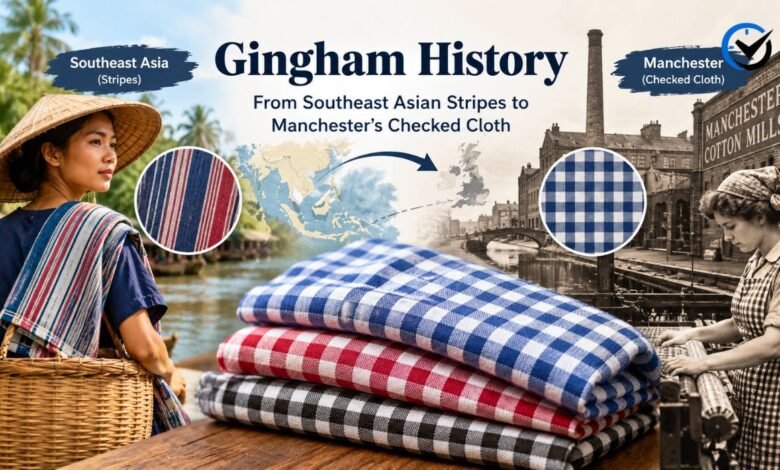
Gingham looks familiar enough to need little explanation. Its neat squares appear on shirts, summer dresses, kitchen curtains, and tablecloths, often pairing white with blue, red, or pink. Yet the fabric’s history begins with a different appearance: stripes. The name traveled through Asian and European trade before becoming closely associated with checked cloth made in Britain. Following that journey reveals how a textile can keep its name while changing its pattern, materials, and everyday meaning. It also helps explain why a fabric linked with simple domestic life belongs within a much larger history of international exchange.
The central story runs from seventeenth-century imports from Southeast Asia to the blue-and-white checks sold by Manchester manufacturers in the eighteenth century. However, this was a gradual development involving merchants, weavers, changing production methods, and several regional traditions. A single birthplace or inventor cannot neatly account for everything now described by the name. Understanding the distinction between the word, the woven cloth, and the familiar pattern makes the timeline clearer. It also prevents two common mistakes: assuming the material was always checked or treating Manchester as the place where checked weaving itself began.
What the Name Reveals About Its Origins
The English word is traced through Dutch gingang to Malay genggang, historically associated with stripes. Its appearance in English during the early seventeenth century fits the wider movement of Asian textiles into European markets. This linguistic connection is useful evidence, but a word’s origin does not establish where every related fabric was first woven. Guingamp, a town in Brittany, also appears in older explanations of the name. The Malay-Dutch connection has stronger support in modern dictionary accounts. Keeping those two explanations separate gives readers a more reliable picture: the documented route of a name is clearer than the precise beginnings of a whole textile tradition.
Southeast Asian Stripes Enter European Trade
Cloth arriving in Europe from Southeast Asia during the seventeenth century included the striped material associated with this name. That detail changes how the early fabric should be imagined. Instead of picturing small blue squares, picture bands of color running across or along a woven cloth. European commerce connected these imports with other Asian textile traditions, particularly the influential cotton industries of India. Britain’s later manufacturers worked within that wider exchange of fabrics and ideas. The story therefore extends beyond a simple journey between two places. Southeast Asia matters to the early imported cloth and its name, while South Asian production belongs to the broader background of Europe’s expanding cotton trade.
Manchester and the Growing Popularity of Checks
By the middle of the eighteenth century, Manchester manufacturers were selling blue-and-white checked cloth under the same name. This is the key turning point behind its modern identity. A pattern made from crossing colored bands gradually became more strongly associated with the fabric than its earlier striped appearance. Manchester’s role was commercial as well as practical: the city helped manufacture and circulate a version that customers could recognize easily. However, describing that development as the invention of checks goes beyond the evidence. Square patterns could be produced through established weaving methods, and Manchester’s importance lies in its place within the cloth’s production and trade.
The change involved materials as well as appearance. Eighteenth-century examples could contain linen, or combine linen threads running lengthwise with cotton threads crossing them. During the nineteenth century, all-cotton versions became increasingly common. Even then, the older vocabulary did not disappear immediately. Early twentieth-century textile descriptions still included striped, checked, and more colorful varieties under the same heading. Some specifications allowed eight colors in the lengthwise threads and six in the crosswise threads. The white-and-color grid now expected by shoppers captures only part of that earlier range. That is why historical garments and fabric descriptions should be read in the context of their period. Applying today’s narrow definition to every earlier example can obscure differences in fiber, construction, and design.
How Dyed Threads Create the Familiar Grid
Traditional checked versions are yarn-dyed, meaning the threads receive their colors before weaving. White and colored yarns are arranged in repeating bands in both directions. Where white crosses white, the cloth looks light; where colored yarn crosses colored yarn, it looks darker. The mixed intersections create an intermediate shade, giving two yarn colors three visible effects. The basic plain weave passes threads alternately over and under one another. Wider yarn bands produce larger checks; narrower bands produce smaller ones without changing the underlying weave. This structure places the design within the cloth rather than merely on its surface. As a result, the checks generally remain visible on both sides. Printed versions can reproduce the appearance, but the method used to create their pattern is different.
The Cotton Industry Behind the Cloth
Manchester’s textile growth depended on connections reaching far beyond northern England. Asian fabrics supplied inspiration, overseas markets bought finished goods, and imported cotton fed the expanding mills. This history also includes slavery. Manufacturers used raw cotton grown by enslaved people in the Americas, while some Manchester-made checked textiles were traded in West Africa in exchange for captured people. In 1788, Manchester’s annual textile exports to Africa were estimated at £200,000. That figure concerns the wider textile trade, rather than this fabric alone. These links belong to the wider industry and should not be treated as proof of the origin of every surviving piece. Nevertheless, they are essential to understanding how cotton production expanded. The cloth’s later associations with cheerful kitchens and summer clothing should be considered alongside the unequal systems that helped sustain industrial textile wealth.
From Working Clothes to Household Textiles
The checked material found uses in work clothes, dresses, children’s garments, and furnishings because it could combine practical construction with a clear decorative pattern. Historical qualities varied, so there was no single weight or grade suitable for everything. A light cloth could work for a shirt or dress, while a more substantial version could serve household purposes. The regular squares also offered useful visual guides when cutting and aligning fabric, although matching them across seams required care. Over time, repeated use in ordinary settings helped build its domestic associations. Curtains, aprons, and table coverings gave the pattern a place in daily life, explaining part of its familiarity beyond the changing demands of fashion.
Dorothy’s Dress and a New Screen Association
The 1939 film The Wizard of Oz gave blue-and-white checks an especially memorable setting. Judy Garland’s Dorothy wore a checked pinafore over a separate blouse, creating an outfit now closely identified with the character. The distinction between those two pieces matters because the costume is often described casually as a single dress. Its plain, recognizable design linked Dorothy to her Kansas home even as she moved through the film’s extraordinary landscapes. The movie did not introduce the fabric, which already had a long history of everyday use. Instead, it supplied a lasting visual reference that later costumes, adaptations, and viewers could recognize almost immediately.
Pink Checks, Brigitte Bardot, and Biba
Pink-and-white checks acquired another prominent association when Brigitte Bardot married Jacques Charrier in 1959. The wedding took place on June 18 in Louveciennes, France. Her lace-trimmed wedding dress, designed by Jacques Esterel, used the pattern often called Vichy in French fashion. The choice helped show how an everyday textile could work in an unconventional bridal outfit. A separate turning point followed in Britain in 1964, when Biba offered a pink checked dress and sold 17,000 examples. Its designer, Barbara Hulanicki, paired the short sleeveless style with a matching headscarf. These episodes demonstrate the fabric’s flexibility: a familiar grid could support a wedding look and an accessible fashion business without needing an elaborate new pattern.
Final Thoughts
Gingham history becomes more interesting when its different strands are kept visible. The name carries a Malay-Dutch connection, the early imported cloth was striped, and Manchester helped establish the checked version familiar today. Changes in fiber and manufacturing widened its use, while ordinary households and memorable garments gave it further meanings. Its success rests partly on a design that is easy to recognize and adapt. Looking closely at the threads, the period, and the purpose of a particular piece reveals more than the squares alone. What seems like a simple pattern can preserve evidence of trade, industrial growth, practical clothing, and changing ideas about style.
Frequently Asked Questions (FAQs)
1. What did the word gingham originally mean?
The name is associated with stripes through Malay genggang and reached English through Dutch gingang. This explains why early descriptions can refer to striped cloth. The connection concerns the history of the word; it does not identify a single inventor or prove the birthplace of every related textile.
2. When did the fabric reach Europe?
Striped cloth associated with the name was imported from Southeast Asia during the seventeenth century. Dates for individual shipments and trading centers would require more specific records. The useful general timeline places these imports before the eighteenth-century checked versions associated with Manchester.
3. Did Manchester invent the checked pattern?
Manchester manufacturers were producing checked versions by the middle of the eighteenth century, but this does not establish that they invented checked weaving. Their documented significance is the manufacture and sale of this cloth within a growing textile industry. Claims naming a first inventor require stronger evidence.
4. Was the material always made entirely from cotton?
No. Historical examples included linen and fabrics combining linen and cotton in different thread directions. All-cotton versions became increasingly common during the nineteenth century. When identifying an older garment, its fiber composition and weave provide useful information beyond the presence of a recognizable checked pattern.
5. Why can two yarn colors produce three shades?
The lightest squares contain white yarn in both directions, while the darkest contain colored yarn in both directions. Between them, white and colored threads cross together, producing a lighter version of the color. The effect comes from the arrangement of threads rather than an additional dye color.
6. How can you distinguish woven checks from printed checks?
Inspect the threads closely and compare both surfaces. In a yarn-dyed check, colored yarns form the design throughout the weave. A printed design is applied after the cloth is made and may look weaker on the reverse. Dye penetration and finishing can complicate this comparison, so avoid judging by the back alone.
7. What are Vichy checks?
Vichy is a name commonly used in French fashion for the familiar checked pattern. Bardot’s pink-and-white wedding dress is a well-known example. Seeing this term on a fabric description helps identify the design, but it does not guarantee a particular fiber, country of manufacture, or fabric weight.
8. Was Dorothy’s costume a single piece?
The recognizable outfit combined a blue-and-white checked pinafore with a separate blouse worn underneath. That construction distinguishes the film costume from some simplified modern reproductions. When recreating the look, garment shape and layering matter alongside the choice of blue-and-white fabric.
9. What does the Biba sales figure tell us?
The sale of 17,000 pink checked dresses shows the commercial success of one specific design in 1964. It helps explain that garment’s importance to Biba’s development. It should not be treated as a measure of the entire fabric market or the popularity of every checked style.
10. Does cotton gingham need special preparation before sewing?
Cotton versions can shrink, so wash and dry new fabric according to its care instructions before cutting when the finished garment will be washable. Check the grid afterward for distortion, and align it carefully when laying out pattern pieces. Preshrinking and accurate cutting help preserve the intended fit and appearance.
Recommended: StartupBooted: Inside Its Consulting Services, Starting Prices, and Broader Blog Content





One Comment