

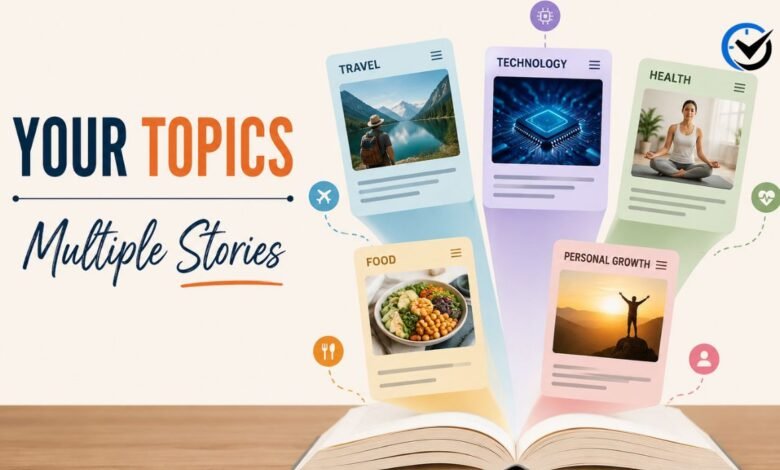
Finding useful information online is easy, but finding information that presents a subject from several meaningful angles can be much harder. This is where Your Topics Multiple Stories takes an interesting approach. The concept centers on turning a single subject into several stories, perspectives, and directions rather than treating every topic as a one-dimensional idea. Its stated purpose is to help readers, learners, writers, and creators discover broader viewpoints through storytelling. The platform describes itself as a place where topics can lead to different narratives across areas such as education, science, history, technology, culture, and other subjects.
What Your Topics Multiple Stories Means
At its simplest, the idea means that one topic does not have to produce only one story. A subject such as technology, for example, can be discussed through history, practical applications, personal experiences, social effects, and future developments. Each angle can reveal information that another approach may leave out. The platform uses this principle to present storytelling as a way of making subjects easier to explore and understand. Rather than asking readers to accept one fixed explanation, the multi-story approach encourages them to consider how the same subject can look different depending on the question being asked.
Why One Topic Can Support Many Stories
Most subjects are naturally broader than they first appear. Consider something as familiar as education. One story might examine classroom teaching, another could explore online learning, while another could focus on student experiences or changes in educational technology. None of these stories has to contradict the others. They simply answer different questions about the same general subject. This makes multiple-story content useful because it recognizes that readers rarely approach a topic with exactly the same needs. A beginner may want a simple explanation, while an experienced reader may be interested in history, examples, problems, or practical applications.
The Role of Different Perspectives
Perspective is one of the most important parts of multi-story storytelling. Two people can look at the same subject and notice completely different details because their experiences and goals are different. A researcher may focus on evidence, a teacher may focus on explanation, and a creator may focus on communication. Bringing these angles together can create a fuller picture without pretending that every viewpoint carries equal factual weight. Good multi-perspective content still needs accuracy and clear distinctions between facts, interpretation, and personal experience.
How the Platform Approaches Story Ideas
The platform explains that users can submit a topic and receive multiple story suggestions based on that subject. Its described process begins with providing a topic and a short description. The team then develops different story ideas intended to explore the subject through varied perspectives and narrative directions. The stated service can provide ten story suggestions, with each suggestion accompanied by a brief overview to help the user decide where to take the idea next.
From a Broad Subject to Specific Ideas
A broad topic can sometimes be difficult to work with because it contains too many possible directions. Turning it into smaller story ideas gives the creator a clearer starting point. For instance, “science” is too large to serve as a focused story by itself, but scientific discoveries, famous experiments, everyday applications, research challenges, or the history of a particular field can become separate narratives. Breaking a large subject into focused stories does not reduce its importance. Instead, it gives each part enough space to be explained properly.
Why Storytelling Can Make Complex Topics Easier
Facts are important, but facts alone do not always make information easy to understand. Stories can provide context by showing how an idea develops, affects people, or connects with real situations. This is especially useful when the subject is complicated or unfamiliar. The platform’s own description emphasizes storytelling as a way to make complex ideas more approachable and engaging. A well-constructed story can give readers a reason to continue reading while gradually introducing information that might otherwise feel difficult or disconnected.
Applications in Education and Learning
Education is one area where this approach can be particularly useful. A teacher can introduce a historical event through several narratives, such as the causes behind it, the experiences of people involved, and the long-term effects. A science lesson can combine a simple explanation with a real-world example and a historical discovery. This gives students more than one route into the same subject. Different stories can also help accommodate different learning preferences without changing the central facts being taught.
Uses for Writers and Content Creators
Writers often face the challenge of finding fresh ideas without constantly abandoning their main subject. A multi-story approach offers a practical solution. Instead of writing repeatedly about unrelated subjects, a creator can explore one broad area through several connected stories. A technology writer, for example, could examine a new development through its background, practical uses, limitations, business impact, and effect on ordinary users. Each piece can have its own purpose while remaining connected to the larger subject.
How Businesses Can Use Multiple Narratives
Businesses can also use different stories to explain what they do. A company may describe a product through a basic introduction, a customer use case, an explanation of the problem it solves, and a deeper look at how it works. These are different narratives, even though they concern the same product. This approach can make business communication more understandable because customers do not all want the same type of information. Some want practical details, while others want context, examples, or answers to specific concerns.
The Difference Between Multiple Stories and Repetition
Creating several stories around one topic does not mean rewriting the same article several times. Repetition happens when different pieces use nearly identical information, structure, and purpose. A genuine multi-story approach should introduce a different question or viewpoint each time. One story might explain what something is, another might explore how it developed, and another might examine how people use it. The central topic remains connected, but the reader gains new information with every piece.
Choosing Topics That Work Well
Not every subject can support an unlimited number of useful stories. A good starting topic usually has enough depth to contain different questions, experiences, or applications. Technology, history, education, travel, science, business, culture, and many lifestyle subjects naturally provide several directions. A narrow subject can still work if it has meaningful context behind it. The key is not the size of the topic but whether each additional story can contribute something genuinely useful.
Keeping Different Stories Connected
Multiple narratives need a clear connection. Without one, a collection of stories can feel random and difficult to follow. The connection may come from a shared subject, a common question, a particular audience, or a consistent theme. Strong organization also helps. Readers should understand why one story belongs beside another and how the pieces contribute to the larger subject. This is especially important when a platform presents several ideas from different fields or perspectives.
The Importance of Research and Accuracy
A collection of different stories is only useful when the underlying information is reliable. Research should come before storytelling, particularly when the subject involves science, history, technology, finance, health, or other areas where inaccurate information can cause confusion. Storytelling should make information easier to understand, not replace evidence. Creators should also separate established facts from opinions, predictions, anecdotes, and interpretations. That distinction helps readers understand what they can confidently take away from a story.
Finding Value for Different Readers
One advantage of diverse storytelling is that the same general topic can serve people with very different interests. A student may want an introductory explanation, while a professional may want practical examples. A casual reader might prefer a human-centered story, while a researcher could be more interested in background and evidence. Multiple stories create room for these differences without forcing every reader through exactly the same experience.
Turning One Idea Into a Content Journey
A strong topic can become a journey rather than a single stopping point. The first story might introduce the subject and answer basic questions. Later stories can explore examples, history, challenges, practical uses, or different perspectives. Readers who become interested in the subject can continue exploring without losing the original context. This makes the overall experience more useful than a single article that tries to answer every possible question at once.
Challenges of the Multi-Story Approach
There are also limitations. Creating several meaningful stories requires more research, planning, and editing than producing one basic article. Poorly planned content can become repetitive, overly broad, or disconnected. Another risk is sacrificing depth for variety. Ten shallow stories are not automatically better than one carefully researched explanation. The quality of each narrative still matters, and creators need to know when another story genuinely adds value.
How to Keep the Experience Clear
Clarity should remain a priority as more stories are added. Each narrative needs a defined purpose, understandable language, and enough context for the reader to follow it. Headings and logical organization can make longer collections easier to navigate. It also helps to avoid introducing unrelated information simply because it happens to fit the broad topic. A focused collection feels intentional, while an unstructured collection can quickly become overwhelming.
Why Diverse Storytelling Remains Relevant
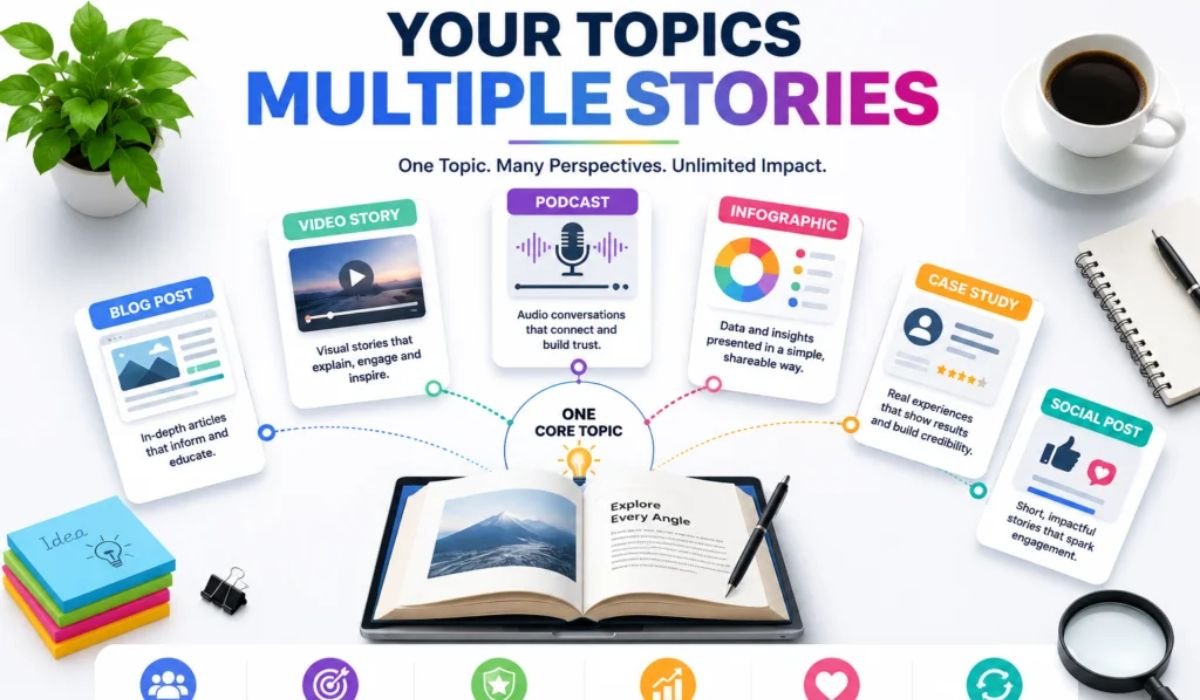
People increasingly encounter information through many formats and viewpoints. A subject may appear in an article, video, classroom lesson, podcast, discussion, or personal account. Multi-story thinking fits naturally into this environment because it recognizes that understanding often develops gradually. One story introduces an idea, another adds context, and another may challenge an assumption or show a practical example. The result can be a broader understanding without requiring every narrative to perform the same job.
What Readers Can Expect From the Concept
Readers approaching a platform built around this idea should think of it as an opportunity to explore rather than a single fixed type of article. The available material may depend on the topic, the intended audience, and the story format being developed. The official site presents the service as a way to generate multiple story suggestions from a submitted subject, while its broader mission emphasizes discovery, creativity, and different perspectives.
Final Thoughts
The central strength of Your Topics Multiple Stories is a simple idea: one subject can contain many useful stories. Exploring those stories through different perspectives can make information easier to understand, give creators more meaningful directions, and help readers discover details they might miss in a single narrative. The approach works best when variety is supported by research, organization, and a clear purpose. Whether used for learning, creative work, publishing, or broader exploration, the multi-story model provides a practical way to look beyond the first explanation and discover the wider context surrounding a topic.
Frequently Asked Questions
1. What is Your Topics Multiple Stories?
It is a concept and platform centered on exploring one subject through multiple stories, perspectives, and narrative ideas. The platform describes a service where users can submit a topic and receive different story suggestions designed to expand the subject into several directions.
2. How does the topic-to-story service work?
The described process begins when a user submits a topic with a brief explanation. The platform then develops multiple story suggestions based on that subject, with each suggestion intended to offer a different angle or narrative direction.
3. Who can benefit from multiple-story content?
Students, teachers, bloggers, writers, researchers, businesses, and other creators can benefit. The approach is especially useful when a subject has several important angles that cannot be fully explored in one short narrative.
4. Can one topic really produce several different stories?
Yes. A broad topic can often be divided according to history, practical use, personal experience, research, challenges, examples, or different audiences. The important point is that each story should add genuinely new information.
5. Is multiple-story content the same as rewriting an article?
No. Rewriting usually presents substantially the same information in different wording. Multiple-story content should approach the central topic from a different question, perspective, experience, or purpose.
6. Why are different perspectives useful?
Different perspectives can reveal details that a single explanation may overlook. They can also help readers with different backgrounds understand the same subject in ways that are more relevant to their needs.
7. Can this approach be used for education?
Yes. Teachers can use several narratives to explain the same lesson, combining background information, examples, historical context, and real-world applications. This can make difficult subjects more approachable.
8. Does every topic need multiple stories?
No. Some subjects are narrow enough that one focused explanation is sufficient. Multiple stories are most useful when additional perspectives provide meaningful information rather than simply increasing the amount of content.
9. What is the biggest challenge with this approach?
Maintaining quality and avoiding repetition are major challenges. Every additional story should have a clear reason to exist and should contribute something that readers cannot already find in the other narratives.
10. What makes a strong multi-story collection?
A strong collection has a clear central topic, distinct narratives, accurate information, useful context, and logical organization. The stories should feel connected while still giving readers genuinely different ways to understand the subject.
Recommended: Tran Ny Tube Overview: Understanding Its Main Features and Uses



One Comment