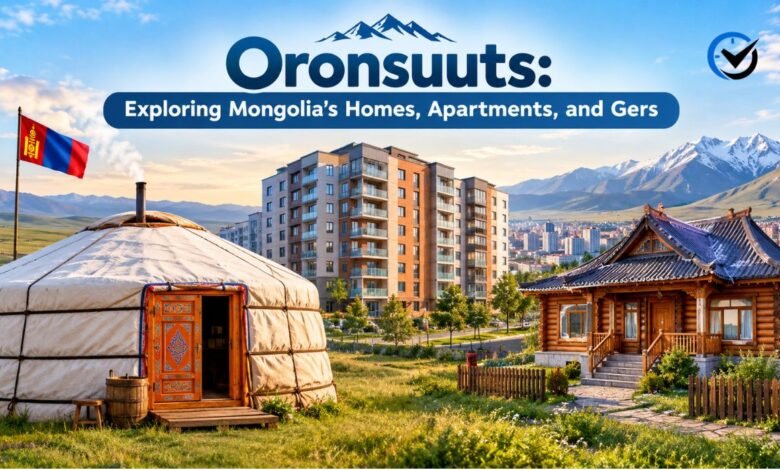
Housing in Mongolia reflects a country shaped by wide-open landscapes, a demanding climate, and rapid urban growth. The word oronsuuts is a romanized form of the Mongolian term орон сууц, commonly used for housing or an apartment. It is often associated with city living, especially apartment buildings in Ulaanbaatar. Yet Mongolia’s homes include much more than flats: traditional gers, detached houses, and neighborhoods that combine several kinds of housing all form part of the picture.
Understanding these homes means looking at how people live, not simply comparing building styles. An apartment may offer piped water and central heating, while a family in a ger district may have a private plot and more room to expand. A ger, meanwhile, is a portable, round dwelling with a design suited to Mongolia’s pastoral traditions and weather. Each option has practical advantages and pressures, and household choices depend on income, location, work, family needs, and access to services.
What “Oronsuuts” Means
In everyday Mongolian usage, орон сууц refers broadly to a dwelling or residential housing. In discussions of city life, the term commonly points to an apartment or a unit in a residential building. The single-word spelling “Oronsuuts” is a romanized version used in English-language writing, where spelling can vary because Mongolian sounds do not always map neatly to English letters.
The word is useful for understanding Mongolia’s housing landscape, but it should not be treated as the name of one specific building style or housing program. It does not describe every home in the country, and it does not mean “ger.” Context matters: a real estate listing, a housing policy discussion, and a conversation about an individual home may use the term in slightly different ways.
Housing in a Vast and Cold Country
Mongolia has a relatively small population spread across a large territory, with many people concentrated in Ulaanbaatar and other urban centers. The climate also shapes everyday housing decisions. Winters are long and severe, so insulation, heating, access to fuel, and the reliability of utilities can affect comfort, health, and household costs.
Conditions vary greatly between cities, provincial centers, and rural areas. In a city, residents may live in high-rise or mid-rise apartments, detached houses, or ger districts. In rural areas, households may use gers alongside other structures, with daily life shaped by livestock, seasonal movement, and distance from services. There is no single “typical Mongolian home” that represents all regions and income groups.
The Ger and Its Cultural Role
A ger is a round, portable dwelling traditionally used by Mongolian families. In English, it is often called a yurt, though ger is the Mongolian word and is preferred when discussing the Mongolian home specifically. Its structure typically includes a circular lattice wall, roof poles, a central support, and a felt covering that helps shelter the interior from wind and cold.
The ger’s design is practical as well as culturally meaningful. It can be assembled and taken apart, which has long suited mobile pastoral life. The interior is organized around a central stove and a central roof opening that lets smoke escape and brings in light. Customs around the doorway, seating, and movement through the space may carry social meaning, though practices differ among families and regions.
How a Ger Is Built for Its Environment
The circular shape helps a ger stand up to strong winds, while its relatively compact interior can be heated more quickly than a large, poorly insulated room. Felt coverings provide insulation, and households can adjust the layers according to season and conditions. The central stove is commonly used for warmth and cooking, making fuel use and ventilation important parts of daily life.
A ger is not automatically comfortable or low-cost in every setting. Maintaining warmth through a harsh winter requires effort and fuel, and the experience depends on the quality of the coverings, stove, and household resources. When gers are situated in dense urban neighborhoods, heating practices can also contribute to local air pollution. The same dwelling that is well adapted to mobility can face different challenges when used as a permanent city home.
Apartments and Urban Housing
Apartment buildings are a visible part of Ulaanbaatar and other Mongolian cities. They range from older residential blocks to newer developments, and their layouts, construction quality, and services can differ. Some are connected to centralized heating, piped water, and sewer systems; others may have maintenance or infrastructure problems that affect residents’ comfort.
Apartment living changes household routines. Residents may have less private outdoor space than families on individual plots, but they can have more direct access to shops, schools, public transport, and other urban services. Elevators, shared entrances, heating systems, and building management all influence daily life. A unit’s location and upkeep may matter as much as its size when a household considers a move.
Detached Houses and Mixed Neighborhoods
Not all Mongolian urban housing fits neatly into the categories of apartment or ger. Detached houses, small buildings, and homes added to family plots are also part of the residential mix. In some areas, a household may use a house for sleeping or storage and a ger for cooking, gathering, or extra living space. These arrangements reflect family preferences and the limits of available infrastructure.
A home’s appearance alone does not reveal how it functions. Two neighboring households may have very different access to water, heating, roads, and sanitation. Some houses are connected to utilities, while others rely on household-level solutions. This variation is one reason that broad labels such as “modern” and “traditional” can obscure important differences in comfort, cost, and access to services.
What Ger Districts Are
Ger districts are residential areas where many households live on individual plots, often in gers, detached houses, or a combination of both. They are especially associated with the outskirts of Ulaanbaatar, although the term can also apply to similar areas in other settlements. Despite the name, a ger district is not made up exclusively of gers; many residents live in houses.
These neighborhoods have grown for a range of reasons, including migration, housing costs, and the availability of land plots. Their layout may differ from that of planned apartment districts, and some areas have limited access to paved roads, piped water, sewer connections, or centralized heating. Conditions vary between districts and even between nearby streets, so it is misleading to describe every ger-area household in the same terms.
Why Ulaanbaatar Has Different Housing Patterns
Ulaanbaatar brings together Mongolia’s largest concentration of jobs, education, services, and public institutions. As the city has expanded, its housing has developed in different ways: apartment neighborhoods grew in the urban core, while ger areas spread across parts of the city’s edges. These patterns reflect a mix of individual household decisions, land access, migration, investment, and city planning.
The result is a city where apartment blocks and low-density residential areas coexist. This creates planning challenges because extending roads, water pipes, heating networks, and sewer systems across a wide area can be costly and slow. It also affects how residents reach schools, clinics, and workplaces. Housing policy therefore involves more than building new units; it must consider transport, utilities, public spaces, and residents’ ability to afford a move.
The Appeal of Apartment Living
For some households, an apartment offers reliable access to services that can be difficult to obtain on an unconnected plot. Central heating can reduce the need to manage a household stove, while piped water and indoor sanitation can make daily tasks easier. Apartment neighborhoods may also be close to workplaces, schools, shops, and bus routes, reducing travel time for residents.
These benefits do not make apartment living the right choice for everyone. Monthly costs, building maintenance, limited space, and the need to share common areas can be concerns. A household that depends on outdoor storage, keeps animals, or values a private plot may find an apartment less practical. Preferences can also change across a person’s life as family size, employment, health, and income shift.
The Appeal of Living on a Plot
A plot in a ger district or a detached-home neighborhood can offer more outdoor space and room to adapt a home over time. Families may build additional structures, use the land for storage, or keep a ger alongside a house. For households with limited income, the ability to improve a home in stages may be more manageable than taking on the cost of an apartment purchase or rent.
A plot does not guarantee easy access to city services. Residents may need to travel farther for water, transport, or healthcare, depending on the neighborhood. Heating and sanitation may require more household labor, and unpaved roads can make winter travel difficult. The trade-off is not simply between “more space” and “more convenience”; it involves the actual quality of local infrastructure and the household’s means.
Heating, Air Quality, and Health
Heating is a central concern in Mongolian housing because winter temperatures can fall far below freezing. In apartments connected to district heating, warmth is delivered through a shared system. In many ger-area homes, residents rely on individual stoves and fuels. The type of stove, fuel, ventilation, insulation, and outdoor conditions all affect indoor comfort and emissions.
Air pollution is a major issue in Ulaanbaatar, particularly during the cold season. Household heating is one contributor, alongside traffic, industry, and other sources. Poor indoor air can also result when smoke enters living spaces or ventilation is inadequate. Improving housing conditions therefore involves several connected steps, such as better insulation, cleaner heating options, reliable energy, and neighborhood infrastructure. No single building type can solve the problem on its own.
Water, Sanitation, and Everyday Services
The convenience of a home depends heavily on what services reach it. In some apartment buildings, water comes through indoor pipes and sanitation is connected to a sewer network. In some ger areas, households may collect water from kiosks or other shared sources and use different sanitation arrangements. Access and reliability vary, so residents’ experiences cannot be inferred from an address label alone.
These differences affect time, privacy, and household work. Carrying water, maintaining a stove, or navigating unpaved roads adds tasks to daily routines. Reliable services can also support health and children’s school attendance. Housing upgrades are most useful when they connect a safe, well-built dwelling to the systems residents need, rather than focusing on the structure alone.
Housing Costs and Affordability
The cost of housing in Mongolia depends on location, building age, size, construction quality, and access to transport and services. Apartment prices and rents can be difficult for lower-income households, while a plot-based home may involve ongoing expenses for fuel, water, repairs, and transport. The cheapest option on paper may not remain the least expensive once these costs are included.
Affordability is also about whether a household can meet expenses without sacrificing essentials. A mortgage or rent payment must be considered alongside heating, utilities, food, travel, and maintenance. New apartment construction may add supply, but it does not automatically provide housing that lower-income households can afford. Programs that support accessible financing or social housing need to match the incomes and needs of the people they are intended to serve.
Redevelopment and Resident Needs
Some plans for improving ger areas involve upgrading roads and utilities, building new residential blocks, or creating more compact neighborhoods. These projects can make services easier to provide and may offer safer, warmer homes. They can also disrupt established routines if residents are moved far from jobs, family networks, schools, or local businesses.
Redevelopment works best when residents have a meaningful role in decisions and understand what a proposed change would mean for them. Compensation, property rights, affordability, temporary relocation, and access to replacement housing all matter. A new building may be physically better while still creating hardship if a household cannot afford its costs or loses access to its community. Good planning measures success through residents’ actual living conditions.
Choosing a Home in Mongolia
For someone comparing housing options, the first step is to consider everyday needs rather than relying on broad assumptions. A household can assess commute time, winter heating, water access, sanitation, building maintenance, space, and total monthly cost. Families should also consider whether the home can adapt to changes, such as a new child, an older relative moving in, or a shift in work location.
Location-specific checks are essential. An apartment should be evaluated for heating, water pressure, insulation, repairs, and shared-building costs. A plot-based home should be assessed for road access, fuel needs, water collection, drainage, and distance to services. Local conditions can vary considerably even within the same district. A careful comparison helps clarify which trade-offs are manageable for a particular household.
Renting or Buying an Apartment
People considering a rental or purchase should confirm what is included in the cost and how utilities are managed. For a rental, this means understanding the lease period, deposit, repair responsibilities, and heating arrangements. For a purchase, buyers may need to review ownership documents, building condition, maintenance obligations, and the reliability of utilities before making a commitment.
New construction is not automatically better than older housing, and an older building is not necessarily unsuitable. Construction quality, upkeep, insulation, plumbing, and the surrounding area all matter. Anyone unfamiliar with Mongolian property rules may benefit from local professional advice before signing agreements. The practical goal is to understand both the dwelling and the obligations that come with it.
Cultural Respect When Discussing Mongolian Homes
It is easy for outside coverage to portray gers only as symbols of nomadic life or as signs of urban hardship. Both views are incomplete. Gers remain meaningful and practical for many families, while the conditions in ger districts vary widely. Similarly, apartment living is not a single experience: buildings differ in quality, affordability, location, and access to services.
Respectful discussion avoids treating one housing style as a measure of a family’s status or values. Housing choices are shaped by opportunity and constraint as well as culture. A household may value a ger’s familiar layout and flexibility while also wanting cleaner heating or easier access to water. Another may prefer an apartment because it places work and services nearby. These choices are personal and often change over time.
The Future of Housing in Mongolia
Mongolia’s housing future will depend on whether cities can provide homes that are safe, affordable, and suited to the climate. That requires coordinated decisions about buildings, land, public transport, heating, water, sanitation, and open space. Energy-efficient design can reduce the fuel needed to keep a home warm, but it must be paired with dependable infrastructure and realistic costs for residents.
There is no single solution for every household or neighborhood. Some areas may benefit from apartment construction, while others may need gradual upgrades that improve roads and utilities without displacing residents. Rural housing needs also differ from those of the capital. Flexible planning can recognize this variety and support improvements that residents can afford and maintain.
Final Thoughts
Oronsuuts is a useful term for understanding Mongolian housing, especially apartment life, but it belongs within a much broader picture. Mongolia’s homes include apartments, detached houses, gers, and mixed arrangements shaped by geography, climate, history, and household needs. The differences between them are real, yet no single category tells the full story of how people live.
A clear view of housing looks beyond buildings to the services and choices surrounding them. Heating, water, affordability, transport, and community ties influence whether a home works well for its residents. Understanding those factors makes it easier to discuss Mongolia’s changing cities with accuracy and respect.
Frequently Asked Questions
1. What does “Oronsuuts” mean?
It is a romanized form of the Mongolian term орон сууц, commonly translated as housing, dwelling, or apartment. In urban contexts, it often refers to apartment housing.
2. Is Oronsuuts the Mongolian word for a ger?
No. Oronsuuts refers broadly to residential housing and is often used for apartments. A traditional Mongolian dwelling is called a ger.
3. What is a ger?
A ger is a round, portable Mongolian dwelling traditionally made with a lattice frame and felt coverings. Its design can be assembled and taken apart, and it is adapted to Mongolia’s climate and pastoral traditions.
4. Do all residents of ger districts live in gers?
No. Ger districts include households living in gers, detached houses, or both. The name describes a type of neighborhood, not a uniform housing style.
5. Are Mongolian apartments centrally heated?
Some apartment buildings are connected to centralized heating, but systems and building conditions vary. Residents should check how heating works in the specific building they are considering.
6. Why are ger districts part of Ulaanbaatar’s housing landscape?
They expanded as the city grew and households sought places to live, including on individual plots. Their development reflects migration, land access, housing affordability, and the pace of urban infrastructure expansion.
7. Is apartment living always more convenient?
Not for every household. Apartments may offer easier access to utilities and city services, while some families prefer the space or flexibility of a plot-based home. Costs, location, and building quality affect convenience.
8. What housing challenges do Mongolian households face?
Challenges vary but can include high housing costs, winter heating needs, limited infrastructure, air pollution, and long travel distances. The specific issues depend on the home and neighborhood.
9. What should someone check before renting an apartment in Mongolia?
They should ask about rent, deposits, heating, water, repairs, building maintenance, and the length of the rental agreement. A visit can help reveal the condition of the unit and shared spaces.
10. Are gers still used in modern Mongolia?
Yes. Gers continue to be used in rural settings and in urban neighborhoods. Their role varies by household, and some families use a ger alongside a detached house or other structures.
Recommended: Sodziu: The Story of Lithuania’s Villages and Countryside