

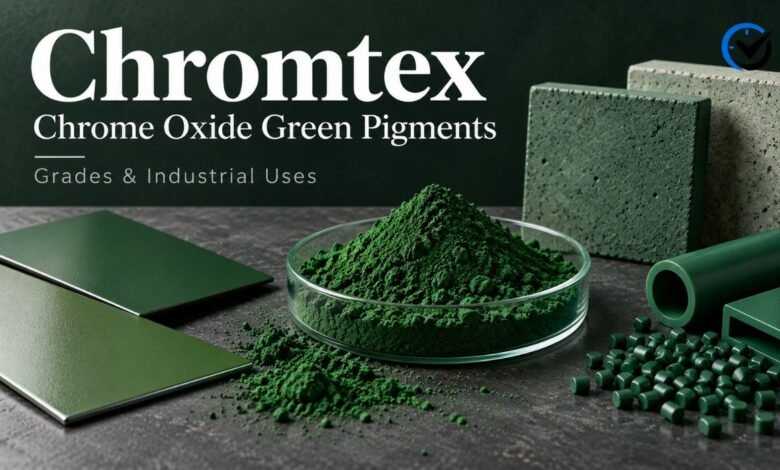
Chromtex is a commercial name associated with a range of synthetic chrome oxide green pigments offered by ZWUKSO, a Polish supplier of inorganic pigments. These products provide green color for industrial materials, including paints, plastics, concrete, rubber, and glass. The name can cause confusion because some online descriptions connect it with textile chemicals or broad claims about advanced fabrics. Understanding the documented product identity helps readers separate those descriptions from the actual pigment range. This article explains its composition, properties, available grades, applications, and practical purchasing considerations. It also clarifies why a product name alone cannot tell buyers everything about performance, suitability, or handling requirements. For anyone comparing industrial colorants, that distinction is the starting point for making an informed choice.
What Is Chrome Oxide Green?
Chrome oxide green is an inorganic pigment based on chromium(III) oxide, written chemically as Cr₂O₃. In plain language, it is a solid coloring material made from chromium and oxygen. Unlike a dye that dissolves in a suitable liquid, a pigment generally remains as small particles distributed throughout another material. Those particles give a coating, plastic component, or building product its color. The documented CHROMTEX range uses finely milled synthetic chrome oxide green. However, the chemical formula does not describe every feature of a commercial grade. Particle characteristics, shade, dispersibility, and other specifications also influence how a product behaves. Buyers therefore need information about the exact grade rather than assuming that every chromium oxide pigment will perform identically in their formulation.
Why the Chromtex and Chromatex Names Cause Confusion
Chromtex and Chromatex should not automatically be treated as interchangeable names. The former appears in ZWUKSO’s chrome oxide green pigment offering. Chromatex Chemicals Pvt. Ltd. is a separate Pakistani business associated with textile auxiliary chemicals. Its products support processes such as fabric pretreatment, dyeing, and finishing. Similar spelling can make the subjects appear connected when they are discussed without clear identification. A textile softener, cleaning agent, or dyeing auxiliary serves a different purpose from a green inorganic pigment. Readers should check the company name, product category, and intended application before combining information from different pages. Claims about improved fabric softness or textile processing efficiency do not establish those properties for the pigment range discussed here. Keeping the names distinct prevents incorrect product comparisons.
Coloring Power, Coverage, and Dispersion
ZWUKSO describes its green pigment series as having good coloring power, hiding power, and dispersibility. These terms address different aspects of performance. Coloring power concerns how strongly a pigment influences the color of a mixture. Hiding power concerns its ability to obscure the surface or material underneath a coating. Dispersibility describes how readily pigment particles can be distributed through a formulation. Good dispersion helps avoid visible specks, streaks, or uneven color. However, a manufacturer’s description is not a numerical guarantee for every application. The binder, mixing equipment, pigment loading, and processing conditions affect the result. A useful evaluation should measure color and coverage in the intended formulation rather than relying only on the appearance of loose powder or a general product description.
Understanding the Available Pigment Grades
The supplier lists eight grades: GA-U, GA-R, GN, GA, GA-3, GA-6, GA-40, and GA-60. These designations identify products within the range, but the names alone do not explain their differences. It would be misleading to assume that a larger number means better quality, stronger color, or suitability for higher temperatures. Those conclusions require the relevant technical specifications. Buyers should request information about shade, particle characteristics, composition, and recommended applications for each candidate grade. Where the supplier provides test values, the test method matters as much as the number. Comparing results obtained under different conditions can produce a false impression of equivalence. Grade selection should begin with the finished product’s requirements and then move to specifications, samples, and controlled application trials.
Uses in Paints, Primers, and Coatings
Paints, primers, ground paints, and fillers are among the applications listed for the pigment series. In these systems, the green particles are incorporated into a binder that eventually forms the coating. The final appearance depends on more than the selected pigment. Binder color, other colorants, surface texture, film thickness, and gloss can all change the visible shade. A formula that looks correct in a small container may look different after application and drying. Manufacturers should therefore evaluate the finished film on a suitable test surface. Coverage, dispersion, and color consistency should be checked together. Where weather resistance or another demanding property is important, the complete coating needs testing under relevant conditions. Pigment selection contributes to performance, but it does not replace formulation development.
Applications in Concrete, Bricks, and Tiles
The documented construction uses include concrete roofing products, colored bricks, tiles, and facade mixtures. In these applications, the pigment provides color within or on the building material, depending on the manufacturing process. Cement color, aggregate composition, water content, surface finishing, and curing conditions can influence the final appearance. A green mixture made with one cement may not match a mixture made with another. Meaningful trials therefore require consistent raw materials and processing conditions. Manufacturers should assess cured samples rather than judging the fresh mixture alone. If uniform appearance across production batches is important, pigment dosing also needs careful control. The appropriate addition rate must come from formulation trials and supplier guidance; there is no universal percentage that can be recommended for all construction products.
Applications in Plastics and Rubber
Plastics and rubber are also listed as intended applications. Here, the pigment becomes part of a polymer formulation, where mixing and processing determine how evenly it is distributed. The same green powder can produce different appearances in transparent, translucent, and opaque materials. Resin color, fillers, surface finish, and component thickness also affect the result. Processors should check whether a selected grade can disperse adequately using their equipment and remain suitable under their actual processing conditions. A laboratory sample should be evaluated for both appearance and the finished material’s required properties. Simply adding pigment successfully does not establish that a component meets its specification. For specialized products, additional requirements may concern composition, migration, mechanical performance, or other application-specific characteristics that need separate confirmation.
Flooring, Enamel Frits, and Colored Glass
The supplier additionally identifies flooring, enamel frits, and colored glass as applications. These uses show that the range extends beyond conventional paint and concrete coloring. They also involve different materials and processing conditions, so suitability cannot be transferred automatically from one application to another. An enamel frit is a glass-based material used in producing enamel coatings, and its composition affects how a colorant behaves. Glass processing likewise requires attention to the complete formulation and production conditions. Flooring may involve mineral or polymer systems with distinct requirements. A manufacturer should specify which system is being considered before requesting a grade recommendation. Trial production is especially useful when appearance changes during heating, curing, or finishing, because the starting powder does not reveal the finished product’s exact color.
Technical Documents, Handling, and Purchasing
A technical data sheet helps buyers assess product specifications and intended uses, while a safety data sheet addresses hazards, handling, storage, and related precautions. These documents have different purposes and should be requested for the exact grade. Chromium(III) oxide should also be distinguished from chromium(VI) compounds; the shared element name does not make their chemistry or hazards identical. Nevertheless, a pigment’s identity is not a reason to disregard dust control or workplace instructions. ZWUKSO lists packaging options of 25 kg net bags and 1,000 kg net big bags. Buyers should confirm current availability, minimum order quantities, delivery terms, and documentation before ordering. A trial quantity can help establish whether the grade fits the process before a larger purchase creates avoidable material or production costs.
Final Thoughts
Chromtex is best understood here as a documented chrome oxide green pigment range with several grades and a broad set of industrial coloring applications. Its value to a manufacturer depends on selecting a suitable grade and incorporating it successfully into the intended material. Clear product identification is particularly important because the similar Chromatex name belongs to a separate textile chemical business. For practical decisions, begin with the finished product’s requirements, obtain current technical and safety documents, and evaluate representative samples. Controlled trials provide a stronger basis for purchasing than broad claims about quality or performance. Careful selection also makes comparisons more useful: buyers can judge the actual shade, processing behavior, and finished result they need rather than relying on the commercial name alone.
Frequently Asked Questions (FAQs)
1. What does Chromtex refer to?
In the product context covered here, it refers to ZWUKSO’s synthetic chrome oxide green pigment range. The commercial name identifies a family of industrial colorants rather than one finished consumer product. To identify a specific material accurately, buyers should combine the name with its grade designation, supplier details, and technical documentation. That gives a clearer basis for discussing suitability.
2. Is chrome oxide green a dye or a pigment?
It is a pigment. Its particles are distributed throughout another material to provide color rather than being used as a dissolved dye. This distinction matters because dispersion becomes a central part of formulation. Uneven particle distribution can affect appearance, even when the correct quantity has been added. Mixing conditions therefore deserve attention alongside the selected grade.
3. Who supplies the documented pigment range?
The range appears in the product offering of ZWUKSO, a Polish business specializing in inorganic pigments. Buyers should identify the supplier and the exact product when requesting information. If purchasing through a distributor, they should also confirm that the supplied material matches the requested grade and that its documentation corresponds to the actual shipment.
4. Are all eight grades interchangeable?
Interchangeability should not be assumed. The listed names identify separate grades, but their suitability must be established from specifications and application testing. Even products based on the same chemical compound can behave differently in a formulation. When replacing an existing grade, compare the finished product’s color, processing behavior, and relevant quality requirements before approving the substitution.
5. Can this pigment be used in household paint?
Paint is a documented application, but that does not mean every grade is automatically suitable for every household coating. A paint manufacturer must evaluate the complete formulation and any applicable product requirements. Consumers should choose a finished paint intended for their use rather than treating loose industrial pigment as a ready-to-use coating or a universal paint additive.
6. Why can colored concrete vary between batches?
Pigment is only one contributor to concrete’s appearance. Cement shade, aggregates, water content, curing, and surface treatment can also influence the visible color. Comparing batches requires consistent preparation and observation conditions. If variation occurs, manufacturers should examine the complete production process instead of assuming that the pigment is responsible merely because it supplies the green color.
7. How should a buyer compare pigment samples?
Compare samples in the intended material using the same formulation, addition rate, mixing procedure, and processing conditions. Evaluate the finished samples under consistent lighting. Depending on the application, useful checks may include shade, coverage, visible specks, and batch consistency. A side-by-side comparison of loose powders is a preliminary observation, not a substitute for a representative formulation trial.
8. Does a green color mean the product is environmentally friendly?
No environmental conclusion follows from the color itself. Green appearance describes the pigment’s visual effect, not its environmental impact. Claims about responsible production, reduced emissions, or other environmental benefits require their own supporting information. Buyers evaluating such claims should ask what is being measured, which product or process is covered, and how the claimed improvement was established.
9. What should buyers ask about price and delivery?
Ask for a quotation tied to the exact grade, order quantity, packaging, destination, and delivery terms. Also clarify sample availability and whether any additional charges apply. A unit price without those details may be difficult to compare with another offer. The relevant purchasing decision includes both delivered cost and whether the material performs adequately in the intended application.
10. Is the pigment automatically approved for specialized uses?
A listed industrial application does not establish approval for every specialized use. Products involving food contact, children’s items, or other regulated applications may have additional requirements. Buyers should obtain documentation relevant to the intended product and market. General descriptions of pigment properties cannot replace confirmation that the specific grade and finished formulation meet the applicable requirements.
Recommended: What Is Merfez? Understanding the Website and Its Content





One Comment