

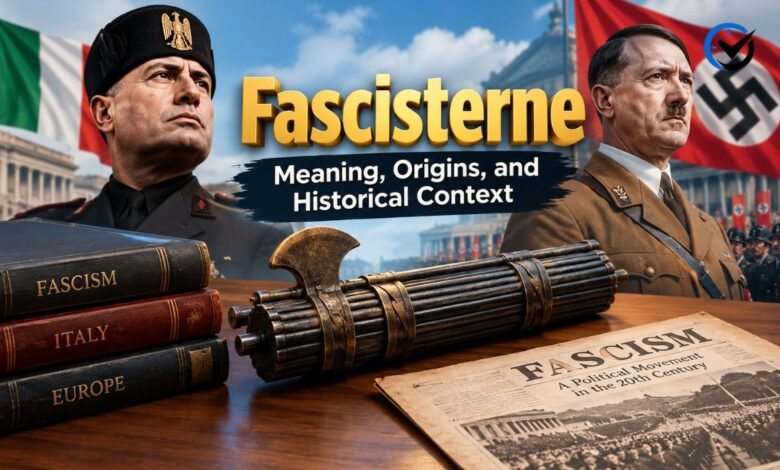
“Fascisterne” is a Danish word that generally means “the fascists.” It is the definite plural form of fascist: it refers to fascists as a group, rather than naming one particular person or organization. In historical writing, the word may describe members of a specific movement, supporters of a fascist government, or people identified with fascist politics. Its exact meaning therefore depends on the language and historical setting in which it appears.
Understanding the term requires looking at both its grammar and its political history. Fascism emerged as a political movement in early 20th-century Europe, especially in Italy after World War I. It was not a single organization that operated everywhere in the same way. Movements in different countries adopted some shared ideas while adapting them to local conditions, leaders, and conflicts. This article explains the word’s meaning, the origins of fascism, its defining features, and the distinctions historians use when discussing it.
What “Fascisterne” Means
In Danish, fascist is fascist, while fascisterne means “the fascists.” The ending makes the noun plural and definite, much like saying “the workers” or “the politicians.” A sentence using the word may refer to a group already known to the speaker or reader. It does not, by itself, tell us which people are meant. Context must identify whether the writer is discussing a historical party, a regime, or fascists more broadly.
The word is related to fascism, the name for a family of political movements and systems that became influential in the period between the two world wars. A person called a fascist might have belonged to a fascist party, held beliefs associated with fascism, or been described that way by an opponent. Those uses are not always equivalent. In careful historical writing, the author should make clear whether the label describes membership, ideology, political behavior, or a later interpretation.
The Roots of Fascism
The name fascism comes from the Italian fascismo, which is linked to fasci, meaning groups or bundles. The term also evokes the ancient Roman fasces: a bundle of rods, sometimes shown with an axe, that symbolized authority and the power of the state. Italian nationalists used the symbol before fascism became a mass movement. Its imagery suggested unity, discipline, and a strong public authority, themes that fascist organizers later emphasized.
Fascism took shape in a Europe unsettled by World War I, political upheaval, economic hardship, and conflict over the future of society. Italy emerged from the war on the victorious side, but many Italians felt that the peace settlement had failed to deliver the territory or influence they believed the country deserved. Inflation, unemployment, strikes, and fear of revolution added to the instability. These conditions did not make fascism inevitable, but they gave its promises of national renewal and order a receptive audience.
Mussolini and the Italian Movement
The movement most closely associated with the word’s early history was led by Benito Mussolini. He founded the Fasci Italiani di Combattimento in 1919. The organization brought together people with varied political backgrounds, including nationalists and veterans. Over time, Mussolini built a more organized movement that attacked socialist groups and sought support from people who feared left-wing revolution. In 1921, the movement became the National Fascist Party.
Fascist squads, often called the Blackshirts because of their uniforms, used intimidation and violence against political opponents, particularly socialists, labor organizers, and local officials. This violence was not separate from the movement’s political strategy. It helped weaken opponents and made the fascists appear to some business owners, landowners, and political leaders as a force capable of restoring order. Their support was uneven, however, and many Italians opposed them or were coerced into silence.
In October 1922, Mussolini and his supporters staged the March on Rome, a demonstration backed by the threat of force. King Victor Emmanuel III appointed Mussolini prime minister, allowing him to enter government through a formal decision by the monarchy. He then consolidated power over several years, suppressing opposition and dismantling democratic institutions. This sequence matters: fascist rule did not begin with a single moment in which Italy instantly became a fully controlled dictatorship. It developed through a combination of political access, violence, legal change, and growing repression.
Ideas and Features Associated with Fascism
Fascist movements commonly promoted an intense form of nationalism and the idea that the nation was in decline and needed to be reborn. They often portrayed the nation as a unified community threatened by internal enemies, foreign powers, or social division. A strong leader was presented as the person who could restore national strength. This promise of renewal helped turn political loyalty into an emotional commitment, especially when movements used rallies, uniforms, symbols, and public ceremonies.
Fascism rejected the idea that political life should be organized mainly around individual rights, open competition, or compromise among parties. Fascist leaders favored a powerful state and a single political movement that claimed to represent the nation as a whole. In practice, this meant restricting opposition, weakening independent institutions, and controlling public debate. The state might preserve some private businesses, but economic activity was expected to serve national goals rather than operate independently of political power.
Fascist movements also opposed socialism and communism, often using the threat of revolution to attract supporters. Their hostility toward the left was not simply a matter of policy disagreement: fascist organizations used violence to attack workers’ groups and political rivals. At the same time, fascism was not identical to traditional conservatism. It sought to mobilize people through mass politics and reshape society around a new national identity, rather than only preserve existing institutions.
Violence, militarism, and political spectacle were important in many fascist movements, though their forms varied. Leaders praised discipline and sacrifice, while public ceremonies made the movement’s strength visible. Military action could be portrayed as a path to national greatness. These themes helped legitimize aggression and repression, but they should not be mistaken for the whole of fascist ideology. The movement also relied on propaganda, administration, legal changes, and support from established institutions.
Fascism Across Europe
Italy was the birthplace of the first fascist regime, but similar movements arose elsewhere. The German Nazi Party shared features with Italian fascism, including dictatorship, extreme nationalism, political violence, mass mobilization, and the destruction of democratic opposition. Nazism, however, placed a particularly central role on racial ideology and antisemitism. Under Adolf Hitler, these ideas led to persecution, aggressive war, and the genocide of six million Jews, along with the mass murder of other targeted groups.
Other countries saw movements that borrowed fascist language or methods without becoming identical to the Italian or German cases. They differed in size, goals, social support, and access to power. Some remained fringe parties; others joined governments or helped undermine democracy. For this reason, a historian assessing whether a movement was fascist will usually examine its own program, actions, leadership, and political setting rather than assume that every nationalist or authoritarian group fits the label.
Fascism and Denmark
The Danish word fascisterne may appear in discussions of Denmark’s own political history. The National Socialist Workers’ Party of Denmark, commonly known by its Danish initials DNSAP, was founded in 1930. It drew inspiration from German Nazism and developed a Danish version of National Socialism. Its presence is relevant to Danish history, but it should not be treated as interchangeable with every person or organization described as fascist.
Germany occupied Denmark in 1940 during World War II. The occupation created a difficult political and social situation, and Danish authorities initially continued to govern under German pressure. DNSAP supported Nazi Germany and sought political influence, but it did not take control of the Danish government. Danish society included varied responses to occupation, including accommodation, resistance, and efforts to protect people targeted by Nazi persecution. A clear account should distinguish these different actors and choices rather than reduce the period to one political label.
How Historians Use the Term
There is no single definition of fascism accepted by every historian. Scholars often compare movements using a set of recurring features, such as ultranationalism, a promise of national rebirth, the rejection of liberal democracy, a powerful leader, and the use or celebration of political violence. The presence of one feature alone is not enough to establish that a movement is fascist. Analysis works best when it considers how the ideas and actions fit together.
The label can also be used loosely in everyday debate as an insult for someone seen as authoritarian or intolerant. That usage may express strong criticism, but it can make historical discussion less precise. A person can support harsh policies or an authoritarian government without belonging to a fascist movement. Calling someone a fascist is more informative when the speaker explains which specific beliefs, organizations, or methods justify the description.
Common Misunderstandings
One common misunderstanding is that fascism was simply another name for dictatorship. Fascist regimes were dictatorships, but not every dictatorship was fascist. Some authoritarian governments focused on maintaining order or protecting existing elites without seeking the same kind of mass mobilization or national transformation. The distinction is not always neat, so scholars may disagree about borderline cases. Their arguments depend on evidence about a movement’s ideology and behavior.
Another mistake is to treat fascism as a uniform international organization with one fixed program. Italian fascists, German Nazis, and movements elsewhere drew on overlapping ideas, but they were not all the same. Local traditions, racial beliefs, religious politics, and national ambitions shaped their goals. Even within one movement, policy and practice could change over time. Recognizing those differences makes comparisons stronger and prevents broad labels from obscuring what happened in each country.
It is also useful to separate the word’s grammatical meaning from its political meaning. Fascisterne translates as “the fascists,” but a translation alone cannot establish who a text refers to or whether its use is accurate. A historian might use it neutrally to identify a political group, while a speaker in a heated argument might use it as an accusation. Reading the surrounding sentence, date, and source helps clarify the intended meaning.
Why the History Still Matters
Studying fascism helps readers understand how democratic systems can weaken. The historical cases show that political institutions can be damaged gradually, including through legal changes, intimidation, attacks on independent organizations, and efforts to discredit opponents. They also show that a movement’s rise depends on more than the charisma of one leader. Decisions by political elites, economic interests, public institutions, and ordinary citizens can all shape what happens.
The history also encourages careful use of political language. Applying a serious historical label should involve more than noticing one striking resemblance or expressing disapproval. It requires looking at a movement’s goals, its view of the nation and the state, its treatment of opposition, and its use of violence. That care does not weaken criticism. It makes the comparison clearer and helps readers tell the difference between a documented historical analysis and a rhetorical claim.
Final Thoughts
Fascisterne is the Danish definite plural meaning “the fascists.” The word may refer to a particular group in a historical source or to fascists more generally, so its meaning depends on context. Its history leads back to the Italian movement that grew after World War I and later influenced movements across Europe. Those movements shared important traits, but they were not identical.
A balanced understanding requires attention to both common patterns and national differences. Fascism involved extreme nationalism, the rejection of political pluralism, and efforts to concentrate power, often supported by violence and propaganda. Examining those features in their historical setting helps explain what the word means and why its careful use matters.
Frequently Asked Questions
1. What does “Fascisterne” mean in English?
It means “the fascists” in Danish. The word is plural and definite, so it usually refers to a group that has already been identified in the conversation or text. It does not name a specific party on its own.
2. Is “Fascisterne” a person’s name?
No. It is a Danish common noun, not the name of an individual. A text may use it to describe members or supporters of a fascist movement, but the surrounding context identifies which group is meant.
3. What is the difference between fascism and a fascist?
Fascism is the political ideology or movement; a fascist is a person associated with it. The term can describe party membership, political beliefs, or actions, so a writer should explain how it is being used in a specific case.
4. Where did fascism begin?
The first fascist movement to take national power began in Italy after World War I. Benito Mussolini founded an early organization in 1919 and later led the National Fascist Party. Political instability and conflict helped the movement gain influence.
5. Was every dictatorship fascist?
No. Fascism is a form of authoritarian politics, but the terms are not interchangeable. Some dictatorships did not promote fascist ideas or seek the same kind of mass political mobilization and national transformation. Historians assess each case using its own evidence.
6. Were Italian fascism and German Nazism identical?
No. They shared authoritarian rule, extreme nationalism, political violence, and the suppression of opposition. Nazism placed a central role on racial ideology and antisemitism, which shaped its policies of persecution and genocide.
7. What was the Danish fascist movement?
The National Socialist Workers’ Party of Denmark, or DNSAP, was a Danish political party founded in 1930. It was modeled in part on German Nazism. It supported Nazi Germany during the occupation, but it did not govern Denmark.
8. Why did fascist movements gain support?
Their support grew in settings marked by political conflict, fear of revolution, economic strain, or national grievance. They promised unity and order, used propaganda, and sometimes received backing from established groups that wanted to defeat left-wing movements. Conditions differed by country.
9. Is “fascist” always used as a neutral historical term?
No. It can be used as a historical description, but it is also used as a political insult. In serious discussion, the writer should identify the beliefs or behavior behind the label and avoid treating it as a substitute for evidence.
10. Why does the word’s Danish form matter?
The Danish form helps readers interpret texts written in Danish and distinguish a general reference to “the fascists” from a specific organization’s name. Translation gives the basic meaning, while historical context reveals which people or movement the source describes.
Recommended: Asiaks Review: What Readers Can Find on the Website





One Comment