

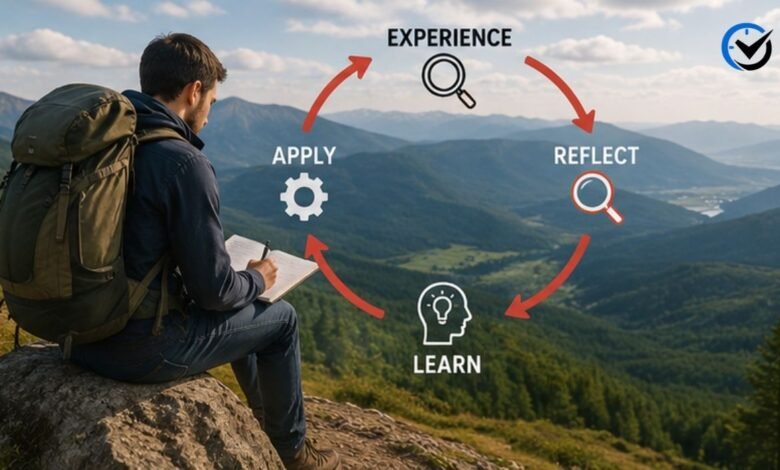
Duaction is generally described as a learning approach that connects knowledge with practical action. Instead of treating study and practice as separate stages, it encourages learners to understand a concept, use it, review the result, and improve. The term is relatively new and does not have one universally accepted academic definition. It is better understood as a developing label for an approach that overlaps with active learning, experiential learning, project work, and reflective practice. Its central idea is simple: knowledge becomes more useful when people can apply it.
What Is Duaction?
At its simplest, Duaction means learning and doing in a connected cycle. A learner studies enough to understand a task and then applies that knowledge instead of waiting until the end of a course. The activity could be a project, simulation, experiment, work assignment, coding exercise, or real-world problem. Afterward, the learner checks what happened and uses the result to guide the next attempt. The focus is therefore not only on remembering information but on turning information into usable ability.
The name is commonly explained as a blend of ideas associated with “dual” and “action,” reflecting the pairing of learning with application. However, there is no single universally accepted founder, official definition, or institution behind the term. Online descriptions vary, so it is more accurate to view Duaction as a practical learning framework than as a replacement for established educational methods. What matters most is the consistent idea of bringing theory and practice closer together.
How the Learning Cycle Works
A useful way to understand the approach is as a repeating cycle: set a goal, learn the needed concept, apply it in a manageable task, observe the result, receive feedback, and adjust. This cycle can happen within one lesson or across a long project. Imagine someone learning web design. Reading about responsive layouts provides a foundation, but building a page reveals problems that reading alone may not expose. Testing the page, fixing the layout, and trying again turns each mistake into useful information.

Why Practice Matters
The gap between knowing and doing is common. A person may remember a definition, pass a quiz, or understand a formula but still struggle with an unfamiliar situation. Practical work reveals whether someone can choose the right information, make decisions, handle mistakes, and adapt. This does not make theory less important. In fields such as medicine, engineering, science, and technology, strong theory is essential. Practical application simply gives learners a way to connect abstract ideas with actual decisions.
Practice can also make learning more relevant. A student studying statistics may understand averages more clearly after using them to examine real data. A new employee learning customer service can gain confidence by handling realistic conversations. A language learner can understand grammar differently after using it in conversation. In each case, the activity gives information a purpose. The learner is not only asking, “What does this mean?” but also, “How do I use it correctly?”
Core Principles
The main principles are active participation, timely application, feedback, reflection, and repetition. Learners need opportunities to create, solve, explain, test, or perform rather than only listen and read. Practice should follow learning at a useful point, feedback should reveal what worked, and reflection should identify lessons from the experience. Repetition then allows skills to become more reliable. Action alone is not enough; practice needs a clear purpose and a way to correct mistakes.
Duaction and Traditional Learning
Traditional instruction and action-based learning do not have to compete. Lectures, textbooks, demonstrations, and structured explanations can provide foundations efficiently, especially when a subject is complex or safety is important. The practical approach adds value by bringing application into the learning process instead of postponing it. A balanced course might explain a concept, demonstrate it, let learners perform a task, and then discuss what happened. This keeps theory and practice connected without treating either as unnecessary.
The approach can also make assessment more realistic. A written test may show whether someone remembers information, while a practical task can show whether that person can use it. Someone studying project management, for example, may know what risk management means but still need practice identifying risks, prioritizing them, communicating concerns, and responding to change. Combining knowledge checks with practical demonstrations provides a broader view of capability and can show exactly where more learning is needed.
Connection With Established Learning Methods
The ideas behind Duaction are not entirely new. Experiential learning uses experience and reflection, active learning emphasizes participation, project-based learning centers on meaningful projects, and work-based learning connects development with workplace activity. Action learning also uses real problems as learning opportunities. Duaction overlaps with these methods while using a newer label to emphasize the relationship between learning and action. A new name does not automatically mean a completely new educational discovery.
Benefits for Students
For students, practical tasks can make abstract lessons easier to understand because concepts gain a visible purpose. Projects may also develop planning, communication, teamwork, problem-solving, and decision-making alongside subject knowledge. However, benefits are not guaranteed. Outcomes depend on task quality, instruction, resources, feedback, and learner experience. A task that is too difficult can overwhelm beginners, while a poorly designed activity can reinforce mistakes. Strong learning design provides explanation, support, practice, and reflection at appropriate stages.

Benefits in the Workplace
The same principle can support professional development. Employees may attend training and then return to work unsure how to apply what they learned. A practical program can bring realistic tasks closer to the training itself. A salesperson might practice a difficult customer conversation, a manager might work through a staffing scenario, or a technology employee might solve a small problem using a newly learned tool. These activities can reveal gaps that a lecture or multiple-choice test may miss and connect training more closely with job performance.
Everyday Examples
The method can also be used in everyday learning. Someone learning photography can study exposure and then take photographs designed to test those settings. A person learning cooking can study a technique and prepare a dish while observing timing and texture. A language learner can study a grammar pattern and use it in conversation. Someone developing budgeting skills can learn a financial concept and immediately create a simple monthly plan. These examples show how practical activity can turn information into something observable and adjustable.
Technology and Practical Learning
Technology can support this style of learning, although it is not required. Online courses can place exercises after lessons, simulations can provide controlled practice, collaboration platforms can support projects, and digital portfolios can show progress over time. Some tools can also provide immediate feedback. The best technology is the one that serves the learning goal. A complicated platform is not automatically better, and a simple notebook, conversation, project, or supervised task may sometimes provide a clearer experience.
Challenges and Limitations
There are practical limitations. Teachers and trainers need time to design suitable tasks and provide feedback. Some subjects require equipment, specialist supervision, safe environments, or realistic data. Hands-on work can also take longer than delivering information through a lecture. Another risk is asking learners to act before they have enough background knowledge. Beginners can become frustrated when a task is too difficult, so good instruction provides a foundation first and gradually increases independence as confidence and skill develop.
How to Use the Approach
A sensible way to use the approach is to choose one clear learning outcome and connect it to a small task. Learn the essential concept, apply it soon afterward, review the result, and identify one improvement for the next attempt. Keep the task realistic but manageable, then increase its difficulty as skills develop. Feedback should be specific rather than simply positive or negative. Reflection can ask what was expected, what actually happened, why the difference occurred, and what should change next time.

Is Duaction a Formal Theory?
Current online descriptions present Duaction as an emerging learning concept rather than a universally standardized educational theory. There is no single definition used across all educational systems, and claims about a specific founder or guaranteed performance improvements should be treated cautiously unless strong evidence supports them. The safest description is that it is a developing term for connecting education with practical action. Its underlying practices have broader roots in established approaches to learning.
Who Can Benefit?
Students, professionals, teachers, trainers, career changers, hobbyists, and independent learners can adapt the basic idea. It is especially useful for skills where performance can be observed and improved, but it is not necessary for every learning goal. Some subjects require substantial reading, memorization, explanation, or careful study before practice is appropriate. The most sensible approach is flexible: use direct instruction for foundations, practical tasks for application, discussion for clarification, and reflection for turning experience into understanding.
Connecting Theory and Practice
The strongest use of Duaction is therefore not a rigid formula but a connection between different parts of learning. A learner should not have to choose permanently between theory and practice. Knowledge explains what to do and why it matters; action tests whether that knowledge can be used; feedback exposes gaps; and reflection helps turn experience into better judgment. This balanced cycle can make learning more purposeful while keeping expectations realistic.
Final Thoughts
Duaction can be understood as a straightforward idea with a modern name: learn something, use it, examine the result, and improve. Its value lies less in the label than in the connection between knowledge and real performance. Because the term is still developing and is not universally standardized, exaggerated claims about its history or effectiveness should be avoided. Used thoughtfully, a learn-and-apply cycle can make education more practical, reveal gaps in understanding, and encourage steady skill development.
Frequently Asked Questions
1. What is Duaction in simple terms?
Duaction connects studying with practical action. A learner gains knowledge, applies it to a task, reviews the outcome, and uses that experience to improve. The activity can vary by subject, but the goal is to make knowledge usable rather than leaving it only as information.
2. Is Duaction the same as learning by doing?
They are closely related, but effective Duaction includes more than activity. It combines preparation, application, feedback, and reflection. Repeating a task without checking mistakes may not produce improvement, so purposeful practice is important.
3. Is Duaction a recognized academic theory?
It is better described as an emerging learning concept than as a universally standardized academic theory. Its ideas overlap with established approaches such as experiential learning, active learning, project-based learning, and action learning.
4. Can Duaction be used for self-study?
Yes. A self-learner can choose a goal, study what is needed for the next task, practice it, review the result, and repeat the process. This can work for writing, programming, languages, design, cooking, and many other practical skills.
5. Does Duaction replace traditional education?
No. It can complement traditional instruction. Books, lectures, demonstrations, and explanations remain important for building foundations. Practical tasks add another layer by helping learners use and test what they have learned.
6. What are some examples of Duaction?
Examples include building a small program after learning a coding concept, creating a design after studying a design principle, practicing a customer conversation after communication training, or conducting a supervised experiment after studying relevant science.
7. Why is feedback important?
Feedback shows learners what worked, what did not, and what needs to change. It can come from a teacher, mentor, colleague, software tool, or careful self-review. Without feedback, practice can sometimes reinforce mistakes.
8. Can it work in the workplace?
Yes. Workplace training can include realistic tasks, role-play, simulations, guided assignments, and supervised use of new tools. These activities help employees connect training with actual job responsibilities.
9. What are the main limitations?
The approach can require more planning, time, resources, and supervision than simple information delivery. Some subjects also need substantial theory before practical work is safe or useful. Poorly designed activities may overwhelm beginners.
10. How can someone start today?
Choose one clear goal and one small practical task. Learn the essential information, apply it soon afterward, check the result, and decide what to improve next time. Repeating the cycle with gradually harder tasks can turn passive study into active skill development.
Recommended: Tasyyblack Explained: Exploring Its Meaning, Origins, Fashion, Branding, and Digital Culture





One Comment