

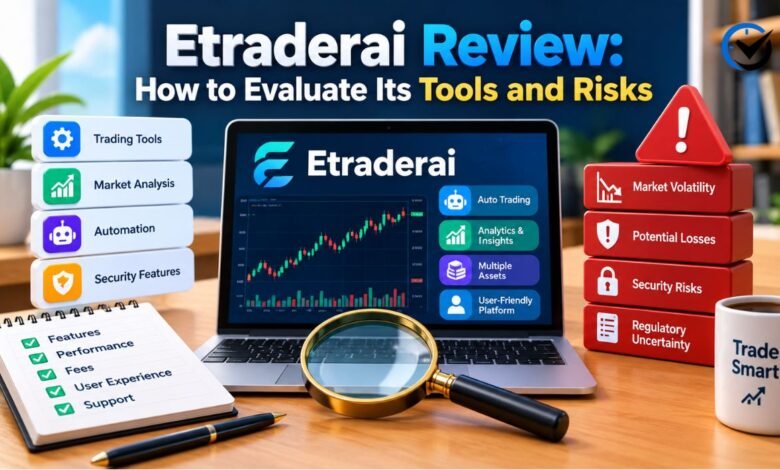
Etraderai is a name that may catch the attention of people looking for artificial intelligence tools for investing or trading. The appeal is easy to understand: software that studies markets, finds patterns, or supports research could save time. But a name and a polished website do not tell you what a service actually does, who operates it, or whether it handles trades. Those details matter before you share personal information or consider using money with any online trading service.
This review takes a cautious, practical approach. Public descriptions associated with the name do not point clearly to one consistent product, and marketing language can make educational material sound like a working trading system. So the useful question is not whether an AI tool sounds advanced. It is whether you can verify its function, costs, operator, security, and performance independently. Readers should treat claims as claims until evidence supports them.
What Etraderai Appears to Be
Descriptions using the Etraderai name vary. One site calling itself ETrader AI GPT says it provides educational information and connects users with independent third-party providers. It describes topics such as stocks, commodities, and foreign exchange, while stating that transactions and personalized advice are outside its scope. Other web pages using similar names describe AI trading, alerts, or automated systems. These descriptions should not be assumed to refer to the same company or service.
That distinction changes how a reader should evaluate the offering. An educational resource may explain market concepts or refer users to outside providers; a trading platform may let users place orders; a broker holds or routes assets; and an automated bot may send instructions to a broker. These roles involve different risks and responsibilities. Before signing up, identify which one you are dealing with and which legal entity provides each part of the service.
What the Name Does Not Prove
The words “AI,” “GPT,” or “automated” do not establish that a tool uses a particular model, predicts prices accurately, or trades profitably. A company can use these terms in marketing without explaining its software in enough detail for an outsider to test. A credible explanation should describe what data the system uses, what output it produces, and whether a human must approve any action.
The name also should not be confused with a similarly named broker or financial company. Lookalike names can lead people to assume a connection that does not exist. Check the exact web address, company name, and legal disclosures, then compare them with the official records of any broker or regulator named on the site. Do not rely on logos, search snippets, social posts, or a sales representative’s assurance as proof of affiliation.
How to Assess the Tools
Market analysis and alerts
If Etraderai or a third-party provider offers market analysis, ask what an alert actually means. Does it report a price movement, identify a technical pattern, estimate a probability, or suggest a trade? Each output has a different purpose. A chart annotation is not a forecast, and a forecast is not evidence that following it would produce a profit after costs and losses.
A useful tool should make its limits visible. Look for timestamps, the asset and market covered, the assumptions behind a signal, and examples of alerts that did not work. Ask whether results include losing trades, cancelled signals, and periods when the tool was unavailable. Screenshots of successful calls are easy to select after the fact; a complete, time-stamped record is much harder to misrepresent.
Automated execution
A service that claims to place trades automatically needs especially careful review. Find out whether it sends orders directly, connects to a separate broker, or merely explains automation in educational materials. If an outside broker is involved, verify that broker independently and understand where deposits are held, who can withdraw them, and what happens if the connection fails.
Automation can act quickly, but speed does not guarantee sound decisions. A program may repeat an error many times, respond poorly to sudden news, or place orders under conditions the user did not expect. Ask whether you can pause the system, set order limits, review open positions, and revoke access without contacting a salesperson. Never grant account permissions broader than the tool needs.
Supported markets and settings
A site may mention stocks, commodities, forex, or digital assets, but that does not necessarily mean the same tool supports each market or can trade them. Ask for the exact instruments, exchanges, trading hours, and account types available through the named provider. Also check whether a claimed feature is live, in testing, or only part of a course or demonstration.
Settings deserve equal attention. A platform should explain position size, leverage, stop orders, fees, and how an order is executed. Leverage can magnify both gains and losses, and a stop order may not fill at the price a user expects in a fast market. If the service cannot explain these terms clearly, it is difficult to judge whether its controls fit your needs.
Costs, Accounts, and Customer Support
Before registering, look for a complete explanation of charges. Costs may come from a subscription, a third-party course, a broker, transaction spreads, commissions, withdrawal fees, or currency conversion. A free registration page does not establish that the full service is free. Request the total cost in writing and check whether charges recur, whether a minimum deposit is required, and how to cancel.
Read the account and withdrawal terms before providing payment details. Confirm which company receives the funds, whether you are paying for education or depositing money for trading, and what documents are required to withdraw. If someone urges you to deposit immediately, promises a personal account manager will secure profits, or discourages you from contacting the named provider directly, pause and verify the situation through an independent channel.
Customer support can reveal how clearly a service operates. Test whether the company provides a working contact method, identifies the entity responding, and answers specific questions about fees, data, and withdrawals. Generic replies do not establish misconduct, but they also do not resolve important uncertainties. Keep copies of terms, account statements, and support messages if you proceed with any financial service.
Evidence, Regulation, and Performance
Check the company and regulatory status
A trading tool and a broker are not necessarily regulated in the same way. The relevant rules depend on the service, the product, and the country where the customer lives. Search the regulator’s own register for the exact legal entity and permissions it claims. A registration number should match the company name and permitted activities; a number displayed on a website is not enough by itself.
Also look for the company’s legal name, registered location, management, and privacy contact. If the site routes users to another provider, check that provider separately. A service may be educational while the linked company offers financial products, and the distinction affects who is responsible for deposits, advice, or trade execution. If you cannot determine who is accountable, treat that as a material information gap.
Evaluate performance claims
Claims about win rates, accuracy, or returns need definitions and evidence. Ask what period was measured, which assets were included, whether results were live or simulated, and whether fees and slippage were counted. A high percentage of winning trades can still lose money if the losing trades are much larger than the winning ones. A short sample may also reflect luck or favorable market conditions rather than a durable advantage.
A stronger record is independently audited, time-stamped, and complete. It should show the strategy’s losses, drawdowns, and periods of underperformance, not only selected profitable examples. Backtests can help test an idea, but they may overstate results when a strategy is tuned repeatedly to historical data. Past performance, simulated or live, cannot guarantee future outcomes.
Main Risks to Consider
The first risk is financial loss. Markets can move against a strategy, and automated tools cannot remove volatility, gaps, liquidity problems, or poor timing. If borrowing or leverage is involved, losses can build faster than a beginner expects. Only consider money you can afford to lose, and do not treat a demo result or a promotional claim as a reason to commit savings.
The second risk is operational and personal-data exposure. A platform may ask for identity documents, contact information, payment details, or access to another account. Review its privacy policy to understand what is collected, why it is shared, and how to close the account. Use a unique password and multi-factor authentication where available. Do not share banking codes, remote-access permissions, or wallet recovery phrases with a representative.
There is also a risk of misunderstanding what you are buying. If a site describes itself as educational but a caller presents it as a profit-generating robot, those messages do not match. Save the page and terms you reviewed, and ask the company to clarify the service in writing before proceeding. A clear explanation should identify the provider, the deliverable, and the limits of what it does.
Who Might Find It Useful
Someone researching AI in finance may find educational material useful if it explains algorithms, market structure, and risk in plain language. That value does not depend on the site placing trades. A learner can use introductory content to develop better questions, then compare it with independent educational sources and regulator guidance before making financial decisions.
A person seeking hands-off investing should be more careful. An AI label does not make a service suitable for a person’s goals, time horizon, or ability to absorb losses. If you are looking for financial advice or portfolio management, check the qualifications and regulatory status of the individual or firm offering it in your country. A general information site is not a substitute for individualized advice.
A Careful Way to Proceed
Start by identifying the exact service and operator. Read the terms, privacy policy, and fee schedule; verify any linked broker; and check whether the tool provides education, alerts, or actual order execution. Ask for written answers about data, withdrawals, and performance. If you cannot verify a basic claim through independent records, do not treat it as established.
If you decide to explore the service, avoid sharing more information or money than the stated purpose requires. Use a demo only as a way to learn the interface, not as proof that a strategy will work with real funds. Set strict limits, keep records, and know how to stop the service and remove account permissions. Stop if the product changes during onboarding or the provider pressures you to make a quick deposit.
Final Thoughts
Etraderai is difficult to review as a single, clearly defined trading product because the name appears alongside different kinds of online descriptions. The site identified as ETrader AI GPT describes itself as an educational and marketing resource that connects users with outside providers, while other similarly named pages make different claims. That makes it essential to verify the exact service before judging its tools or risks.
The most useful review is therefore one based on evidence rather than promises. Confirm who operates the service, what it actually provides, how it earns money, and whether any performance data can be independently checked. If those answers are incomplete, treat that uncertainty as part of the risk assessment. No automated system can make market outcomes certain, and careful research remains necessary even when software is involved.
Frequently Asked Questions
1. What is Etraderai?
Etraderai is a name associated online with different kinds of financial and AI-related services. Some descriptions present educational material or links to outside providers, while others use trading and automation language. Check the exact website and legal entity before assuming what a particular service offers.
2. Is Etraderai an automated trading bot?
That depends on the specific service using the name. A website may discuss automated trading without offering a bot that places orders. Confirm whether it executes trades, sends alerts, provides education, or refers users elsewhere before opening an account.
3. Is Etraderai connected to E*TRADE?
A similar name does not prove a business connection. Verify any claimed relationship through the companies’ official disclosures and the relevant regulator’s records. Do not assume that branding or a search result establishes an affiliation.
4. Does Etraderai guarantee profits?
Treat any claim of guaranteed returns or near-certain profits with skepticism. Trading involves risk, and market conditions can change quickly. Ask for independently verified, complete performance records, including losses and fees, instead of relying on promotional examples.
5. What markets does Etraderai cover?
Online descriptions associated with similar names mention areas such as stocks, commodities, forex, and digital assets. That does not prove that one specific service supports all of them. Check the provider’s current terms and identify which markets, if any, are actually available.
6. How can I check who operates the service?
Look for the full legal company name, business location, contact details, and any claimed regulatory permissions. Confirm those details using official company and regulator records. If the site directs you to another provider, investigate that provider separately.
7. What fees should I check before registering?
Review subscription charges, course fees, broker commissions, spreads, withdrawal costs, currency conversion, and any required deposit. Ask whether charges recur and how to cancel. Make sure you know which company receives each payment.
8. Is a demo account proof that the tool works?
No. A demo can help you learn an interface, but simulated orders may not reflect real execution, slippage, fees, or emotional pressure. Demo results do not establish that the same strategy will perform well with real money.
9. What information should I avoid sharing?
Do not share passwords, one-time banking codes, remote-access permissions, or wallet recovery phrases with a representative. Before submitting identity or payment details, read the privacy policy and confirm which company collects and stores the information.
10. What should I do if I cannot verify a claim?
Pause before registering, paying, or depositing funds. Ask the provider for written details and check them against independent records. If the company, fees, trading function, or withdrawal process remains unclear, do not rely on the claim as a basis for a financial decision.
Recommended: Tracqueur Explained: Tracking Technology, Common Applications, and Privacy Considerations





One Comment