
New England Patriots vs Chicago Bears Match Player Stats: Offensive Leaders and Defensive

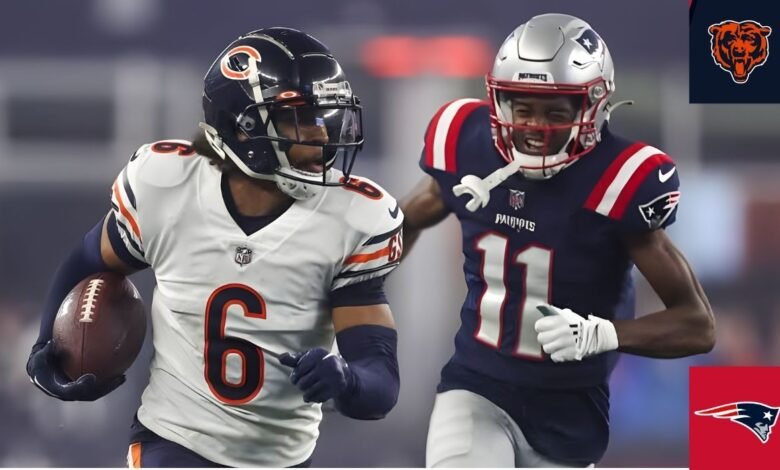
The New England Patriots vs Chicago Bears Match Player Stats from November 10, 2024, tell the story of a game decided largely by defensive pressure. New England won 19–3 at Soldier Field, but the result involved more than a comparison between rookie quarterbacks Drake Maye and Caleb Williams. Rushing support, receiving efficiency, field goals, and stalled possessions all shaped the afternoon. This review covers that specific Week 10 meeting, keeping its numbers separate from other games between these teams. It explains each player’s contribution and the match conditions behind the numbers.
Final Score and the Decisive First-Half Stretch
The game remained close until New England scored ten points in the final 1:46 of the second quarter. Maye found Ja’Lynn Polk for a two-yard touchdown, and Joey Slye later added a 37-yard field goal as the half ended. That sequence changed a 3–3 tie into a 13–3 Patriots lead. New England finished with 328 total yards to Chicago’s 142 and held the ball for 32:28, compared with the Bears’ 27:32. Neither team scored during the third quarter, while two more Slye field goals completed the scoring in the fourth. The late first-half stretch mattered because it forced an already struggling Bears offense to chase a larger deficit after the break.
Drake Maye’s Passing Performance
Maye completed 15 of 25 passes for 184 yards, one touchdown, and one interception. His completion rate was 60%, and he averaged 7.36 yards per attempt. Those figures show a more productive passing afternoon than Williams had, although Maye’s performance included mistakes and missed opportunities. He also supplied 24 rushing yards on four attempts, including a 19-yard gain. Chicago recorded one sack against him, with no yardage lost on that play. The fairest assessment is that Maye contributed enough to complement the defense, while still leaving room for improvement in his decisions and execution.
Caleb Williams and Chicago’s Protection Problems
Williams finished 16 of 30 for 120 passing yards, with no touchdown passes or interceptions. He completed 53.3% of his attempts and averaged four yards per throw. More damaging were the nine sacks that cost Chicago 51 yards. Protection was a major issue: starting tackles Braxton Jones and Darnell Wright were unavailable, and guard Teven Jenkins left with an ankle injury. Those absences provide necessary context, but they do not explain every failed play. His 15 rushing yards offered limited relief because New England repeatedly stopped possessions before they developed into sustained scoring threats.
Rushing Leaders and Offensive Balance
Rhamondre Stevenson led all rushers with 74 yards on 20 carries, averaging 3.7 yards per attempt. Antonio Gibson added 26 yards on five carries, while JaMycal Hasty contributed 20 on six. With Maye’s rushing included, New England gained 144 yards on 35 attempts. D’Andre Swift led Chicago with 59 yards on 16 carries, also averaging approximately 3.7 yards. Their similar averages make workload and supporting contributions important to the comparison. New England received contributions from more ball carriers and maintained enough offensive continuity to keep using the run. Chicago finished with 73 rushing yards and fewer opportunities to establish balance.
Receiving Leaders on Both Teams
Austin Hooper led the game with 64 receiving yards on three catches, averaging 21.3 yards per reception. DeMario Douglas caught four passes for 50 yards, and Kayshon Boutte added four for 47. Hunter Henry contributed one reception for 14 yards, while Polk scored on his only catch. Chicago’s most productive receiver was Keenan Allen, who caught five passes for 44 yards. DJ Moore finished with three catches for 24 yards, Rome Odunze had three for 23, and Cole Kmet caught two for 13. The difference was especially clear in the value of completed passes. Hooper created substantial gains despite fewer catches than Allen.
The Players Behind New England’s Nine Sacks
Deatrich Wise Jr. and Anfernee Jennings led the Patriots with two sacks each. Keion White, Jahlani Tavai, Jeremiah Pharms Jr., Brenden Schooler, and Dell Pettus each received credit for one, bringing the total to nine. Tavai also led the team with eight combined tackles, while Pharms supplied three tackles for loss. Sacks directly removed yardage and often increased the distance Chicago needed for a first down. However, the run stops mattered too: preventing easy gains on early downs helped create situations in which the pass rush could attack. The defensive performance depended on both kinds of disruption working together.
Coverage and the Plan to Contain Williams
New England paired its pressure with coverage that limited Williams’ options and made escaping the pocket difficult. One notable adjustment involved Schooler tracking the quarterback rather than simply covering a receiver. This role, commonly called a quarterback spy, gave the defense an extra answer when Williams tried to extend plays with his legs. Christian Gonzalez and the other defensive backs also contributed to a passing attack that produced no completion longer than 18 yards. The tactical explanation is that coverage and pursuit reinforced each other: fewer available throws gave rushers time, while controlled escape routes reduced improvisation.
Chicago’s Defensive Contributions
Chicago’s defense had useful individual moments despite the loss. T.J. Edwards intercepted Maye and was heavily involved in tackling, creating an early opportunity for the Bears offense near midfield. Jacob Martin recorded Chicago’s only sack. The Bears also kept New England to one touchdown, which prevented the score from growing through repeated trips to the end zone. However, conceding enough yardage for four field goals still carried a cost. A takeaway can improve a team’s position, but its value depends partly on the following possession. Chicago failed to turn its interception into points, leaving a promising defensive play without a scoring reward.
Third Downs and Red-Zone Efficiency
Chicago converted just one of 14 third-down attempts, a success rate of 7.1%. New England converted five of 14, or 35.7%. That difference gave New England more chances to advance. New England also reached the red zone five times and scored a touchdown on only one visit, a 20% touchdown rate. Chicago’s lone red-zone visit produced no touchdown. These figures help explain why a game with a clear yardage advantage still contained only one touchdown. The Patriots were better at sustaining possessions, yet frequently had to accept field goals when they approached the Chicago goal line.
Field Goals, Punt Returns, and Field Position
Slye made all four field-goal attempts, connecting from 30, 37, 25, and 33 yards. He also converted the extra point after Polk’s touchdown, accounting for 13 of New England’s 19 points. Cairo Santos supplied Chicago’s only score with a 33-yard field goal. Marcus Jones returned three punts for 45 yards, including a 24-yard return that helped set up New England’s final possession before halftime. Bryce Baringer averaged 57 yards across five punts, with a net average of 41.4. DeAndre Carter’s 38-yard punt return gave Chicago an early opening. The contrast was in how effectively each offense used the position its returner provided.
Final Thoughts
This matchup was primarily a defensive win supported by enough offense and reliable kicking. Maye supplied timely passing, Stevenson handled the largest rushing workload, and Hooper produced the most receiving yards. Chicago’s offensive problems were broader than one quarterback’s stat line, especially given the protection changes and limited gains after completions. At the same time, the Patriots’ poor red-zone touchdown rate prevents an overly glowing assessment of their offense. The strongest reading of the game credits New England’s coordinated defensive effort while recognizing the weaknesses that remained on both sides.
Frequently Asked Questions
1. When and where was this Patriots–Bears game played?
The game took place on November 10, 2024, at Soldier Field in Chicago during Week 10 of the NFL regular season. New England won 19–3. Identifying the date matters because these teams have met in different seasons with different quarterbacks and rosters. The performances discussed here belong to this particular meeting and should not be combined with figures from earlier games.
2. Which player gained the most yards from scrimmage?
Stevenson led with 77 yards from scrimmage: 74 rushing yards and three receiving yards. This measure combines a player’s rushing and receiving production. It differs from passing yards, which belong to a separate category. Using the distinction avoids treating a running back’s combined offensive gains as directly equivalent to the distance gained through a quarterback’s completed throws.
3. What do the quarterbacks’ passer ratings tell us?
Maye recorded a passer rating of 79.4, while Williams finished at 63.2. Traditional NFL passer rating combines completion percentage, yards per attempt, touchdown rate, and interception rate. It does not directly include rushing production or sack losses. These ratings therefore help describe passing efficiency, but they cannot fully represent the protection problems or the value of a quarterback extending a possession with a run.
4. Why did Chicago have only 69 net passing yards?
Williams gained 120 yards through completed passes, but Chicago lost 51 yards on sacks. Subtracting those losses produces 69 net passing yards. NFL team statistics deduct sack yardage from passing production, rather than from the quarterback’s rushing total. This distinction explains why an individual passing figure can look noticeably better than the team’s overall progress through its passing game.
5. Why did avoiding interceptions not help Williams more?
Keeping possession is valuable, but an offense also needs to gain enough ground to continue drives. Williams threw no interceptions, yet sacks and unsuccessful passing plays repeatedly put Chicago in difficult situations. A punt ends an offensive opportunity without appearing as a turnover in the usual turnover totals. The absence of interceptions therefore did not mean the Bears were moving the ball efficiently or threatening to score.
6. How important was Polk’s two-yard touchdown catch?
Polk’s reception supplied the only touchdown of the game, giving it far greater scoring value than its yardage suggests. It completed New England’s 70-yard drive and broke the 3–3 tie. Receiving totals measure distance gained, but they do not fully capture the importance of finishing a possession. A short scoring catch can therefore matter more to the result than a much longer reception elsewhere on the field.
7. Why are tackles and sacks assessed differently?
A tackle records bringing down or helping stop the ball carrier, while a sack usually records stopping the quarterback behind the line on a passing play. Large tackle totals may show involvement, but they do not automatically establish an excellent defensive performance. The location and timing of a tackle matter. Stops before the required first-down distance are more useful than tackles made after an offense has already gained what it needed.
8. What does a quarterback spy actually do?
A quarterback spy watches the passer and reacts when he attempts to leave the pocket. The purpose is to limit scrambling lanes while other defenders handle coverage and pressure. This assignment can require speed, patience, and controlled tackling rather than an immediate rush. Schooler’s use against Williams illustrated how a player known mainly for special teams can fill a specific defensive role suited to the opponent.
9. Did New England win the turnover battle?
No. New England threw one interception, while Chicago had no interceptions or lost fumbles. The Patriots therefore finished behind in the conventional turnover comparison. Chicago also surrendered possession twice after failing on fourth down, but those plays are not included in the usual turnover differential. The distinction matters when reading a box score: possession changes can hurt an offense even when its turnover total remains zero.
10. Can these statistics predict the next meeting?
They provide useful background, but they cannot reliably predict another result on their own. Injuries, coaching decisions, personnel changes, and player development can alter the matchup substantially. Nine sacks in one game do not establish an expected total for a rematch. A sound comparison would examine the players available and each team’s more recent performances, using this game as historical context rather than a fixed forecast.
Recommended: Seahawks vs Atlanta Falcons Match Player Stats: 37–9 Result and Full Breakdown




One Comment