

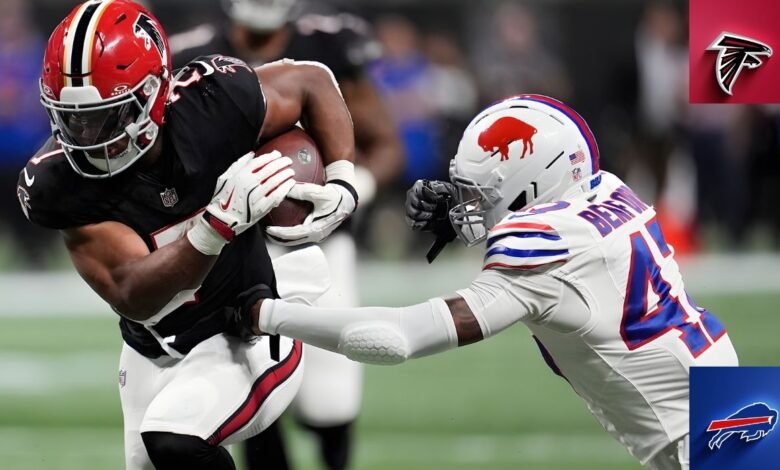
Atlanta beat Buffalo 24–14 on October 13, 2025, at Mercedes-Benz Stadium in a Week 6 Monday night game. The score captures the result, but the player numbers explain how the Falcons earned it. Bijan Robinson supplied the biggest running play, Drake London carried the receiving attack, and Michael Penix Jr. helped Atlanta avoid costly turnovers. Buffalo produced two touchdown drives but struggled to build on them. This Buffalo Bills vs Atlanta Falcons Match Player Stats breakdown examines those performances, the defensive stops, and the late possession that settled a game still within Buffalo’s reach during the fourth quarter.
How Atlanta Built Its First-Half Lead
Tyler Allgeier opened the scoring with a 21-yard touchdown run, finishing Atlanta’s first possession. Buffalo answered through Dawson Knox, who caught a 19-yard touchdown pass from Josh Allen to make it 7–7. The Falcons then moved ahead on Penix’s nine-yard scoring pass to London with 26 seconds remaining in the opening quarter. Robinson’s 81-yard touchdown run in the second quarter widened the lead to 21–7. Atlanta therefore reached halftime with three touchdowns produced by three different players. Its early scoring combined sustained drives with one explosive run, giving Buffalo several problems to solve rather than a single threat to contain.
Bijan Robinson’s Running and Receiving Impact
Robinson finished with 170 rushing yards on 19 carries, averaging 8.9 yards per attempt, and added six catches for 68 yards. That gave him 238 yards from scrimmage across 25 touches. His long touchdown accounted for almost half his rushing total, but his contribution extended well beyond that highlight. Removing the 81-yard run still leaves 89 yards on his other 18 carries, about 4.9 per attempt. His receiving production gave Atlanta another way to advance the ball through completions as well as carries. The combination matters: Buffalo had to account for Robinson both behind the line of scrimmage and as a passing option.
Drake London Made Atlanta’s Passing Game Work
London caught 10 of his 16 targets for 158 yards and a touchdown, averaging 15.8 yards per reception. He supplied 63.2% of Atlanta’s passing yardage, showing how much of the aerial attack flowed through him. His longest catch gained 39 yards, while his touchdown reception gave the Falcons a lead they never surrendered. Kyle Pitts added three catches for 18 yards, and Allgeier caught one pass for six yards. Those smaller contributions highlight London’s importance without suggesting that every target succeeded. Atlanta repeatedly returned to its leading receiver, and his catches delivered both field position and points against Buffalo’s coverage.
Michael Penix Jr. Kept the Offense Moving
Penix completed 20 of 32 passes for 250 yards, one touchdown, and no interceptions. His completion rate was 62.5%, and his passer rating was 97.1. He was sacked twice for a combined loss of 17 yards, so Atlanta’s passing game was productive without being completely protected from pressure. The clearest advantage was ball security. Penix did not give Buffalo an interception that could shorten the field or reverse momentum. He also found Robinson for a crucial 23-yard gain during Atlanta’s final scoring drive. That completion mattered more to the outcome than simply adding another respectable number to his passing total.
Josh Allen’s Touchdowns Could Not Offset the Mistakes
Allen completed 15 of 26 passes for 180 yards, with two touchdowns and two interceptions. His 57.7% completion rate and 72.6 passer rating were both below Penix’s figures. He added 42 rushing yards on six carries, including a 24-yard run, but was sacked four times for 23 lost yards. His touchdown throws showed that Buffalo could finish drives when its offense found rhythm. The wider possession record was less encouraging: outside the two touchdown drives, Buffalo had six punts, two interceptions, and a turnover on downs. Evaluating Allen’s night therefore requires looking at stalled possessions alongside the successful throws that kept Buffalo competitive.
James Cook Gained Ground Without a Breakaway
James Cook carried 17 times for 87 yards, averaging 5.1 yards per rush. His longest gain was 14 yards, and he did not score. That was useful production, particularly when Buffalo needed manageable situations for its passing game. However, Cook did not deliver the large scoring run that transformed Robinson’s night. With Allen’s rushing yards and Ty Johnson’s five-yard carry included, Buffalo finished with 134 yards on 24 attempts. A team average of 5.6 yards per rush shows that the Bills’ ground game had value. Their larger problem was turning that movement into complete possessions that regularly threatened Atlanta’s end zone.
Buffalo’s Receivers Had an Uneven Night
Joshua Palmer led Buffalo with 60 receiving yards on two catches, including a 45-yard gain. Khalil Shakir caught three passes for 33 yards, Tyrell Shavers added three for 27, and Keon Coleman had three for 11. Coleman’s six targets underline the difference between involvement and yardage: frequent opportunities did not produce substantial gains. Ray Davis caught two passes for 19 yards, including Buffalo’s second touchdown, while Knox’s single reception produced the opening score. Johnson added one catch for 11 yards. Palmer left with an ankle injury after his second catch, reducing Buffalo’s options with Dalton Kincaid and Curtis Samuel already inactive.
Atlanta’s Defense Pressured Allen and Took the Ball Away
Dee Alford recorded six combined tackles, one sack, an interception, and three passes defended. His interception came shortly before halftime, while DeAngelo Malone’s late interception ended Buffalo’s final possession. Atlanta also received sacks from David Onyemata, Sam Roberts, and Ruke Orhorhoro. The defensive approach helps explain those results: the Falcons sent extra pass rushers on 55.9% of Allen’s dropbacks. Extra rushers can leave coverage vulnerable, but Atlanta limited Buffalo’s passing output while repeatedly disrupting the quarterback. Mike Hughes also made six combined tackles. The defensive contribution involved coverage, pressure, and timely takeaways, with different players supplying each part of that effort.
Buffalo’s Defense and Special Teams Created Chances
Shaq Thompson led Buffalo with 10 combined tackles, while Taylor Rapp made seven. Ed Oliver and Javon Solomon each recorded a sack, giving the Bills two sacks for 17 lost yards. Those efforts did not prevent Atlanta’s major gains, but Buffalo’s defense kept the Falcons from scoring another touchdown after halftime. Greg Rousseau then blocked Parker Romo’s 37-yard field-goal attempt early in the fourth quarter, preserving the 21–14 score. Punter Mitch Wishnowsky placed four of his six punts inside Atlanta’s 20-yard line. Buffalo received opportunities through stops and field position; its offense could not turn them into the tying score.
Third Downs and the Closing Drive Separated the Teams
Atlanta converted five of 12 third downs, or 41.7%, compared with Buffalo’s two of nine, or 22.2%. The Falcons also led 22–17 in first downs and 443–291 in total net yards. Those advantages became especially important on the final scoring possession. Starting with 6:43 remaining, Atlanta used 14 plays to cover 68 yards and consume five minutes. Romo’s 33-yard field goal with 1:43 left made the score 24–14. Buffalo now needed two scores, a much harder task with so little time available. The drive showed how a few successful plays can change both the scoreboard and an opponent’s remaining chances.
Final Thoughts
Atlanta’s 24–14 victory came from several advantages working together. Robinson generated explosive offense, London gave Penix a productive primary receiver, and the defense disrupted Buffalo while securing two interceptions. The Bills had useful rushing gains, two well-executed touchdown drives, and a blocked field goal that kept the game close. They lacked the sustained offensive response needed after those openings. The player statistics make the outcome understandable when read alongside the scoring sequence and possession record. Atlanta built an early lead, survived Buffalo’s second-half push, and finally used a long drive to put the result beyond one-score reach.
Frequently Asked Questions (FAQs)
1. When and where was the Bills vs Falcons game played?
The game took place on Monday, October 13, 2025, at Mercedes-Benz Stadium in Atlanta, Georgia. It was a Week 6 regular-season matchup, with Atlanta playing at home. The victory moved the Falcons to 3–2, while Buffalo fell to 4–2. Identifying the date matters because games between the same teams in different seasons have different players, statistics, and outcomes.
2. Does Robinson’s 238-yard total mean he rushed for 238 yards?
No. Robinson’s 238 yards were yards from scrimmage, combining 170 rushing yards with 68 receiving yards. Rushing measures gains when a player carries the ball, while receiving measures gains credited after completed passes. Combining them describes his contribution through both roles. Kickoff and punt returns are excluded from scrimmage yards, so this figure should not be confused with all-purpose yardage.
3. Why do passing and rushing yards add up to more than total offense?
Team total offense uses net passing yards, which subtract yards lost on sacks. Buffalo had 180 passing yards and 134 rushing yards, but its sacks cost 23 yards, leaving 291 total net yards. Atlanta had 250 passing yards and 210 rushing yards, then lost 17 yards on sacks, producing 443. Adding the individual quarterback’s passing yards directly to rushing yards overlooks that adjustment.
4. Did Josh Allen score any rushing touchdowns?
Allen did not score a rushing touchdown in this game. His six carries produced 42 yards, but both Buffalo touchdowns came from his passes to Knox and Davis. A quarterback receives a passing touchdown in his statistics when a teammate catches his scoring throw. That differs from a rushing touchdown, which requires the quarterback to carry the ball into the end zone.
5. Were all six of London’s unsuccessful targets dropped passes?
No. London had 16 targets and 10 catches, but the six unsuccessful targets cannot automatically be labeled drops. An incomplete pass may involve inaccurate placement, defensive coverage, a breakup, or a ball the receiver cannot reasonably catch. Target and reception totals describe opportunities and completions. Determining drops requires examining the individual plays rather than subtracting catches from targets.
6. Did Buffalo lose any fumbles?
Buffalo recorded two fumbles, both charged to Allen, but lost neither to Atlanta. Its two turnovers were interceptions. This distinction prevents overstating the Falcons’ takeaway total: a fumble becomes a lost fumble only when the opposing team gains possession. Atlanta finished without an interception or lost fumble, giving it a two-turnover advantage for the game.
7. Which team performed better inside the red zone?
Buffalo scored touchdowns on two of three red-zone possessions, while Atlanta scored on one of three. The red zone is the area inside the opponent’s 20-yard line. Atlanta still won because its touchdown runs from 21 and 81 yards occurred outside that area. Red-zone efficiency therefore measures one part of scoring performance, rather than explaining every point a team produces.
8. How much did penalties contribute to the statistical gap?
Buffalo committed eight penalties for 64 yards, while Atlanta had six for 35 yards. The Bills therefore conceded 29 more penalty yards. That difference added to their difficulties, but penalty yardage alone cannot explain the loss. A penalty’s importance depends on when it occurs, whether it extends a drive, and whether it erases a successful play.
9. Did Atlanta dominate time of possession?
Atlanta held the ball for 31 minutes and 39 seconds, compared with Buffalo’s 28 minutes and 21 seconds. The difference was three minutes and 18 seconds, a meaningful but relatively modest edge. The timing of possession mattered greatly: Atlanta’s late five-minute drive reduced Buffalo’s comeback window. Overall possession time is most useful when considered alongside drive outcomes.
10. Did Robinson receive an award for this performance?
Robinson was named NFC Offensive Player of the Week for his Week 6 performance against Buffalo. The honor followed a game in which he contributed heavily as both a runner and receiver. It recognizes his individual impact, while the result also depended on London’s catches, Penix’s ball security, Atlanta’s defensive pressure, and the successful closing possession.
Recommended: Baltimore Ravens vs Buffalo Bills Match Player Stats: Receiving Targets and Catches





One Comment