
MathPlayZone Review: Math Games, Subject Quizzes, Arcade Content, and Age Requirements

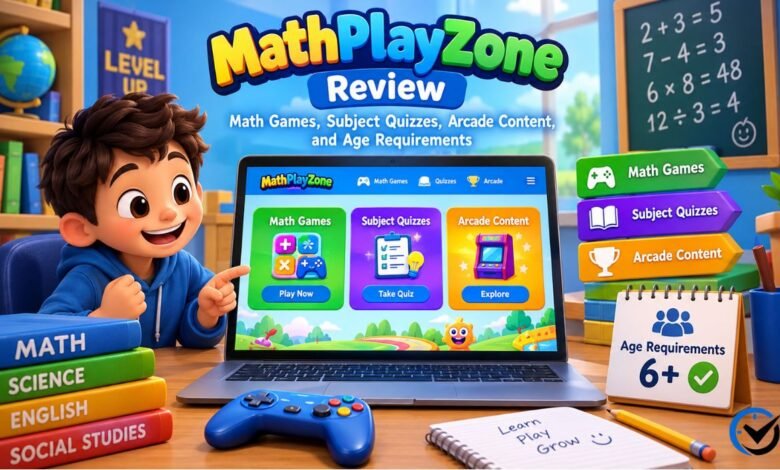
MathPlayZone brings together arithmetic challenges, educational quizzes, and a much larger collection of arcade games. Despite its name, the catalog also covers science, history, geography, racing, sports, and action games. That mix matters when deciding whether to visit for focused practice or entertainment. A number puzzle and a racing game may share the same website without serving the same learning purpose. Understanding the categories helps visitors choose an activity that matches what they actually want to do.
Age eligibility also matters. The website’s terms and privacy policy state that it is designed for users aged 13 and older, even though some game descriptions use broader language about suitability. This review examines the published catalog, game descriptions, and policies. It explains what the activities involve, where their educational value may lie, and what visitors should consider about advertising and privacy. It does not claim that every game has been tested or that playing produces measured academic gains.
What the Website Actually Offers
The main navigation separates the collection into Math, Science, History, Geography, and Arcade. The catalog checked for this review displayed nine math entries, three science entries, one history entry, two geography entries, and 120 arcade entries. Those figures describe a snapshot of the listings and may change. They also show that casual gaming occupies considerably more space than subject practice. Visitors can browse categories, use the search field, and sort category listings by options such as title or latest entries. Individual pages provide descriptions, with some also listing controls. This structure works as a game directory, but the published pages should not be mistaken for a sequenced teaching program with lessons arranged by grade, prerequisites, and assessment milestones.
Arithmetic Practice and Timed Number Challenges
The math section centers on addition, subtraction, multiplication, and division. Dedicated games for each operation ask players to calculate answers against a timer, making speed part of the challenge. Let’s Reach 1000 uses a running total that players increase through addition, while Let’s Reach Zero reverses the direction through subtraction. Quiz Math presents addition or subtraction equations that must be judged true or false before time runs out. These formats are better approached as practice with familiar operations than as evidence that a learner understands a new concept. Someone who keeps making the same error should pause, work through the calculation slowly, and identify the mistake before returning to another timed round.
Math Push and Math Boy Take Different Approaches
Math Push combines movement with number puzzles. Players arrange numbered blocks to create expressions matching the values on barriers that obstruct an exit. Its listed controls include movement, undo, and reset, allowing a player to reconsider a sequence of actions. Math Boy uses a different structure: solving arithmetic equations prevents enemies from reaching the character. Its five modes cover the four basic operations and a mixed option. Incorrect answers make enemies advance faster. The distinction is useful when choosing between planning a solution and responding quickly under pressure. Neither format should be judged solely by its score. A stronger check is whether the player can explain the expression formed in the puzzle or solve comparable equations without relying on the game’s timing and visual cues.
Science Games Mix Quizzes With Movement
The science collection contains The Brain Lab, Smarty Pants: Science Quiz, and The Magic of Science. The Brain Lab is described as an endless runner in which players collect objects associated with solids, liquids, or gases. Smarty Pants uses questions about subjects including planets, the human body, and science. The Magic of Science is presented as a collection of 30 interactive levels covering basic scientific concepts. These are different ways of presenting subject content, so an appealing animation does not automatically indicate the depth of explanation. For focused study, visitors should look at what the activity asks them to recognize or answer, then review unfamiliar ideas separately. Identifying a state of matter, for example, is only one part of understanding its properties.
History and Geography Focus on Knowledge Questions
Smarty Pants: History Quiz is the listed history activity, covering periods described as ancient civilizations, medieval times, and modern history. The geography section contains Smarty Pants: Geography Quiz and Flags Maniac. The former asks about countries, capitals, landmarks, and other geographic facts; the latter centers on recognizing national flags. This makes the collection easier to understand than a broad promise of mastering entire school subjects. Recognizing a flag involves recall, while explaining a historical event requires context, chronology, and competing perspectives. Visitors can use a missed question as a starting point for further reading. A useful follow-up to identifying a country is locating it on a map and learning about its neighbors, rather than treating a correct flag answer as complete geographic understanding.
The Arcade Section Changes the Site’s Character
The arcade library includes entries such as Cookie Clicker, Snow Rider 3D, Drift Hunters, Slope, Basketball Stars, and Fortzone Battle Royale. Its range extends from incremental clicking and racing to sports, platform challenges, and combat. This broader collection explains why the website should be assessed as both an educational directory and an entertainment portal. A reflex-based game may require attention or coordination, but that alone does not establish a connection to mathematics instruction. Visitors seeking number practice can stay within the math category; those browsing for leisure have considerably more choices. Game titles also deserve individual inspection because mechanics and themes differ widely. The site’s minimum age requirement is a separate issue from whether a particular title suits an individual player or a classroom activity.
Understanding the Minimum Age Requirement
Both the terms of use and the privacy policy specify that the website is designed for people aged 13 and older. The terms further state that accessing the service means attesting to being at least 13. This is more specific than individual descriptions that refer to games as suitable for all ages. For anyone assessing the website for younger children, the stated access requirement needs to guide the decision. The reviewed policies do not describe an exception based on parental permission. Teachers and families should therefore distinguish three separate questions: whether someone meets the access requirement, whether the game’s content is appropriate, and whether its academic difficulty matches the intended learning task.
Advertising, Cookies, and Personal Information
The privacy policy explains that information can be collected both voluntarily and automatically. Names and email addresses may be provided through comments or contact forms, while technical information can include an IP address, browser details, device characteristics, and usage data. The stated purposes include operating the service, analyzing activity, and delivering targeted advertising. The policy identifies Google Analytics and describes advertising managed through Playwire, as well as cookies and similar tracking technologies. These disclosures mean visitors should consider data handling alongside the game selection. The policy also describes advertising consent choices for users in the European Economic Area, the United Kingdom, and Switzerland. Its statement about deleting information discovered to have come from children under 13 does not change the minimum age stated elsewhere.
Getting Useful Practice Without Overstating Results
A practical approach starts with a specific task, such as answering multiplication questions accurately or checking whether an addition equation is correct. Choose the activity that matches that task and review mistakes afterward. For a learner struggling with accuracy, removing time pressure during follow-up work can help reveal where the calculation went wrong. To assess progress, compare performance on similar problems outside the game and ask for an explanation of the method. A rising game score may reflect familiarity with controls as well as stronger subject knowledge. The reviewed pages do not establish independent learning outcomes, a complete curriculum, or a teacher reporting dashboard. The clearest use is therefore supplementary practice or recreation, with the purpose chosen deliberately rather than inferred from the website’s name.
Final Thoughts
MathPlayZone offers a varied game directory with a small arithmetic collection, several subject activities, and a substantially larger arcade library. Its most useful features are the visible category structure and the different styles of challenge, from number puzzles to timed calculations and factual quizzes. Choosing well requires matching the activity to a clear purpose, checking individual content, and respecting the stated minimum age of 13. Advertising and privacy disclosures also belong in that assessment. The platform is easiest to judge when expectations remain specific: a place to select supplementary activities or entertainment, with educational results assessed through actual understanding rather than assumed from gameplay.
Frequently Asked Questions (FAQs)
1. Is MathPlayZone a complete mathematics curriculum?
The reviewed catalog shows a small collection of arithmetic and puzzle activities, rather than a complete course. It does not demonstrate a structured sequence covering all topics at each grade level. Use it alongside explanations, written problems, and other teaching materials when the goal is sustained mathematical learning.
2. What is the minimum age for using the website?
The stated minimum is 13 years old. Both the terms and privacy policy describe the service as intended for users aged 13 and older. Broad wording about a game being suitable for all ages should not be treated as replacing that website access requirement.
3. How are Math Push and Math Boy different?
Math Push requires players to arrange numbered blocks into expressions that clear barriers, emphasizing planning within a puzzle. Math Boy makes arithmetic answers part of defending a character from enemies. Choose according to the desired task: thinking through an arrangement or responding to equations under time pressure.
4. Are the games free to access?
The arcade section describes its collection as free. That description does not mean the website is free of advertising or tracking. Visitors should distinguish the cost of accessing an activity from the site’s advertising model and read any prompts associated with the selected game before proceeding.
5. Is an account required to play?
The public game pages reviewed do not establish a universal account requirement. Name and email fields appear with comment forms, which concern posting comments rather than proving that a player account is necessary. Follow the selected activity’s instructions and avoid confusing participation in comments with access to gameplay.
6. Can adults use the arithmetic activities?
The stated age requirement includes adults, and the activities can be selected for basic arithmetic practice or casual play. Their usefulness depends on the task rather than a school grade label. An adult checking calculation accuracy may prefer reviewing errors carefully instead of concentrating exclusively on a higher score.
7. Are the science games virtual experiments?
The published descriptions do not establish a collection of realistic laboratory simulations. They describe a states-of-matter runner, a science quiz, and interactive concept levels. These can introduce or revisit ideas, but they should not be assumed to teach experimental design, measurement, or evidence interpretation without examining the activity itself.
8. Does “unblocked” guarantee access at school or work?
No. The arcade section uses that description, but access still depends on the network, device, and local restrictions. It should not be read as a guarantee that every game will load everywhere. Check the institution’s permitted resources and access rules before selecting a game for use there.
9. What should I do if a game does not load?
Check your connection and reload the page. If other game pages work, the issue may be specific to the embedded title. Trying another permitted browser can help identify a compatibility problem. The published catalog does not guarantee that every game will function on every device.
10. How can a teacher check whether an activity helped?
Ask learners to solve comparable questions without the game and explain their reasoning. Compare accuracy and the types of mistakes made before and after practice. This gives more useful evidence than a score alone, especially when scores also depend on quick reactions, repeated attempts, or familiarity with the controls.
Recommended: United Airlines Flight UA82 Emergency: Inside the Newark–Delhi Dreamliner’s Unexpected Return



One Comment