

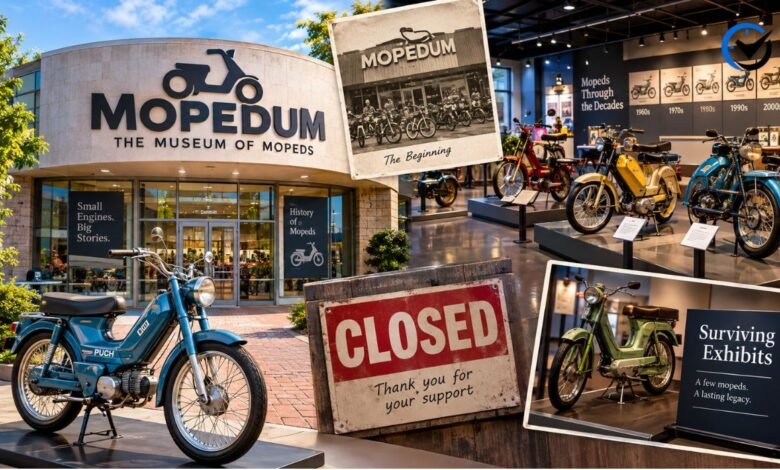
Mopedum was a Swedish nostalgia museum in Nynäshamn, a coastal town south of Stockholm. Also known as Svenska Nostalgimuseet, it brought together vintage mopeds and recreated settings from Swedish life between 1952 and 1979. The original museum closed permanently in December 2022, but selected exhibits survived through a purchase by Vällingby Centrum in western Stockholm. That distinction matters if you have found an old visitor review or are considering a trip. The former attraction and the surviving displays are now different places with different formats. Understanding their connection provides a clearer picture of what the museum offered, why it closed, and what can still be experienced today.
The appeal extended beyond engines and vehicle design. A moped displayed beside the objects of its era invites questions about where people traveled, what they bought, and how their homes looked. A kitchen or country store provides another way into that same history, especially for someone with little interest in mechanics. Objects that appear unremarkable when new can become useful records of habits, taste, and domestic priorities. Together, these objects make everyday routines visible. Older visitors may recognize things from their childhood, while younger visitors can compare those surroundings with their own lives. The museum’s broader subject was therefore the world around the moped: ordinary possessions, familiar environments, and the ways people remember a period that has passed.
The Original Museum
Nisse and Lotta Skogmyr created the museum, which operated from 2012 until its closure ten years later. Its address was Vikingavägen 39 in Nynäshamn, where it occupied the town’s former indoor swimming hall. That setting is a distinctive part of its history: a building once used for another everyday activity became a place for presenting everyday objects from the past. Reusing that building gave the attraction an identity tied to the town, alongside its broader Swedish subject. The location also helps explain older listings that still associate the collection with Nynäshamn. They describe the original venue, rather than the later exhibition in Stockholm. For anyone tracing the museum’s story, the founders, the building, and the operating dates provide useful starting points.
The exhibition paired vehicles with reconstructed environments instead of treating transport history as an isolated subject. Descriptions from its operating years mention clothing, home furnishings, a small shop, and a period gas station. These settings gave the collection a social context. Visitors could consider a vehicle alongside the places where someone might have shopped, worked, or spent time at home. The creators’ choices also shaped which parts of the past received attention. A nostalgia exhibition presents selected scenes rather than every experience of an era, so its displays are best understood as a particular view of Swedish daily life. That perspective helps explain both its personal character and its historical limits. It also encourages visitors to ask whose daily experiences are represented, and which aspects of the period lie outside the exhibition.
A 1952–1979 Timeline
The years 1952–1979 formed the exhibition’s central timeline and were presented as the moped’s golden age. These dates described the history on display, rather than the years when the museum itself was open. The distinction is easy to miss when reading a brief attraction description. Comparisons can be made across a generation, rather than between objects separated by centuries. A defined period also gives visitors a useful way to compare objects: the furnishings, clothing, and vehicles associated with the early 1950s can be considered alongside those of the 1970s. Changes become easier to notice when several kinds of possessions are shown together. The timeline should still be treated as the museum’s chosen focus; it does not mean Swedish moped history began and ended within those boundaries.
Vehicles and Everyday Life
Around the time it opened, the original collection was described as containing about 70 mopeds. That figure belongs to an early description of the Nynäshamn museum and should not be confused with the selection now displayed elsewhere. The current Vällingby exhibition includes Swedish and European mopeds, with brands such as Crescent, Husqvarna, Monark, Fram, and Victoria. For a visitor, these small motorized two-wheelers offer both visual and mechanical comparisons. Frame shapes, finishes, seating arrangements, and visible mechanical details provide things to examine, even without specialist knowledge. When model information is available, matching it to the visible vehicle makes those differences easier to understand. A collection can introduce the variety within a vehicle category that otherwise seems simple, while individual examples provide starting points for learning about their manufacturers and owners.
The reconstructed interiors broadened that experience. A country store suggested a different shopping routine, with customers being served across a counter. A 1950s kitchen showed a domestic setting through its cupboards and furnishings, while a 1970s children’s room brought childhood into the story. Some of these environments were later recreated at Vällingby Centrum, including a room with Dunderklumpen wallpaper. Such details offer more than decoration: they give visitors concrete objects to compare with their own surroundings. The counter, cupboard fronts, and wallpaper are also useful details for anyone interested in period interiors. What has changed in kitchen storage, shop layouts, or children’s room design? Those questions make the displays approachable without requiring anyone to remember the original period or know the technical history of a moped.
The Museum’s Closure
The original museum closed permanently in December 2022 after its owners and creators decided to retire. Retirement is the documented context for the decision and for Vällingby Centrum’s subsequent purchase. The decision brought an exhibition shaped by its creators to the end of a decade of public operation. Closing the venue ended its operation as a museum in Nynäshamn, but it left a separate question about the future of its contents. Buildings, collections, and exhibitions do not always share the same fate. In this case, another organization acquired material that could be presented in a new setting. The result was preservation through a change of location and display format, rather than continued operation of the original attraction.
Preserving the Exhibits
Vällingby Centrum announced its acquisition in December 2022. The purchase included the museum’s recreated environments and a number of its mopeds, allowing selected material to remain together instead of being broken up for auction. The new nostalgia exhibition opened on March 17, 2023, with period rooms recreated in the shopping center’s public passages. The March opening also explains why photographs of these rooms can appear under a newer exhibition name. This was a new presentation of material from the former museum. It should not be described as proof that the original venue reopened or that every object was transferred. For the visitor, the connection is more specific: recognizable parts of the collection were preserved and made accessible in another location, with a different layout and setting.
The choice of destination has a historical connection of its own. Vällingby Centrum opened in 1954, placing its beginnings within the period represented by the exhibits. It was part of the Swedish ABC planning idea, linking work, housing, and a town center. The old interiors therefore sit within a place whose history overlaps with theirs. Today, the recreated environments are enclosed behind glass and distributed through the center’s passages. That arrangement changes how people encounter them: someone shopping may notice a historical room without having planned a museum visit. The objects remain available for observation, although the setting offers a different experience from exploring the original collection in a dedicated museum building.
Visiting Vällingby Centrum
The current exhibition describes five display areas at Vällingby Centrum. Two are outside Hemköp, one occupies a corner space at the beginning of Pajalagatan, and two are near K:5. The moped display is in the Pajalagatan corner location, so it is worth looking beyond the first historical room you find. The exhibition is free to view and follows the center’s opening hours; checking those hours before traveling is sensible. Because the rooms are dispersed, leave time to find the different locations rather than viewing just one case. Visitors should expect glass-fronted displays spread through public passages rather than one continuous museum route. Looking closely at each setting, and comparing the domestic scenes with the vehicles, offers a way to understand how the surviving material fits together. The original Nynäshamn address is no longer the destination for this exhibition.
Final Thoughts
The story of this Swedish nostalgia museum has a clear progression: a collection and its recreated settings opened in Nynäshamn, the creators retired, and selected exhibits found another home. Its significance lies in the attention given to ordinary things that can otherwise disappear from public view. A household interior, shop counter, or small vehicle can prompt useful questions about daily life and changing design. The surviving displays preserve part of that opportunity, while the change of venue remains an essential part of the story. For readers and visitors alike, appreciating the collection means recognizing both what remains available and how its present presentation differs from the museum that originally brought these objects together.
Frequently Asked Questions
1. What was Mopedum?
It was a nostalgia museum in Nynäshamn, Sweden, combining vintage mopeds with reconstructed scenes of daily life. Its subject extended to clothing, household furnishings, shops, and other objects from 1952–1979, giving the vehicles a wider cultural setting than a purely mechanical exhibition would provide.
2. Where was it located?
The original venue occupied a former indoor swimming hall at Vikingavägen 39 in Nynäshamn, south of Stockholm. That address remains part of the museum’s history, but visitors interested in the surviving exhibition should plan for Vällingby Centrum rather than the former Nynäshamn attraction.
3. Who founded it?
Nisse and Lotta Skogmyr were its owners and creators. Their retirement preceded the museum’s closure and the purchase of selected material by Vällingby Centrum. Their role is important because the exhibition reflected the choices of the people who assembled and presented it.
4. What does 1952–1979 mean?
Those years identify the exhibition’s historical focus, described as the moped’s golden age. They are not its opening and closing dates. The museum operated decades later, from 2012 to 2022, using vehicles and everyday objects to portray the earlier period.
5. Is it still open?
No. The Nynäshamn museum closed permanently in December 2022. Old photographs and reviews can describe its former displays, but they should not be used to plan a visit there. Selected exhibits can instead be seen in the nostalgia exhibition at Vällingby Centrum.
6. Why did it close?
The documented reason was the creators’ decision to retire. The subsequent purchase provided a way to preserve selected material after their museum operation ended. The original museum’s closure and the collection’s later preservation were separate events, which explains why selected objects remain publicly accessible.
7. Did everything move?
The purchase included reconstructed environments and a number of mopeds. That does not establish that every vehicle and object from the original collection moved together. The present exhibition should be understood as a preserved selection, rather than a complete reproduction of everything once displayed.
8. Which brands are displayed?
The current exhibition lists Crescent, Husqvarna, Monark, Fram, and Victoria among its brands. It includes Swedish and European examples from the 1952–1979 period. Comparing the displayed vehicles offers an introduction to differences in styling and construction without requiring visitors to be experienced collectors.
9. Is admission free?
The recreated displays at Vällingby Centrum are free to view in the center’s public passages. Access follows the center’s opening hours. This arrangement makes it possible to include the exhibits in a visit to the area without buying a ticket for a separate museum venue.
10. Is the website the museum?
No. A website using the name currently publishes material about vintage mopeds, but online content does not establish that the former physical museum has reopened. Treat the website’s articles, the closed Nynäshamn venue, and the surviving Vällingby displays as distinct sources of information. Sharing a name does not establish continuity of museum ownership.
Recommended: Tozymagazine.com USA: Birthday Wishes, Business Articles, and Its Broader Publishing Focus





One Comment