

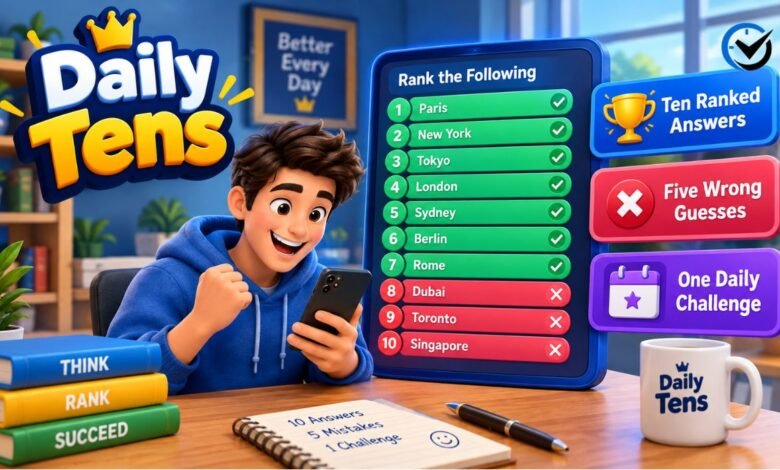
A trivia question usually asks for one fact. Daily Tens asks you to rebuild an entire ranked list, which makes the challenge feel different almost immediately. You might recognize the subject and name several strong answers, yet still struggle to fill the last few spaces. The basic goal is straightforward: identify ten entries in the day’s list before making five incorrect guesses. The difficulty comes from understanding exactly what the question measures and recalling the less obvious names that belong near the bottom of the top ten.
This guide explains the rules, the ranking system, and practical ways to approach a difficult board. It also covers percentile results, older puzzles, saved progress, and an important source of confusion: separate sites can use the same game name while offering different features. Knowing which version you are playing helps you interpret its instructions correctly. Whether you enjoy geography, movie statistics, or general knowledge, the useful starting point is the same: read the category carefully before deciding which answers deserve a guess.
What Is Daily Tens?
Daily Tens is a free browser-based trivia game built around a new top-ten question each day. Isaac Schiffler introduced the original project with Ivan Li, Jacob Schuster, and Nathan Smidt. Its appeal rests on a compact format: one subject, a fixed answer set, and limited room for mistakes. Rather than move through unrelated quiz questions, you stay with one list until the round ends. The challenge combines factual knowledge with an understanding of rankings, making it suitable for players who enjoy recalling names, records, places, and measurable achievements.
How the Ten-Answer Board Works
The board has ten positions corresponding to the entries in the day’s ranking. You type an answer, submit it, and see whether it belongs in the list. A correct response fills its ranked position automatically, so you can begin with whichever entry you know best. The round ends when you identify all ten answers or make five wrong guesses. Those rules create an important practical distinction between total attempts and mistakes: correct submissions do not consume the allowance for incorrect answers. Finding several entries early therefore leaves you room to think carefully about the remaining spaces.
Why the Ranking Metric Matters
The category tells you the subject, but the metric tells you which answers qualify. The original game provides an information icon beside the question that explains the measure being used. A list of the largest U.S. states by area asks something different from a list ranked by population. Likewise, movie rankings can change depending on whether the question measures box office revenue, a particular market, or another defined total. Before submitting anything, identify the object being ranked, the measurement, and any stated limits. That brief check can prevent a confident answer from becoming an avoidable mistake.
Dates and definitions deserve the same attention. A ranking based on a stated year may differ from one using more recent figures, while a historical record may cover a specific competition or period. For example, a question about championship victories requires you to think about wins rather than appearances in finals. Treat these distinctions as part of the puzzle itself. If a familiar name seems likely but you cannot connect it to the exact measure, pause before entering it. Recognition helps you generate possibilities; the question’s wording helps you decide which possibilities are worth testing.
Making Five Wrong Guesses Last
Begin with answers you can justify, then slow down as uncertainty increases. There is little benefit in spending several mistakes on names that merely belong to the wider category. When considering a doubtful entry, ask what makes it likely to fall inside the ten-place cutoff. A country might be familiar without ranking highly for the statistic in question, just as a successful film might sit below the required revenue threshold. You do not need to calculate every value from memory, but each guess should have a reason. This approach makes limited attempts more useful without pretending that any strategy guarantees a perfect score.
Handling an Unfamiliar Category
When the obvious answers run out, divide the topic into smaller groups in your mind. For geography, move through regions rather than recalling countries at random. For films, consider relevant studios, franchises, or release periods, depending on the question. For sports, think about the competition and historical period that define the record. These are practical ways to organize recall, not promises that missing names will suddenly appear. The remaining board positions may help you notice gaps in your thinking, but they do not prove which answer comes next. Keep using the stated metric to judge every new possibility.
Scores, Percentiles, and Shared Results
The original game shows how your performance compares with other people who played that day’s puzzle. A percentile provides context alongside the number of answers you found: it describes your position relative to that day’s participants. It should not be treated as a permanent measure of intelligence or general knowledge. A difficult subject, a familiar category, and the particular group of players can all affect comparisons. Sharing results gives friends a common challenge to discuss, especially when their interests differ. For a fair comparison, attempt the same puzzle independently before exchanging answers or searching for the list.
Older Puzzles and Saved Progress
An archive lets players return to lists from previous days, which makes the game useful beyond the current challenge. Choose an older puzzle to explore an unfamiliar topic or revisit something you found difficult, then consider why each missed answer qualified. That review is more valuable than simply memorizing the order of one list. The original game also offers optional Google sign-in to synchronize progress and streaks across devices. You can play without an account, but players moving between a phone and computer should check the available syncing options. Use the same game version when comparing saved records across devices.
Why Similarly Named Versions Can Be Confusing
Search results also include an independent trivia site using the Daily Tens name. Its published rules describe a three-stage hint system, five hint steps, unlimited practice, and statistics stored on the player’s device. The original game’s instructions describe percentile comparisons and optional account syncing. These details should stay attached to their respective versions. For instance, a guide describing local-only statistics may not explain how the original game’s sign-in works. Before relying on advice about hints, streaks, resets, or saved scores, compare it with the instructions displayed in the game you opened. Similar names and a shared top-ten format do not establish that two sites share an operator, puzzle archive, or feature set.
Final Thoughts
Daily Tens works best when you approach it as a ranking puzzle with a trivia foundation. Read the measure first, enter answers you know with confidence, and use your remaining guesses thoughtfully. Older lists offer a way to explore weak areas, while daily results provide a shared challenge for friends. A missed answer can be useful if it helps you understand a record, definition, or cutoff more clearly. The aim is to enjoy the question and gradually become better at reading what it asks, rather than expect the same score across every subject.
Frequently Asked Questions (FAQs)
1. What is Daily Tens?
It is a daily trivia game in which players identify ten answers belonging to one ranked list. Each challenge has a defined subject and measurement. A useful first step is to open the ranking information, because knowing the broad topic alone may leave you guessing at the wrong set of answers. The format rewards both recall and attention to the question.
2. How many incorrect guesses can I make?
The original game’s round ends after five incorrect submissions. You can also finish by finding all ten answers before reaching that limit. Think of the allowance as five mistakes rather than five total guesses. As the board fills, consider your remaining attempts before testing uncertain names, especially when several possibilities fit the general subject but only a few can qualify.
3. Do I have to guess the answers in order?
No. Correct answers appear in their appropriate ranked positions regardless of when you submit them. Start with the entry you can identify most confidently, even if you think it belongs in the middle of the list. You do not need to reconstruct the entire order before playing, which lets you focus first on identifying members of the answer set.
4. Why might an answer that fits the topic be wrong?
Belonging to the category is only the first requirement. The answer must also fall within the particular ranked list. A famous city, team, or movie can fit the subject while missing the cutoff. Recheck the measure, timeframe, and scope before assuming the game has rejected a correct response. Also distinguish a spelling problem from a disagreement about the underlying ranking. If something still seems inconsistent, look for an available feedback or reporting option.
5. Is the game free, and must I create an account?
The original game is free to play in a browser without downloading an application or creating an account. Optional sign-in is available for syncing progress and streaks. Decide whether that feature matters to you based on how you play: someone using one device may have different needs from someone switching regularly between a phone and a computer.
6. What does my percentile result mean?
It places your result in relation to other people who attempted that day’s puzzle. Read it alongside your answer count and the difficulty you experienced. Because the comparison concerns a particular challenge and its participants, it should not be interpreted as a fixed assessment of your knowledge. It compares results rather than proving how many facts you know across unrelated subjects. Comparing several different categories may give you a more useful picture of your interests.
7. Can I play a puzzle I missed yesterday?
Yes. The original game’s archive provides access to earlier daily lists. You can use it to catch up, try a different subject, or revisit a difficult board. Playing a missed question and restoring a daily streak are separate matters, however. Check the version’s streak rules before assuming that an archived attempt changes your current record.
8. Does every version have hints and unlimited practice?
Do not assume that features described for one site apply to another. The separate independent version publishes rules for a hint ladder and unlimited practice, while the original game’s public instructions emphasize its daily list, archive, percentile results, and optional syncing. The independent version’s hint ladder moves from a clue to first letters and then an answer reveal. Check the controls and help page in your chosen game before following a guide that refers to particular buttons or modes.
9. Why does my progress look different on another device?
First, confirm that you opened the same game version. Then check whether you are using the same optional account where syncing is supported. Device-based records can differ from account-synced records, particularly across separate browsers. Avoid treating similar names as proof that progress should transfer automatically. Checking the game and account first is easier than trying to rebuild a missing history. If the mismatch continues, consult the game’s help options before changing or resetting anything.
10. Can I suggest a subject for a future challenge?
Yes. The original game’s instructions direct players to a list-suggestion option in its menu. A useful proposal includes a clear subject and a measurable ranking, such as population or a defined competition record. Adding a timeframe can make the idea easier to evaluate. Avoid vague labels such as “best” unless you define the measurement that makes them rankable. Suggesting a topic does not guarantee publication, but a precise question gives the creators something concrete to consider.
Recommended: Michigan Man $1M Lottery Story: Two Online Wins Totaling $1,366,984



One Comment