
49ers vs Seahawks Match Stats: Key Numbers, Scores, and Highlights
 Admin
Send an email
4 days ago
Admin
Send an email
4 days ago
The latest postseason meeting between the San Francisco 49ers and Seattle Seahawks delivered a one-sided result in one of the NFL’s most competitive divisional rivalries. Seattle defeated San Francisco 41-6 at Lumen Field on January 17, 2026, advancing from the NFC Divisional Round to the conference championship. The final score reflected Seattle’s control of offense, defense, and special teams. This breakdown of the 49ers vs Seahawks Match Stats explains the major numbers, leading performers, turning points, and tactical differences that shaped the game.
Match Overview and Final Score
Seattle entered the contest as the NFC’s top seed and quickly demonstrated why it had earned home-field advantage. The Seahawks led 17-0 after the first quarter and carried a 24-6 advantage into halftime. They added 17 unanswered points after the break to complete the 41-6 victory. San Francisco never reached the end zone and scored only through two Eddy Piñeiro field goals. Seattle’s 35-point winning margin made this one of the most decisive postseason results in the history of both franchises.
49ers vs Seahawks Score Table
| Quarter | San Francisco 49ers | Seattle Seahawks |
|---|---|---|
| First Quarter | 0 | 17 |
| Second Quarter | 6 | 7 |
| Third Quarter | 0 | 10 |
| Fourth Quarter | 0 | 7 |
| Final Score | 6 | 41 |
Quarter-by-Quarter Scoring Breakdown
The opening quarter established the direction of the entire game. Seattle scored 17 points through a kickoff-return touchdown, a field goal, and a passing touchdown, while San Francisco was held scoreless. The 49ers produced six points in the second quarter, but Seattle answered with a rushing touchdown to maintain an 18-point halftime lead. The Seahawks scored ten more points in the third quarter and seven in the fourth. San Francisco was shut out throughout the second half, removing any realistic possibility of a comeback.
Rashid Shaheed’s Opening Kickoff Touchdown
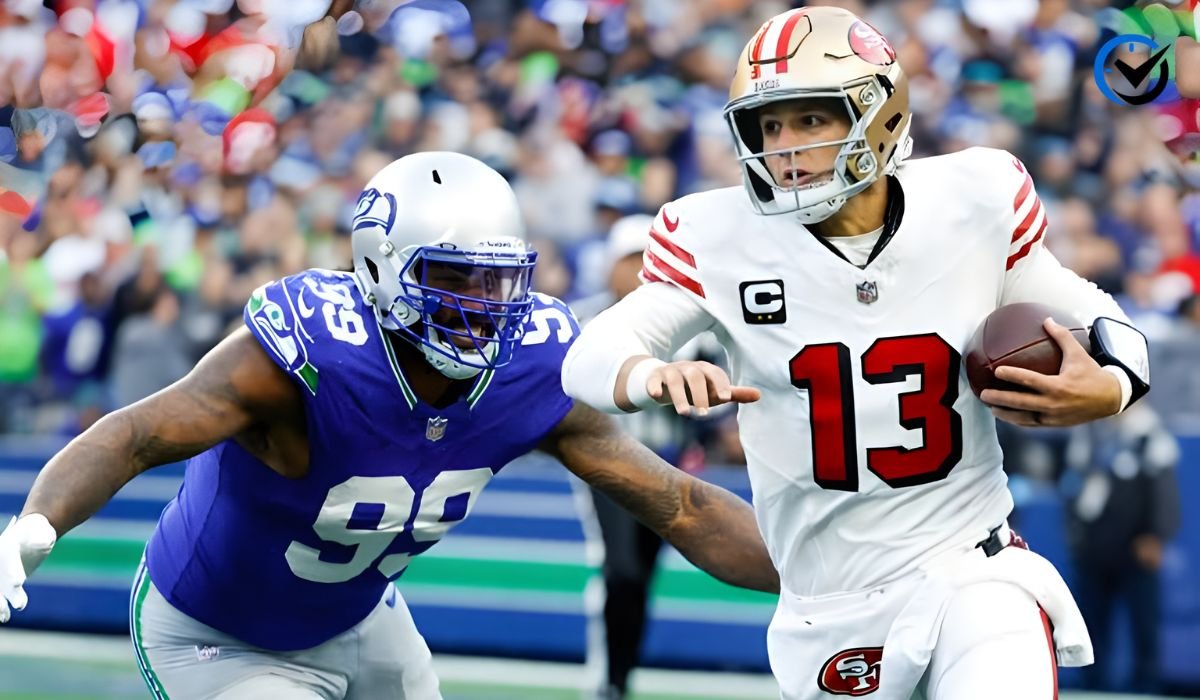
Rashid Shaheed created the first major highlight by returning the opening kickoff 95 yards for a touchdown. The play gave Seattle a 7-0 lead only seconds into the game and immediately placed pressure on San Francisco’s offense. A kickoff-return touchdown does not add to a team’s offensive yardage, but it has enormous value because it produces points without requiring an offensive snap. It also gave Seattle’s defense an early lead to protect, allowing the unit to attack Brock Purdy instead of playing cautiously.
Seattle’s Early Control of the Game
San Francisco’s opening possession ended on downs, and Seattle converted the favorable field position into a 31-yard Jason Myers field goal. The 49ers then lost the ball when linebacker Ernest Jones IV forced a fumble from tight end Jake Tonges. Seattle again took advantage of the short field, with Sam Darnold finding Jaxon Smith-Njigba for a four-yard touchdown. Those early mistakes helped the Seahawks build a 17-0 lead before San Francisco could settle into the game. Seattle’s ability to turn mistakes into points separated the teams from the beginning.
Sam Darnold’s Efficient Passing Performance
Sam Darnold completed 12 of 17 passes for 124 yards and one touchdown. His passing total was modest, but Seattle did not need him to attempt difficult throws throughout the night. He completed more than 70 percent of his attempts, avoided an interception, and delivered the touchdown pass that extended the early lead. Playing despite an oblique issue, Darnold managed the game with patience and protected the football. His performance showed that quarterback success is not always measured by a large yardage total, especially when the running game and defense are controlling the contest.
Kenneth Walker III Leads the Ground Attack
Kenneth Walker III was the leading offensive performer, rushing for 116 yards and three touchdowns. He became the first Seattle player to record more than 100 rushing yards and three rushing scores in a playoff game. His first touchdown, a seven-yard run late in the second quarter, gave the Seahawks a 24-6 halftime advantage. He later added scoring runs of 15 and six yards. Walker’s combination of vision, acceleration, and balance allowed Seattle to control the second half while steadily wearing down San Francisco’s defense.
How Seattle’s Offensive Line Set the Tone
Seattle’s offensive line created dependable running lanes and helped reduce the pressure placed on Darnold. The Seahawks could use straightforward rushing concepts because their blockers consistently reached useful positions at the line of scrimmage. Walker frequently reached the second level without taking heavy initial contact, particularly during his second-half touchdown runs. The blocking also allowed Seattle to manage the clock and remain in comfortable down-and-distance situations. Even after running back Zach Charbonnet left with a knee injury, the Seahawks maintained their physical approach instead of changing the offensive plan.
Brock Purdy’s Difficult Night
Brock Purdy completed 15 of 27 passes for 140 yards, with no touchdowns and one interception. He also lost a fumble late in the game. Purdy occasionally extended plays and found short completions, but Seattle rarely allowed him to establish a steady rhythm. The increasing deficit forced San Francisco into predictable passing situations, making the offense easier to defend. Ernest Jones intercepted a pass intended for Luke Farrell in the third quarter, while DeMarcus Lawrence later produced a strip-sack that Nick Emmanwori recovered. Those turnovers ended any remaining hope of a response.
Christian McCaffrey’s Limited Production
Christian McCaffrey finished with 35 rushing yards on 11 carries and caught five passes for 39 yards, giving him 74 yards from scrimmage. Those numbers were well below the level San Francisco normally expects from its most versatile offensive player. McCaffrey also dealt with a shoulder problem during the game, further complicating the 49ers’ attempt to build momentum. Seattle defended him with disciplined pursuit and limited his opportunities in open space. With McCaffrey contained, the 49ers lost the central player around whom much of their offensive flexibility was built.
San Francisco’s Only Points
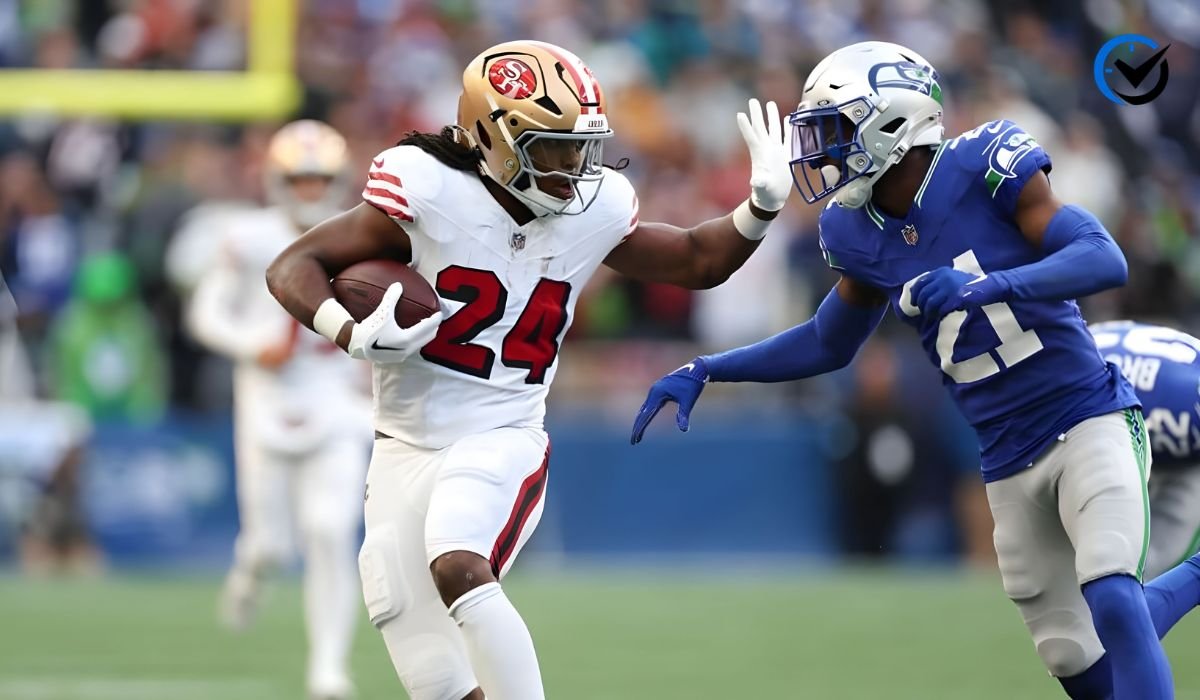
The 49ers’ six points came from field goals rather than completed touchdown drives. Eddy Piñeiro connected from 40 yards and later converted a difficult 56-yard attempt during the second quarter. San Francisco briefly reduced the deficit to 17-6, but Seattle answered before halftime with Walker’s first touchdown. The response was important because it prevented the 49ers from carrying meaningful momentum into the break. Although the two field goals rewarded some positive movement, settling for three points was not enough against a Seattle team that consistently finished its opportunities.
Seattle’s Defensive Standouts
Ernest Jones IV produced one of the game’s strongest all-around defensive performances. He forced Tonges’ first-quarter fumble and later intercepted Purdy, directly helping Seattle generate favorable field position. DeMarcus Lawrence added pressure from the edge and forced another fumble on a late sack, which Emmanwori recovered. Leonard Williams also delivered an important fourth-down sack early in the second half. Seattle’s defense forced three turnovers, stopped multiple fourth-down attempts, and prevented San Francisco from scoring a touchdown for the second meeting in a row.
Third Downs, Fourth Downs, and Field Position
Situational football played a major role in the result. San Francisco’s early fourth-down failure gave Seattle a short field, while another turnover on downs after halftime stopped a drive when the 49ers urgently needed a touchdown. Seattle did not have to build long scoring possessions every time because takeaways, special teams, and defensive stops repeatedly improved its starting position. Michael Dickson also helped by pinning San Francisco near its own goal line on a well-placed punt. These hidden yards made Seattle’s job easier and forced the 49ers to cover more ground.
Why Total Yardage Does Not Explain the Score
The game demonstrates why total yardage alone can be misleading. Seattle did not need an enormous offensive output to score 41 points because Shaheed supplied a special-teams touchdown and the defense repeatedly created short fields. At halftime, the teams were separated by only two total yards, with Seattle holding a 151-149 advantage, yet the Seahawks led by 18 points. Field position, turnovers, red-zone execution, and fourth-down results produced the difference. Seattle finished drives efficiently, while San Francisco moved the ball at times without turning that movement into touchdowns.
The Importance of Turnover Margin
Seattle protected the football and forced San Francisco into three giveaways. That created a turnover margin of plus-three for the Seahawks, one of the clearest statistical explanations for the final score. Each mistake either removed a possible San Francisco scoring chance or handed Seattle favorable field position. The Seahawks remained patient because they were not giving the 49ers easy opportunities in return. San Francisco, meanwhile, had to chase the game after falling behind. That urgency contributed to riskier decisions, difficult fourth-down situations, and further mistakes as the contest progressed.
Injuries and Their Effect on San Francisco
San Francisco entered the postseason dealing with significant physical concerns, and more problems appeared during the game. McCaffrey played through a shoulder issue, while Tonges was also hurt. The 49ers were already operating without the full strength and depth that had defined some of their strongest teams. Injuries do not erase Seattle’s execution, but they help explain why San Francisco struggled to respond once the game became physical and fast. A depleted lineup had fewer ways to create mismatches or rotate fresh players against Seattle’s balanced roster.
What the Result Meant for the Rivalry
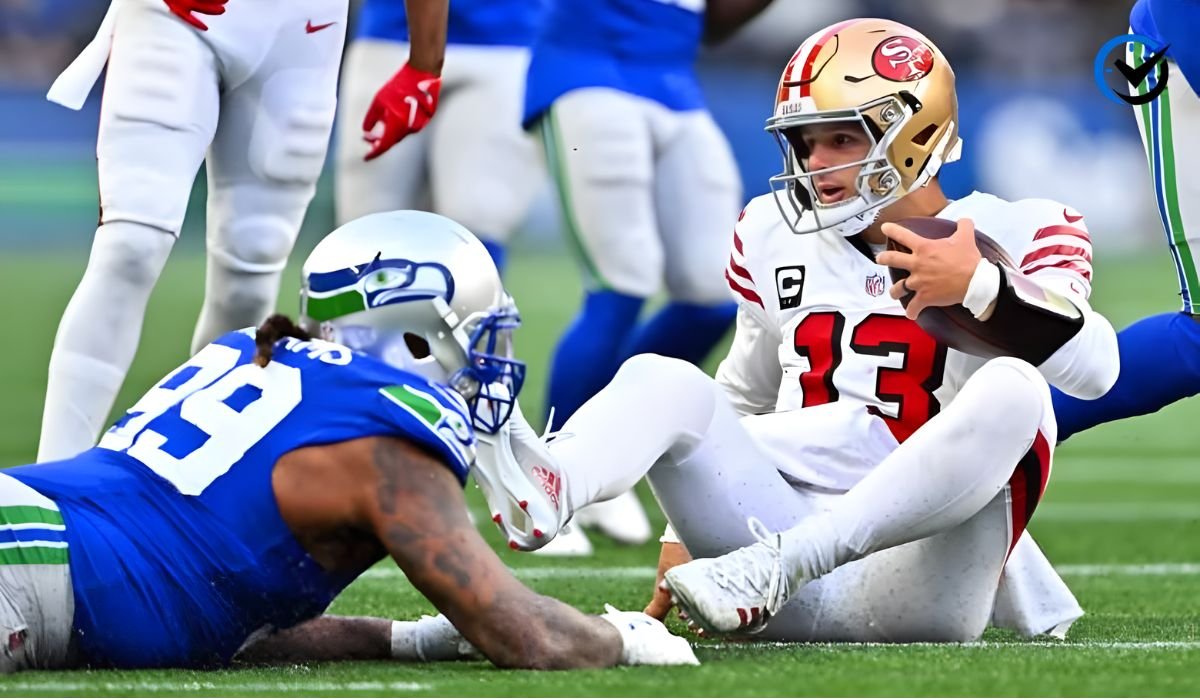
The victory gave Seattle a 2-1 advantage over San Francisco in postseason meetings. The Seahawks had previously won the 2013 NFC Championship Game 23-17, while the 49ers won a 2022 Wild Card matchup 41-23. The 2026 divisional result became the largest playoff victory recorded by either team in this rivalry. It also followed Seattle’s 13-3 win over San Francisco in the final week of the regular season. Winning twice in a short period showed that the Seahawks’ defensive success was part of a repeatable matchup advantage rather than a single unusual performance.
Final Thoughts
The key 49ers vs Seahawks Match Stats reveal a complete Seattle performance rather than a victory built on one individual number. Shaheed changed the game with his 95-yard return, Walker rushed for 116 yards and three touchdowns, and Darnold completed efficient passes without committing a turnover. Seattle’s defense added three takeaways and kept San Francisco out of the end zone. Purdy and McCaffrey never found the production needed to challenge the lead. The 41-6 result ultimately reflected Seattle’s sharper execution in every important phase of the game.
Frequently Asked Questions
1. What was the final score of the latest 49ers-Seahawks playoff game?
Seattle defeated San Francisco 41-6 in the NFC Divisional Round on January 17, 2026. The Seahawks led from the opening kickoff and never allowed the 49ers to make the score competitive. San Francisco’s only points came from two field goals in the second quarter, while Seattle scored through offense and special teams.
2. Who was the leading performer for the Seahawks?
Kenneth Walker III delivered the biggest offensive performance. He rushed for 116 yards and scored three touchdowns, helping Seattle control the game after establishing its early lead. His production allowed the Seahawks to rely on the running game, protect Darnold, manage the clock, and limit the risk of offensive turnovers.
3. How did Sam Darnold perform against the 49ers?
Darnold completed 12 of 17 passes for 124 yards and one touchdown. He did not throw an interception and avoided the costly mistakes that damaged San Francisco. His four-yard scoring pass to Smith-Njigba helped Seattle take a 17-0 first-quarter lead. It was an efficient, controlled performance rather than a high-volume passing display.
4. What were Brock Purdy’s passing statistics?
Purdy completed 15 of his 27 attempts for 140 yards. He did not throw a touchdown, was intercepted once, and lost a fumble. Seattle’s pressure and coverage forced him into difficult situations, especially after San Francisco fell far behind. His late turnovers helped the Seahawks turn a comfortable lead into a decisive victory.
5. How many turnovers did San Francisco commit?
The 49ers committed three turnovers. Tonges lost a fumble forced by Ernest Jones, Purdy threw an interception to Jones, and Purdy later lost a fumble on Lawrence’s strip-sack. Seattle did not commit a turnover, giving the Seahawks a plus-three margin and several valuable short-field opportunities during the game.
6. Did Christian McCaffrey score a touchdown?
No. McCaffrey did not score and finished with 35 rushing yards and 39 receiving yards. His 74 total yards showed some contribution, but Seattle prevented him from making the explosive plays that often drive San Francisco’s offense. A shoulder problem during the game also affected an already difficult matchup.
7. Who scored the opening touchdown?
Shaheed scored on a 95-yard return of the opening kickoff. The touchdown came before either offense had taken the field and gave Seattle immediate control of the atmosphere and scoreboard. It was the defining early highlight and placed San Francisco in a difficult position from the first offensive possession.
8. Why did Seattle win despite modest passing numbers?
The Seahawks did not need a large passing total because they excelled in other areas. They scored on special teams, forced three turnovers, ran effectively with Walker, and repeatedly began possessions with favorable field position. Darnold’s main responsibility was to make sound decisions, complete available throws, and protect the ball.
9. How many points did San Francisco score in the second half?
The 49ers scored no points after halftime. They entered the third quarter trailing 24-6 and needed an early touchdown to create pressure, but Seattle stopped their first possession on fourth down. An interception, another turnover on downs, and a late fumble prevented San Francisco from producing a serious comeback attempt.
10. What made this game historically important?
Seattle’s 41-6 win tied the largest playoff victory in franchise history by scoring margin and sent the team to its first NFC Championship Game since the 2014 season. It was also San Francisco’s most lopsided postseason defeat in decades. Within the rivalry, the result gave Seattle its second win in three playoff meetings.
Recommended: Detroit Lions vs 49ers Match Player Stats: Top Performers and Game Highlights
Admin
Send an email
4 days ago


One Comment