

The Chargers vs Texans Match Player Stats tell the story of a playoff game transformed by turnovers, defensive pressure, and several record-setting plays. Houston defeated Los Angeles 32–12 in the AFC Wild Card Round on January 11, 2025, at NRG Stadium. The Chargers opened the game with a 6–0 advantage, but the Texans recovered from a poor start and controlled most of the final three quarters. C.J. Stroud, Nico Collins, Joe Mixon, and Houston’s defense all delivered important performances. Los Angeles rookie Ladd McConkey also produced one of the finest receiving displays by a first-year player in postseason history, despite his team’s defeat.
Game Overview and Final Score
Houston finished with 429 total yards compared with Los Angeles’ 261, showing how strongly the Texans controlled the game after their early mistakes. The Texans generated 261 net passing yards and 168 rushing yards, while the Chargers recorded 211 net passing yards and only 50 yards on the ground. Houston also earned 23 first downs and averaged approximately six yards per offensive play. The most important difference, however, was ball security. Los Angeles committed four turnovers, all on Justin Herbert interceptions, while Houston lost the ball twice. Those extra possessions allowed the Texans to overcome an uneven beginning and gradually build a comfortable lead.
Chargers vs Texans Score Table
| Team | Q1 | Q2 | Q3 | Q4 | Final |
|---|---|---|---|---|---|
| Houston Texans | 14 | 0 | 3 | 3 | 20 |
| Los Angeles Chargers | 0 | 3 | 7 | 6 | 16 |
How the Chargers Built an Early Lead
The Chargers appeared ready to take control when Houston turned the ball over on the opening possession. John Metchie III lost a fumble, giving Los Angeles excellent field position inside Texans territory. Houston’s defense limited the damage, however, forcing the Chargers to settle for a Cameron Dicker field goal. Dicker later converted another kick to make the score 6–0. Los Angeles moved the ball well enough to create opportunities, but its inability to score touchdowns proved costly. Turning two favorable situations into six points rather than 14 kept Houston close and gave the home team time to settle into the contest.
C.J. Stroud’s Passing Performance
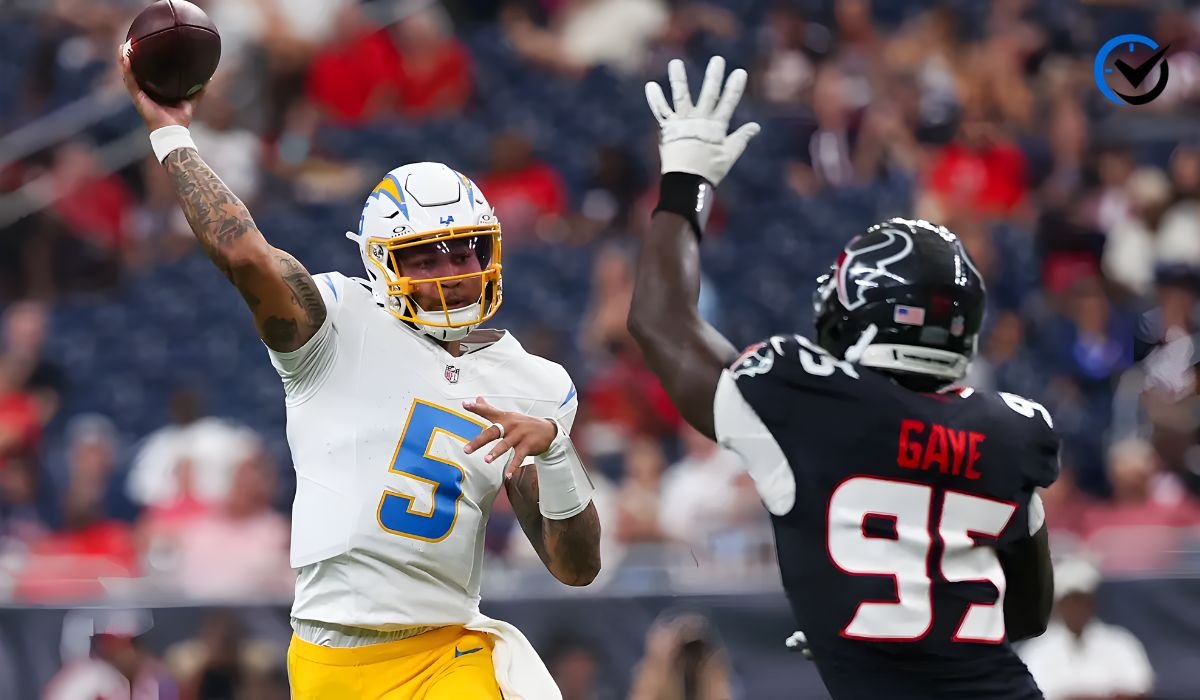
C.J. Stroud completed 22 of 33 attempts for 282 yards, one touchdown, and one interception. His final numbers were impressive because Houston’s offense struggled during much of the opening half. Stroud’s defining moment began near his own goal line after he recovered a mishandled snap. Instead of accepting a broken play, he escaped pressure, moved outside the pocket, and completed a 34-yard pass to Xavier Hutchinson. That play energized the Texans and helped launch a 99-yard touchdown drive. Stroud later connected with Nico Collins for a 13-yard score, giving Houston a lead it never surrendered.
Justin Herbert’s Difficult Afternoon
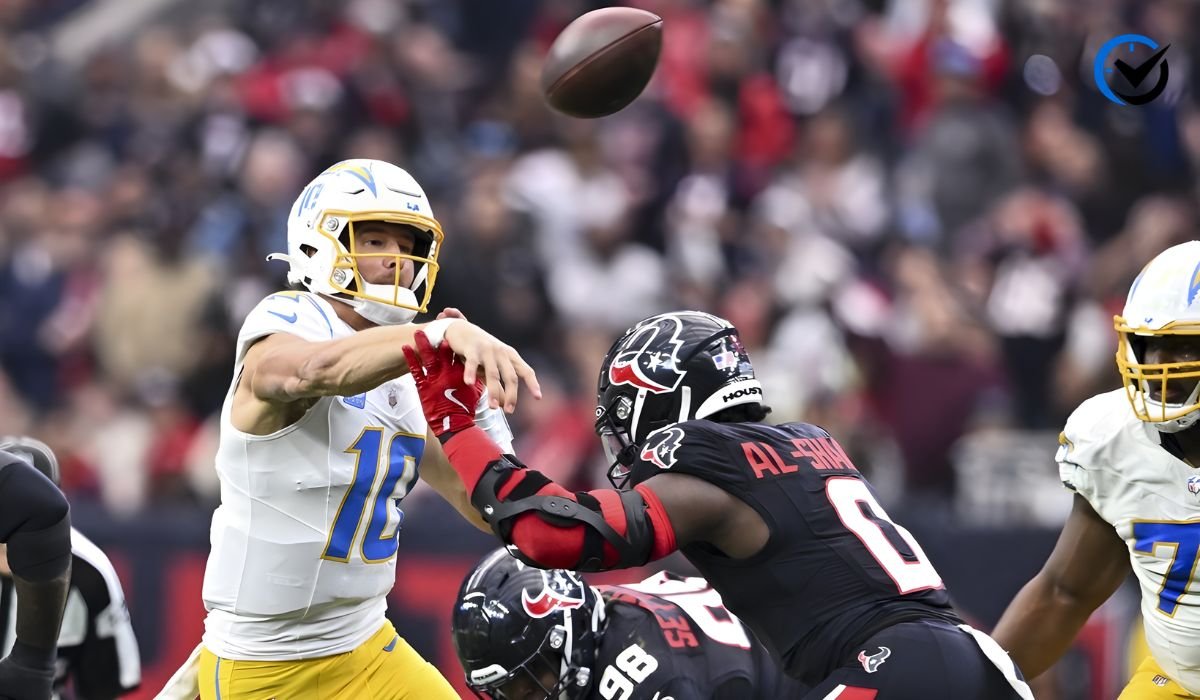
Justin Herbert completed 14 of 32 passes for 242 yards, one touchdown, and four interceptions, finishing with a 40.9 passer rating. The performance was especially surprising because Herbert had thrown only three interceptions throughout the entire 2024 regular season. Houston’s coverage repeatedly removed his preferred early options, while the pass rush forced him to make difficult throws under pressure. Some interceptions came from aggressive attempts to rescue the offense, but others reflected inaccurate placement or misread coverage. Herbert still produced one spectacular touchdown pass to McConkey, yet that single play could not overcome four possessions lost to Houston’s defense.
Nico Collins Leads Houston’s Receivers
Nico Collins was Houston’s most productive receiver, catching all seven of his targets for 122 yards and one touchdown. He became the first Texans receiver to record more than 120 yards in a playoff game, surpassing the franchise’s previous postseason mark. Collins was not targeted during the first quarter, but his involvement changed the rhythm of Houston’s offense. His 13-yard touchdown completed the important 99-yard drive, while gains of 37 and 41 yards helped Houston stretch the field. Collins consistently created separation, caught the ball securely, and gave Stroud a dependable option whenever the Chargers threatened to regain momentum.
Ladd McConkey’s Record-Setting Performance
Ladd McConkey was the clear offensive standout for Los Angeles, finishing with nine receptions for 197 yards and one touchdown. His yardage established an NFL postseason record for a rookie receiver. The biggest moment came in the fourth quarter, when McConkey caught Herbert’s pass and raced for an 86-yard touchdown. He accounted for most of the Chargers’ passing production and repeatedly found space against Houston’s coverage. However, the rest of the receiving group made little impact. McConkey’s exceptional numbers demonstrate that a player can dominate his individual matchup even when turnovers, weak rushing production, and inconsistent execution prevent his team from succeeding.
Joe Mixon Controls the Ground Game
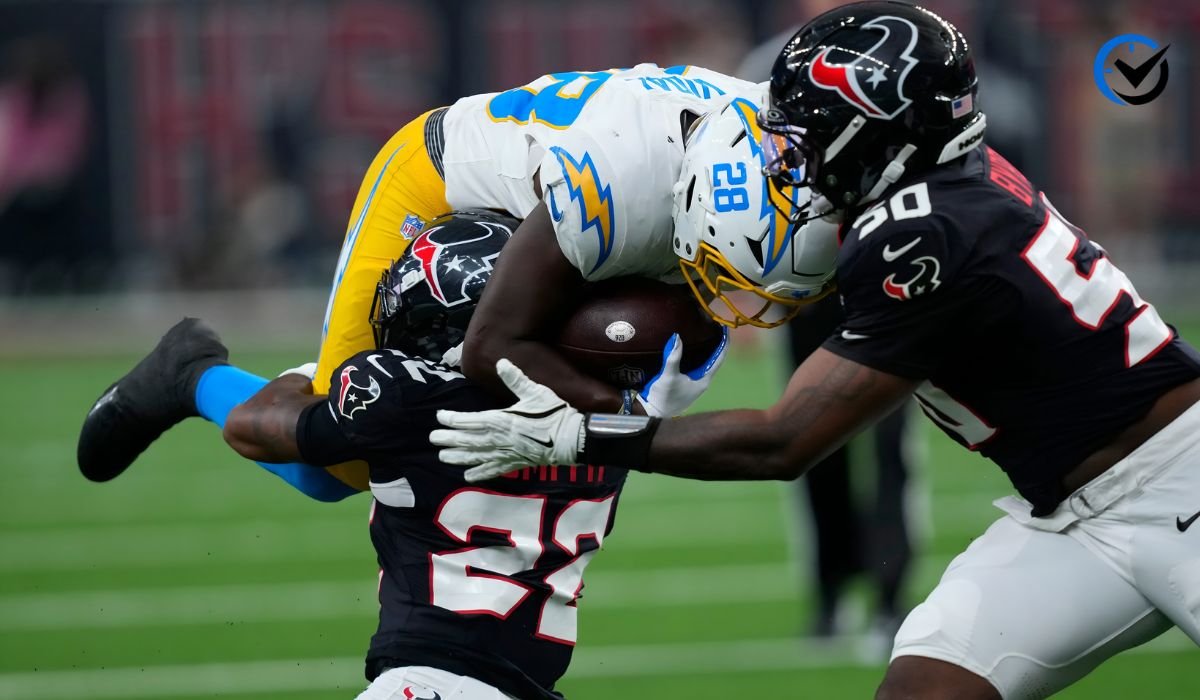
Joe Mixon gave Houston the balanced attack that Los Angeles could not produce. He carried the ball 25 times for 106 yards and scored on a 17-yard run in the fourth quarter. His steady production helped the Texans control possession, avoid predictable passing situations, and wear down the Chargers’ defensive front. Mixon did lose a fumble, but Houston’s defense prevented that mistake from becoming a turning point. Stroud also contributed useful rushing yards when plays broke down. Houston’s 168 total rushing yards provided a strong contrast with Los Angeles’ 50, allowing the Texans to remain patient and protect their second-half advantage.
Houston’s Four-Interception Defensive Display
The Texans’ secondary produced the game’s most influential statistical performance. Kamari Lassiter recorded the first interception, Eric Murray returned another 38 yards for a touchdown, and Derek Stingley Jr. added two late picks. Murray’s score pushed Houston’s lead to 20–6 and forced Los Angeles into an increasingly pass-heavy approach. Stingley then punished Herbert’s attempts to create a comeback. The interceptions were not isolated accidents. Houston’s defenders communicated well, closed throwing windows, and anticipated routes. Their disciplined coverage worked with the pass rush to make Herbert uncomfortable, turning a competitive game into a decisive playoff victory.
Pass Rush, Protection, and Third-Down Pressure
Houston sacked Herbert four times for 31 lost yards, with Will Anderson Jr. and Mario Edwards Jr. each credited with 1.5 sacks. Danielle Hunter also contributed a sack while consistently affecting the pocket. Los Angeles struggled to keep Herbert comfortable long enough for deeper routes to develop, which was particularly damaging once the Chargers fell behind. Houston faced pressure as well, but Stroud’s movement and improvisation helped him escape several difficult situations. The Texans also made timely stops on third and fourth downs. Their ability to combine pressure with close coverage limited extended Los Angeles drives and increased the likelihood of rushed decisions.
Special Teams and the Unusual Final Score
Special teams contributed one of the game’s most memorable sequences. After McConkey’s long touchdown reduced the deficit, Houston blocked Cameron Dicker’s extra-point attempt. D’Angelo Ross recovered the loose ball and returned it to the opposite end zone, giving the Texans two points instead of allowing the Chargers one. It was the first defensive two-point return following a blocked extra point in NFL postseason history. Ka’imi Fairbairn also made three field goals for Houston, including kicks from 41, 37, and 30 yards. These plays helped produce a 32–12 final score, the first such score in NFL history.
Final Thoughts
Houston’s 32–12 victory was shaped by resilience, balance, and game-changing defense. The Texans overcame an early turnover, found momentum through Stroud’s improvisation, and received major performances from Collins and Mixon. Their secondary then decided the game by turning four Herbert passes into interceptions, including Murray’s touchdown return. Los Angeles could celebrate McConkey’s historic rookie display, but its lack of rushing production and repeated turnovers made a comeback unrealistic. Overall, the matchup demonstrated why playoff results rarely depend on one impressive statistic. Houston won because its offense, defense, and special teams all delivered important plays when the pressure was highest.
Frequently Asked Questions
1. When did the Chargers and Texans play this playoff game?
The game took place on January 11, 2025, during the AFC Wild Card Round following the 2024 regular season. Houston hosted the matchup at NRG Stadium because the Texans entered the playoffs as the AFC South champion. Los Angeles qualified as a wild-card team after finishing the regular season with an 11–6 record. It was the first postseason meeting between the two franchises. Houston’s victory advanced the team to the divisional round for the second consecutive year, while the loss ended Jim Harbaugh’s first season as Chargers head coach.
2. What was the final score of Chargers vs. Texans?
The Houston Texans defeated the Los Angeles Chargers 32–12. Los Angeles scored the opening six points through two field goals, but Houston responded with 32 of the game’s final 38 points. The Texans led 10–6 at halftime and extended the advantage throughout the second half. Houston scored through an offensive touchdown pass, a rushing touchdown, a defensive interception return, three field goals, and a defensive two-point return. That unusual combination made 32–12 a unique final score that had not previously occurred in NFL history.
3. Who had the most passing yards?
C.J. Stroud led the game with 282 passing yards, completing 22 of his 33 throws. Justin Herbert finished with 242 yards on 14 completions from 32 attempts. Although the difference in passing yardage was only 40 yards, their overall performances were very different. Stroud recovered from an early interception and directed several productive drives, including a 99-yard touchdown possession. Herbert delivered an 86-yard touchdown pass but threw four interceptions. Those turnovers mattered far more than the relatively narrow difference between the quarterbacks’ passing totals.
4. Who was the leading receiver in the game?
Ladd McConkey led all receivers with 197 yards on nine catches. Nico Collins led Houston with 122 yards on seven receptions, and he scored the Texans’ only passing touchdown. McConkey’s total was remarkable because Los Angeles finished with only 242 gross passing yards, meaning he accounted for most of the team’s production through the air. His 86-yard touchdown was also the Chargers’ longest and most explosive offensive play. Collins’ performance was more directly connected to the winning effort because his catches helped Houston sustain drives and maintain control.
5. How many interceptions did Justin Herbert throw?
Herbert threw four interceptions, the highest total of his NFL career at that point. Kamari Lassiter, Eric Murray, and Derek Stingley Jr. were responsible for the takeaways, with Stingley collecting two. Murray returned his interception for a 38-yard touchdown, directly adding seven points to Houston’s lead. The four picks were particularly unexpected because Herbert had thrown only three during 17 regular-season games. Houston’s combination of pressure, disguised coverage, and strong defensive back play made it difficult for him to find safe throwing opportunities.
6. How did the Texans run the ball?
Houston rushed for 168 yards and relied heavily on Joe Mixon, who gained 106 yards on 25 carries. Mixon averaged 4.2 yards per attempt and scored the final touchdown on a 17-yard run. The ground game helped Houston stay balanced and prevented the Chargers from concentrating only on Stroud. It also kept the clock moving once the Texans established a second-half lead. By comparison, Los Angeles managed only 50 rushing yards. That difference allowed Houston to dictate the game’s pace while forcing Herbert into obvious passing situations.
7. Why was the 99-yard drive so important?
Houston’s 99-yard drive changed the emotional and tactical direction of the contest. The Texans were trailing 6–0, had struggled to move the ball, and began the possession at their own 1-yard line. Stroud’s improvised completion to Xavier Hutchinson rescued a broken play and moved Houston away from danger. The offense then continued downfield before Stroud found Collins for a 13-yard touchdown. Instead of giving Los Angeles another possession with strong field position, Houston took a 7–6 lead and gained the confidence needed to control the rest of the game.
8. What made Houston’s defensive plan successful?
The Texans combined a productive four-man rush with disciplined coverage in the secondary. Their edge defenders forced Herbert to move inside or release the ball before routes fully developed. Meanwhile, Houston’s defensive backs stayed close to receivers and reacted quickly when passes were late or inaccurate. The defense also limited the Chargers to 50 rushing yards, removing an important way to reduce pressure on Herbert. Once Los Angeles fell behind, its offense became easier to anticipate. Houston could attack the quarterback while keeping enough defenders in coverage to challenge risky throws.
9. Did the Chargers have any positive individual performances?
McConkey’s record-setting receiving performance was the clearest positive result. He showed reliable hands, strong route running, and the speed needed to turn a completion into an 86-yard touchdown. Cameron Dicker also made both of his field-goal attempts, providing all six of Los Angeles’ first-half points. Defensively, the Chargers created two turnovers and limited Houston early. However, those individual contributions were overshadowed by poor offensive balance, four interceptions, and missed chances near scoring range. The game showed promise in several areas but also exposed problems the team needed to address.
10. What do the player stats reveal about the result?
The numbers show that Houston’s victory came from balance and complementary football. Stroud passed for 282 yards, Mixon exceeded 100 rushing yards, Collins surpassed 120 receiving yards, and the defense intercepted four passes. Special teams also contributed reliable field goals and a rare two-point return. Los Angeles depended too heavily on Herbert and McConkey because its rushing attack and supporting receivers generated little production. The Chargers vs Texans Match Player Stats therefore reveal more than a quarterback comparison: Houston received meaningful contributions from every phase, while Los Angeles relied on too few successful elements.
Recommended: 49ers vs Seahawks Match Stats: Key Numbers, Scores, and Highlights



One Comment