

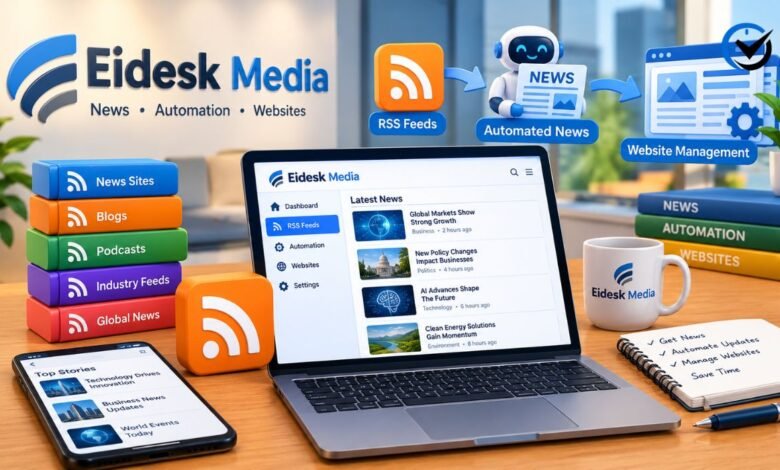
Eidesk Media was advertised in 2015 as software for collecting news and managing a publishing website. Its main idea was to combine automatic imports from external feeds with articles added by an editor. The product description also covered administration, page layout, advertising, and reader interaction. This makes its historical purpose fairly clear, although its present availability is harder to establish. Understanding the project means separating the tools it advertised from claims about what remains supported today. It also helps to understand what feed automation actually does, where human decisions remain necessary, and why a feature list cannot demonstrate reliability.
A Publishing System Advertised in 2015
A public advertisement dated December 14, 2015, described the product as an automatic and manual news collection website. The offer placed it closer to a publishing package than a subscription news service. Its intended use was to help an owner bring material into a website, arrange that content, and administer the resulting pages. However, a sales advertisement documents what a seller promised; it does not establish how many customers used the software or how well it performed. There are no verified adoption figures or independent performance measurements in that listing. Its features should therefore be understood as advertised capabilities.
How RSS and Atom Supplied Content
RSS and Atom are formats that websites use to distribute updates in a form other software can read. Instead of checking each publication manually, an importer reads a feed containing entries such as article titles, dates, summaries, and sometimes complete text. The historical package advertised support for both formats. A hypothetical sports publisher could follow selected league announcements and bring new entries into its content system. This would reduce repeated copying, but the result would depend on what each source supplied. A feed with short summaries would not automatically contain complete reporting, photographs, or every detail shown on the source page.
What Scheduled Imports Did
Automatic collection was advertised through cron jobs, a common way to run tasks at scheduled times on a server. In plain English, the owner could arrange for an importing task to run repeatedly without starting it by hand. A hypothetical hourly schedule would make 24 scheduled runs per day, although that example is not a documented product setting. Scheduling a task also does not guarantee a successful import. A source might be unavailable, a feed might change, or the server might encounter an error. Publishers still need to check whether their collection process runs successfully and whether imported entries arrive as expected.
Bringing Full Articles Into the Feed
The listing mentioned FiveFilters Full-Text RSS for retrieving fuller article content. That tool is designed to expand partial feeds by fetching article pages and identifying the main text. This explains how an importing workflow could sometimes obtain more than a headline and excerpt. However, extraction is a separate step with its own limitations. A changed page layout can affect the result, and some pages may be inaccessible or unsuitable for extraction. For publishers, checking output means looking for missing passages, captions mixed into paragraphs, and unrelated text. They should also establish permission to reuse material rather than treating technical access as authorization.
Why Manual Publishing Mattered
Manual article creation gave editors a way to add material that did not come from an external feed. A local publication, for example, could write an interview, explain a community announcement, or publish its own event report alongside collected updates. These are illustrative uses, not documented customer examples. The value of that combination is editorial flexibility: importing can handle repeated collection work while people contribute context and reporting. Editors still need to check dates, distinguish announcements from independent coverage, and correct misleading headlines. Collecting a statement accurately does not establish that the statement itself is true or complete.
Organizing Stories and Managing Users
Categories, subcategories, pages, and two named user types, administrator and moderator, appeared in the advertised package. These functions address different needs. Content organization helps readers navigate a growing archive, while separate accounts can help a team distribute responsibilities. A practical category structure might separate national coverage from local reporting, then divide local stories by subject. The important decision is whether those divisions make sense to readers. Account labels, meanwhile, should not be mistaken for a complete permissions policy. The surviving feature list does not explain exactly which actions each role could perform or whether access could be customized.
Homepage Layouts and Advertising
The product offered widgets and drag-and-drop homepage arrangement, with advertising placed through widgets. A widget is simply a reusable section of a page, such as a content panel or advertising area. This kind of control can help an owner decide which information receives attention first. For example, an important announcement might deserve a prominent position instead of being buried beneath routine updates. Layout choices should also account for reading order and the space occupied by advertisements. The presence of advertising tools does not establish earnings. Revenue would depend on audience size, advertiser demand, placement, and the commercial arrangements involved.
Mobile Design and Language Support
Responsive design using Bootstrap 3, translation support, and right-to-left layouts were also advertised. Responsive design allows a page to adjust to different screen sizes, helping the same content appear on phones, tablets, and desktop screens. Translation settings address a different issue: the language of interface labels and other site text. Right-to-left support concerns the direction of layouts used for languages such as Arabic. None of these features proves that every screen was accessible or every translation was accurate. A publisher would still need to review navigation, text display, and page elements with readers who use the intended devices and languages.
Comments, Sharing, and Image Loading
The historical feature list included Disqus and Facebook comments, social sharing previews, and image lazy loading. These tools concern different parts of the reader experience. Comment systems provide space for discussion, sharing previews influence how an article appears when shared, and lazy loading delays loading some images until they are needed. Their usefulness depends on implementation. Comments require moderation, previews need suitable titles and images, and delayed image loading should not leave confusing gaps in a page. These are practical evaluation points rather than evidence that the original installation handled them well. No verified performance comparison accompanies the advertised feature list.
Backups and Present Availability
Image and database backups were listed, but backup tools only help when copies can actually restore a working site. An owner should know which content is included, where copies are kept, and whether restoration has been tested. Present access to the original Eidesk software, current support, and ongoing updates remain unverified. Bootstrap 3 has also reached end of life, so an old installation would need assessment of its dependencies before reuse. Historical sales posts do not resolve those questions. Someone evaluating a surviving copy should establish its origin and license, review its code and requirements, and test it away from a public website.
Final Thoughts
Eidesk Media represents a historical attempt to bring news collection and website administration into one publishing package. Its advertised combination of imported material and manual articles explains its intended appeal to website owners. The useful lesson is that automation handles parts of a workflow, while publishers remain responsible for selection, context, presentation, and maintenance. The surviving description offers a view of the product’s planned functions, without proving commercial success or present support. Readers researching it today should keep those limits in mind and judge any proposed installation through current documentation and testing rather than relying on an old sales offer.
Frequently Asked Questions (FAQs)
1. Was it publishing software or a ready-made news service?
The advertisement presented a website package for sale with importing and administration functions. That supports describing it as publishing software rather than a service supplying independently reported news. It does not clarify every delivery detail, such as installation assistance or hosting. Buyers would have needed to establish what they actually received before treating the offer as a complete operating service.
2. What is the practical difference between RSS and Atom?
Both formats communicate website updates, but they organize their underlying data differently. For a publisher, the immediate concern is whether the importing tool understands the feed a source provides. Supporting both formats can broaden compatibility. It does not guarantee identical content from every source, because one publisher may supply complete articles while another distributes only titles and short descriptions.
3. Did automated collection mean the software wrote articles?
There is no evidence in the historical listing that it generated articles through artificial intelligence. The described automation concerned retrieving material and running import tasks. That is different from writing original reporting or producing new explanations. An automatically collected article can still contain errors or outdated information, so automation should not be mistaken for an independent editorial review.
4. Could a publisher use it mainly for original reporting?
Manual article creation was advertised, making original posts part of the intended publishing model. A publication could, in principle, emphasize its own reporting instead of relying heavily on imported material. However, the listing does not describe the editing interface in enough detail to evaluate its suitability for a modern newsroom. Features such as revision history or approval workflows should not be assumed.
5. Could it retrieve complete articles from every source?
No such universal capability is established. Some feeds already contain full articles; others provide only excerpts. An extraction tool may help with the latter, but success depends on the source page and access conditions. Publishers should check the completeness of each result and the permitted use of the material. A successful extraction alone does not settle either question.
6. Could several people manage the same website?
Administrator and moderator accounts were advertised, indicating that the design contemplated more than one type of user. However, the description does not provide a detailed permissions matrix. Before sharing access, an owner would need to check who could edit content, change settings, or manage accounts. Separate logins are useful only when their permissions match the team’s intended responsibilities.
7. Did unlimited categories mean unlimited capacity?
The word unlimited in a feature advertisement should not be read as a measured performance guarantee. The number of categories is different from the number of articles a server can store or the visitors it can serve comfortably. Storage space, database behavior, hosting resources, and import volume all matter. Real capacity would need testing with a representative workload.
8. What did the historical price include?
The December 2015 advertisement stated an asking price of ₦20,000. It did not provide a complete explanation of licensing terms, maintenance commitments, hosting charges, or future updates. That amount is historical and cannot establish today’s purchase price. Anyone considering a surviving copy should seek a clear agreement covering delivery and usage rights instead of assuming the old offer included ongoing support.
9. Is Eidesk the same product as eDesk or AnyDesk?
The available evidence does not establish that connection. eDesk markets customer support software for online sellers, while AnyDesk provides remote desktop software. Those functions differ from the news importing and publishing package described here. Similar spelling can cause mistaken matches, so readers should check a product’s exact name and purpose before assuming that documentation for another service applies.
10. What matters most when evaluating an old publishing installation?
The first priority is understanding what the installation contains and whether it can be maintained. That includes its software versions, external integrations, account permissions, and recovery process. A working homepage is only one part of the assessment. Test imports and administration separately, verify that backups restore correctly, and establish how problems will be fixed before using the system publicly.
Recommended: Cockalier From Puppy to Adult: Size, Temperament, Exercise, Health, and Daily Care





One Comment