

When people first come across the term DPMO, it often looks like just another confusing acronym from the world of manufacturing or quality control. In reality, understanding DPMO meaning is much simpler than it appears once you break it down into plain language. DPMO stands for Defects Per Million Opportunities, and it is one of the most widely used metrics in quality management systems around the world. Businesses use this number to figure out how well or how poorly a process is performing, especially when it comes to spotting mistakes before they reach customers. This article walks through everything you need to know about this concept, from its basic definition to how it is calculated, why it matters, and how it connects to popular improvement frameworks like Six Sigma. By the end, you will have a clear, practical understanding of this term without needing a background in statistics or engineering.
What Is DPMO Meaning in Simple Terms
At its core, DPMO meaning refers to a way of measuring quality by counting how many defects show up for every one million chances a defect could occur. Instead of just saying “we had five mistakes today,” this metric adjusts for the size and complexity of the process being measured. A small business making ten products a day and a large factory making ten thousand products a day cannot be compared fairly using raw defect counts alone. DPMO solves this problem by standardizing the measurement, so companies of any size, in any industry, can compare their performance on equal footing. This makes it a favorite tool among quality managers, production supervisors, and process improvement teams who need consistent numbers across different departments or facilities.
Breaking Down the Three Key Words
To really grasp DPMO meaning, it helps to look at each word separately. The word “Defects” refers to anything that does not meet the expected standard, whether that is a scratch on a product, a missing part, a software bug, or an error in a customer service call. The word “Million” is simply the scale used for comparison, since measuring per million gives a large enough sample to smooth out random variation. The word “Opportunities” is perhaps the most important and least understood part of the phrase, because it refers to every single place within a product or process where a defect could possibly happen. A single item might have multiple opportunities for failure, such as a phone that could fail in its screen, battery, camera, or speaker, giving four separate opportunities per unit.
Why Opportunities Matter So Much
Many people new to this topic assume that opportunities simply means the number of units produced, but that is not accurate. If a company only counted units instead of opportunities, it would miss a huge amount of detail about where problems are actually happening. Think about a car assembly line where each vehicle has hundreds of components that could go wrong, from the engine to the seatbelts to the paint job. Counting each vehicle as just one opportunity would completely hide how many individual points of failure exist. By counting every possible failure point separately, the resulting number gives a much more honest picture of process reliability, which is exactly why quality professionals rely on it so heavily.
The Basic Formula Behind DPMO
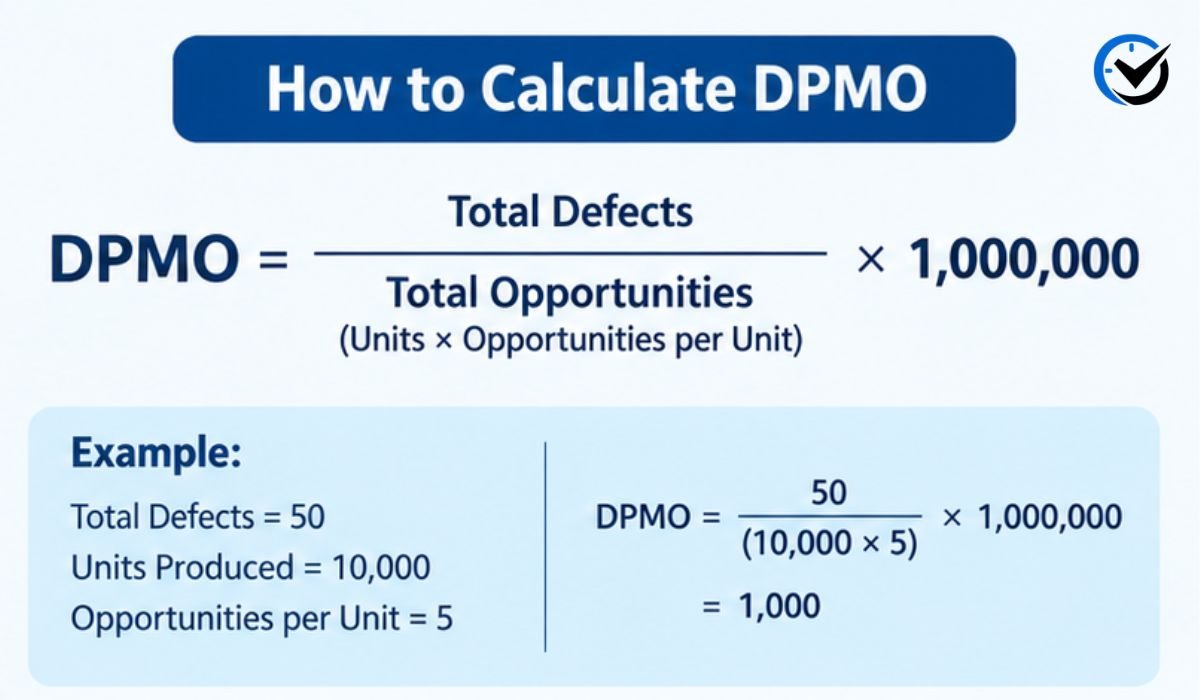
The calculation itself is not complicated once you understand the pieces involved. The formula is the total number of defects divided by the total number of units multiplied by the number of opportunities per unit, and then that entire result is multiplied by one million. In plain words, you first figure out how many total chances for error existed across your entire batch, then see what fraction of those chances actually resulted in a defect, and finally scale that fraction up to a per-million basis. This scaling step is what makes the number easy to compare across different products, teams, or time periods, since everything is expressed using the same one million baseline regardless of how big or small the actual production run was.
A Simple Everyday Example
Imagine a bakery that produces two thousand cupcakes in a single day, and each cupcake has four things that could go wrong, such as wrong frosting color, uneven baking, missing sprinkles, or a cracked liner. That gives a total of eight thousand opportunities for the day. If the bakery inspector finds forty defective cupcakes, the defect rate would be forty divided by eight thousand, which equals zero point zero zero five. Multiplying that by one million gives a result of five thousand defects per million opportunities. This number on its own might sound alarming, but it becomes far more useful when compared against the bakery’s own numbers from previous weeks or against industry benchmarks, allowing owners to see whether quality is improving or slipping over time.
How This Connects to Six Sigma
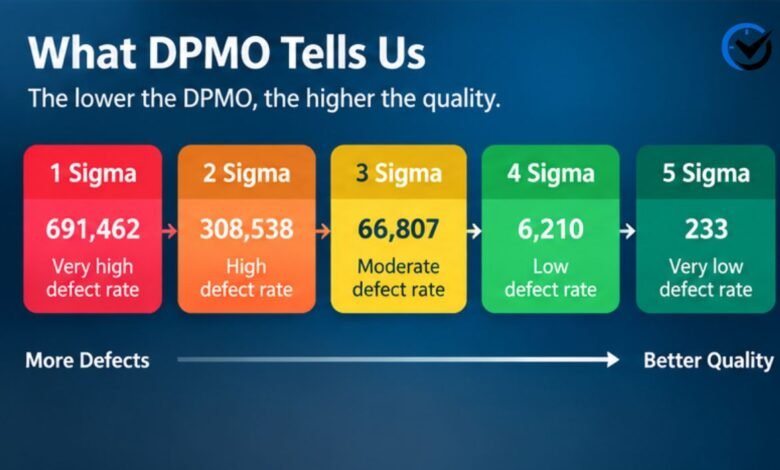
Anyone researching DPMO meaning will almost certainly run into the term Six Sigma, since the two are closely linked. Six Sigma is a structured approach to improving processes and reducing errors, originally developed in the manufacturing world but now used across healthcare, finance, logistics, and many other industries. Within this framework, DPMO acts as a foundational number that gets converted into what is known as a sigma level, which ranges roughly from one to six. A higher sigma level means fewer defects and a more reliable process, with a perfect six sigma level representing just a tiny handful of errors per million opportunities. This conversion allows teams to translate a raw defect count into a broader quality score that is instantly recognizable to anyone familiar with process improvement standards.
Understanding Sigma Levels and What They Represent
Sigma levels give context to raw defect numbers by placing them on a standardized scale that quality professionals across the globe recognize. A process operating at a low sigma level, such as two, tends to produce a very high number of defects and generally signals serious problems that need immediate attention. Moving up to a sigma level of four is often considered a reasonably good baseline for many industries and reflects a process that has some room for improvement but is generally under control. Reaching sigma levels of five or six is considered exceptional and is typically only achieved by organizations that have invested heavily in refining their systems, training their teams, and continuously monitoring their output for even the smallest inconsistencies.
Why Businesses Care About This Number
Quality is not just a nice-to-have feature for companies; it directly affects costs, customer trust, and long-term reputation. When defect rates are high, businesses spend more money on rework, returns, warranty claims, and customer complaints, all of which eat into profits. By tracking DPMO consistently, organizations can catch problems early, before they turn into expensive recalls or damaged relationships with customers. This metric also gives leadership teams a clear, data-driven way to set improvement goals, since it is much easier to aim for a specific numeric target than to rely on vague statements like “we need better quality.” Over time, tracking this number also helps companies prove to clients, auditors, or regulators that their processes meet required standards.

Industries Where This Metric Is Commonly Used
While the concept originally grew out of manufacturing floors, its use has spread far beyond factories in recent decades. Software development teams use similar defect tracking methods to measure bugs found during testing phases relative to the number of features or code sections reviewed. Healthcare organizations apply comparable thinking to track medication errors or procedural mistakes relative to total patient interactions. Call centers and customer service departments often adapt this approach to measure how many customer interactions contain errors, such as wrong information given or unresolved issues, compared to the total number of calls handled. This flexibility is part of what makes the underlying idea so valuable, since almost any process with countable steps and potential failure points can be measured this way.
Common Mistakes People Make When Calculating This Metric
One of the biggest errors people make is confusing units with opportunities, which leads to numbers that look far better than the actual situation warrants. Another frequent mistake is failing to clearly define what counts as a defect before starting the measurement, which results in inconsistent tracking between different shifts or team members. Some teams also forget to update their opportunity count when a product design changes, meaning older calculations no longer reflect the current number of possible failure points. Being careful and consistent with definitions from the very beginning is essential, because even small inconsistencies in counting can lead to misleading conclusions about whether a process is actually improving or getting worse.
How to Improve a High Defect Rate
Once a business identifies that its defect rate is higher than desired, the next step involves digging into root causes rather than just addressing surface-level symptoms. Teams often start by mapping out each step of a process to identify exactly where failures tend to cluster, since defects are rarely spread evenly across every stage. Training programs for employees, better equipment maintenance schedules, and clearer work instructions are common solutions that address the human and mechanical sides of quality problems. Many organizations also introduce checkpoints throughout their process rather than only inspecting the finished product, which allows them to catch and correct mistakes earlier, before more time and materials are wasted on something that will ultimately need to be redone or discarded.
The Difference Between DPMO and Similar Metrics
People researching this topic often come across related terms like DPU, which stands for Defects Per Unit, or PPM, which stands for Parts Per Million. While these metrics sound similar, they measure slightly different things and serve different purposes. DPU simply counts defects relative to the number of units produced, without factoring in the number of opportunities within each unit, making it a simpler but less detailed measurement. PPM is often used interchangeably with defect rates in some industries but does not always account for multiple opportunities per unit the way this metric does. Knowing these distinctions helps avoid confusion when comparing quality reports from different sources or industries that might use slightly different measurement standards.
Real-World Impact on Customer Experience
Beyond the technical calculations, this metric ultimately connects back to something every business cares about deeply, which is how customers experience their products or services. A lower number reflects fewer chances that a customer receives something broken, incorrect, or unsatisfactory, which directly builds trust and loyalty over time. Companies that consistently track and improve their defect rates often find that customer complaints drop, positive reviews increase, and repeat business grows stronger. This creates a ripple effect throughout the organization, since happier customers typically lead to steadier revenue, which in turn allows businesses to invest further in the very quality improvement programs that got them there in the first place.
Tools and Software Used for Tracking
Many organizations no longer calculate this metric by hand, especially as production volumes grow large enough that manual tracking becomes impractical. Quality management software platforms now offer built-in dashboards that automatically calculate defect rates in real time as data gets entered from inspection stations or automated sensors. These tools often include visual charts that show trends over weeks or months, making it easy for managers to spot patterns without needing to run calculations themselves. Some platforms also integrate directly with production equipment, pulling data automatically rather than relying on someone to manually log every defect, which reduces human error in the tracking process itself and provides a more reliable long-term record.

Getting Started With This Metric in a Small Business
Smaller businesses sometimes assume that structured quality metrics are only for large corporations with dedicated quality departments, but that is not the case at all. Even a small shop or startup can begin tracking this number using nothing more than a simple spreadsheet and a clear definition of what counts as a defect and what counts as an opportunity. Starting small, perhaps by tracking just one product line or one stage of production, allows a business to build the habit of consistent measurement before expanding the practice more broadly. Over time, even modest tracking efforts can reveal surprisingly useful insights about where the most common problems occur, giving smaller businesses a genuine competitive advantage without needing expensive software or specialized staff.
Final Thoughts
Understanding DPMO meaning does not require a background in engineering or statistics, as this article has hopefully shown. At its heart, this metric is simply a fair and consistent way to measure how often things go wrong relative to how many chances existed for something to go wrong in the first place. Whether you run a small bakery, manage a software team, or oversee a large manufacturing plant, this way of thinking about quality gives you a practical tool for spotting problems early and tracking real improvement over time. The math behind it is straightforward once the terms are clearly defined, and the benefits of consistent tracking extend far beyond the factory floor into nearly every industry that values reliability and customer satisfaction. By keeping the core ideas in mind, defects, opportunities, and the million-based scale, anyone can start applying this concept to their own work and begin building a clearer picture of process quality.
Frequently Asked Questions
1. What does DPMO stand for?
DPMO stands for Defects Per Million Opportunities. It is a quality measurement that shows how many defects occur for every one million chances that a defect could happen within a process or product.
2. Why is DPMO used instead of just counting total defects?
Simply counting total defects does not account for differences in production volume or complexity between processes. DPMO standardizes the measurement on a per-million basis, making it possible to fairly compare quality across different products, teams, or company sizes.
3. How is DPMO different from a defect rate percentage?
A defect rate percentage typically compares defects to total units produced, while DPMO compares defects to the total number of opportunities for failure, which can be much higher than the unit count when each item has multiple points that could go wrong.
4. What counts as an opportunity in the DPMO formula?
An opportunity is any specific point within a product or process where a defect could realistically occur. For example, a single electronic device might have several opportunities, including its screen, battery, buttons, and internal wiring.
5. Is a lower DPMO always better?
Yes, a lower number always indicates fewer defects relative to the opportunities available, which generally reflects a more reliable and well-controlled process. Businesses aim to reduce this number over time as part of ongoing quality improvement efforts.
6. How does DPMO relate to Six Sigma?
DPMO serves as the foundational number used to calculate a process’s sigma level within the Six Sigma framework. Lower DPMO values correspond to higher sigma levels, which represent stronger overall process performance and fewer errors.
7. Can small businesses use DPMO tracking?
Absolutely, small businesses can track this metric using simple tools like spreadsheets, without needing specialized software or a dedicated quality team. Starting with one product or process is an effective way to build the habit before expanding further.
8. What industries commonly use DPMO?
While it originated in manufacturing, this metric is now used across software development, healthcare, call centers, logistics, and many other industries that need a reliable way to measure and reduce errors within their processes.
9. What is a good DPMO score?
A good score depends heavily on the specific industry and product, since acceptable defect levels vary widely. Generally, lower numbers are considered better, and companies often set internal targets based on their own historical performance or industry benchmarks.
10. What is the difference between DPMO and DPU?
DPU, or Defects Per Unit, measures defects relative only to the number of units produced, without considering multiple opportunities per unit. DPMO offers a more detailed view by factoring in every possible point of failure within each unit.
Recommended: Best Papa a la Huancaina Near Me: Creamy, Spicy, and Unmissable





One Comment