

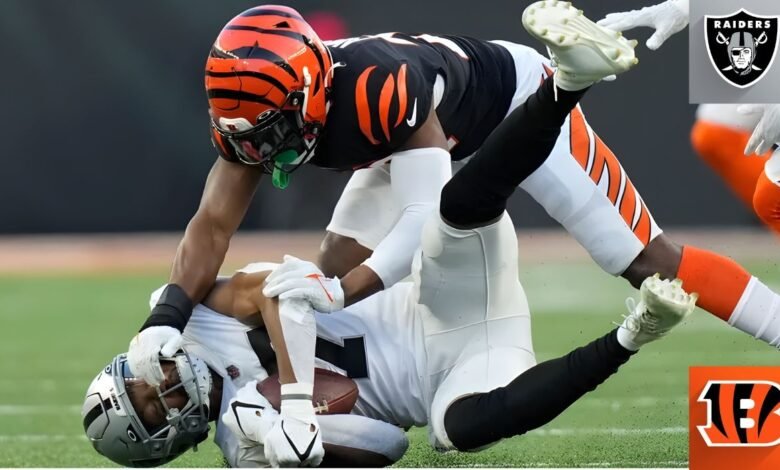
The Las Vegas Raiders vs Bengals Match Player Stats below cover the teams’ most recent meeting, played on November 3, 2024, at Paycor Stadium in Cincinnati. The Bengals won 41–24 after building a 31–10 lead through three quarters. The final score suggests a clear home victory, but the player numbers show how several different performances shaped the result: Joe Burrow’s five touchdown passes, Chase Brown’s strong ground game, and Mike Gesicki’s 100-yard receiving day gave Cincinnati its edge. For Las Vegas, Jakobi Meyers topped the receiving chart, while the Raiders’ two quarterbacks split the passing work.
This game was a Week 9 regular-season matchup, not a playoff contest. It was also the latest Raiders–Bengals meeting available for this recap. Cincinnati entered the game at 3–5 and Las Vegas at 2–6; the result moved the Bengals to 4–5 and the Raiders to 2–7. Keeping the date clear helps when comparing this box score with older meetings between the franchises, including their 2021 playoff game.
What the Final Score and Team Stats Show
Cincinnati scored in every quarter: 7 points in the first, 10 in the second, 14 in the third, and 10 in the fourth. Las Vegas opened with a touchdown and added a field goal in the first half, but did not score in the third quarter. The Raiders put up 14 points in the final period, including a defensive touchdown, but the late push did not erase the gap built earlier.
The Bengals finished with 373 total net yards, compared with 217 for the Raiders. Cincinnati also held the ball for 35 minutes and 14 seconds, more than 10 minutes longer than Las Vegas. Penalties were fairly close: the Raiders had six for 51 yards, while the Bengals had seven for 60. The yardage and possession figures help explain why Cincinnati controlled much of the game, even though Las Vegas found ways to score late.
Joe Burrow Led Cincinnati’s Passing Attack
Joe Burrow completed 27 of 39 passes for 251 yards, five touchdowns, and one interception. His completion rate was about 69 percent, and his passer rating was 115.5. The five touchdown passes tied his career high at the time. His passing yardage was not unusually high, but he made the most of key opportunities, spreading touchdowns among several receivers rather than relying on one target.
Burrow’s impact came from converting drives into points. He connected with Chase Brown, Drew Sample, Andrei Iosivas, and Mike Gesicki for scores. That distribution made it harder for the Raiders to focus their coverage on one player. Burrow also avoided a sack in the passing statistics listed on the team box score, although he had three rushing attempts for 11 yards. His one interception came on a defensive play that Las Vegas turned into a touchdown.
Chase Brown Supplied Cincinnati’s Ground Game
Running back Chase Brown led the game in rushing with 27 carries for 120 yards, an average of 4.4 yards per attempt. He did not score on a carry, but his work helped Cincinnati sustain drives and manage the game. Brown also caught five passes for 37 yards and a touchdown, bringing his total to 157 yards from scrimmage. That combination made him one of the Bengals’ most productive players in both phases of the offense.
Brown’s receiving touchdown helped Cincinnati answer the Raiders’ opening score. His role was especially valuable because the Bengals could use him as a runner and as a short-pass option. Those touches gave Burrow a dependable outlet and forced the Raiders to account for Brown even when he was not carrying the ball. His 120 rushing yards were the game’s highest individual total on the ground.
Mike Gesicki Was Cincinnati’s Top Receiver
Mike Gesicki led all players in receiving yards, finishing with five catches for 100 yards and two touchdowns. His longest reception covered 47 yards. The Bengals’ passing attack spread the ball around, but Gesicki made the biggest impact among Cincinnati’s pass catchers by combining a long scoring play with another touchdown in the red zone.
Ja’Marr Chase recorded seven catches for 43 yards, the most receptions by a Bengals player in the game. Chase drew attention from the Raiders’ defense, but his yardage total stayed modest compared with his usual explosive potential. Brown added five receptions for 37 yards, while Drew Sample caught four passes for 14 yards and a touchdown. Andrei Iosivas had one catch for 10 yards, also for a score. Together, these contributions gave Burrow several scoring options.
Raiders Quarterbacks Split the Passing Work
Gardner Minshew completed 10 of 17 passes for 124 yards, with no touchdowns or interceptions. Desmond Ridder completed 11 of 16 for 74 yards, one touchdown, and no interceptions. Minshew produced more passing yardage, while Ridder had the Raiders’ only passing touchdown. Together, they completed 21 of 33 attempts for 198 yards and one touchdown.
The difference between the two stat lines reflects their separate roles in the game. Minshew handled the earlier passing work, and Ridder added a late scoring connection with tight end Brock Bowers. The Raiders did not match Burrow’s five touchdown passes, but the quarterback totals should be read alongside the team’s limited possession time and lower yardage. Neither Las Vegas passer threw an interception, and the Raiders’ defensive score came from a pick-six rather than a passing touchdown.
Las Vegas Had a Quiet Rushing Day
Alexander Mattison led the Raiders with 36 rushing yards on nine attempts, averaging 4.0 yards per carry. Zamir White carried six times for 10 yards and scored the team’s rushing touchdown. Ameer Abdullah added 12 yards on four carries, while Ridder gained two yards on one attempt. The team’s limited production on the ground left Las Vegas with fewer ways to extend drives.
The Raiders’ rushing numbers were much lower than Brown’s individual total for Cincinnati. That gap mattered because a steady run game can keep an offense on schedule and reduce the pressure on its quarterback. Las Vegas did get a touchdown from White, but the run game did not produce a sustained source of yardage. Mattison’s 36 yards led his team, yet no Raiders runner reached 40 yards.
Jakobi Meyers Led the Raiders’ Receivers
Jakobi Meyers was Las Vegas’ leading receiver, catching eight passes for 105 yards. His longest reception was 23 yards, and he accounted for nearly half of the Raiders’ combined passing yardage. Meyers did not score, but his catch and yardage totals made him the clearest receiving standout for the visitors. His production gave both quarterbacks a reliable target across the game.
Brock Bowers finished with five catches for 45 yards and one touchdown, including the late 22-yard scoring reception from Ridder. Tight end Harrison Bryant caught two passes for 22 yards, while Abdullah had three receptions for 14 yards. Tre Tucker caught two passes for five yards, and rookie Ramel Keyton added one catch for seven. Bowers’ touchdown gave the Raiders a late offensive score, while Meyers’ 105 yards led their receiving group.
Defensive Plays Shaped the Late Score
Cincinnati defensive end Trey Hendrickson recorded four sacks, a career high at the time. His pressure repeatedly pushed the Raiders into difficult passing situations, and a late strip-sack helped Cincinnati regain the ball near the Las Vegas goal line. The Bengals converted that opportunity into points, reinforcing a lead they had built with their offense. Hendrickson’s performance was the most prominent individual defensive contribution in the game.
Las Vegas also made a major defensive play. Cornerback Jack Jones returned an interception 29 yards for a touchdown early in the fourth quarter, cutting into Cincinnati’s lead. That play showed how defensive scoring can change the look of a box score: the Raiders reached 24 points without matching the Bengals’ offensive touchdown production. The Bengals still answered the challenge and added points of their own, while their defense generated pressure and a fumble recovery.
Why Cincinnati Won the Statistical Matchup
The clearest difference was Cincinnati’s efficiency in the passing game. Burrow threw five touchdown passes on 39 attempts, while the Raiders’ quarterbacks combined for one touchdown on 33 attempts. The Bengals also had the game’s leading rusher and leading receiver. Those advantages meant that Cincinnati could score through multiple routes: downfield passes, short connections, and Brown’s work as a runner and receiver.
Possession and total yards added to that edge. Cincinnati held the ball for 10 minutes and 28 seconds longer and finished with 156 more net yards. Las Vegas did create a defensive touchdown and scored twice in the final quarter, but the Raiders had no points in the third. Cincinnati’s 14-point third quarter built the cushion that made the late Raiders scores insufficient to change the outcome.
What the Raiders’ Numbers Reveal
The Raiders’ stats were led by Meyers’ receiving production and the combined work of Minshew and Ridder. Meyers surpassed 100 yards, and both quarterbacks completed a majority of their attempts. Yet the offense managed only 217 net yards and one passing touchdown. The difference between completing passes and sustaining scoring drives was central: Las Vegas had a useful receiving performance, but fewer total opportunities and less production across the full offense.
The rushing chart also highlights a challenge for the Raiders. Mattison led the team with 36 yards, and White scored once, but the group did not provide the same volume or yardage as Brown did for Cincinnati. When the running game produces little, a team can become more dependent on passing situations, where the defense can anticipate the play. The Raiders’ late points came through both defense and offense, but they arrived after Cincinnati had established control.
How to Read the Box Score
A box score records individual outcomes, but it does not show every detail of how a game unfolded. For example, Meyers’ 105 receiving yards identify him as the Raiders’ top receiver, but they do not capture the timing of each catch or whether a reception moved the chains. Similarly, Brown’s 120 rushing yards show volume and production but do not by themselves explain how his runs affected field position and play selection.
It is also useful to separate offensive and defensive points. Jones’ interception return counted toward Las Vegas’ 24 points, but it was not a passing touchdown by either Raiders quarterback. Likewise, Burrow’s five touchdown passes account for Cincinnati’s passing scores, while the team also scored through a field goal. Reading the scoring summary alongside passing, rushing, and receiving lines gives a more complete account of who contributed and how.
Final Thoughts
The November 3, 2024, meeting ended with Cincinnati beating Las Vegas 41–24. Burrow led the passing attack with 251 yards and five touchdowns, Brown led the ground game with 120 rushing yards, and Gesicki topped all receivers with 100 yards and two scores. For the Raiders, Meyers led the receiving chart with 105 yards, while Bowers caught a late touchdown and Jones provided the game’s defensive score.
The team numbers support the final result: Cincinnati gained more yards, held possession longer, and scored consistently across all four quarters. Las Vegas had individual bright spots and a strong late response, but its offense could not keep pace with the Bengals’ scoring efficiency. These stats offer the clearest answer to who led each team: Cincinnati’s leaders shaped the win, while the Raiders’ most notable performances came from Meyers, Bowers, and Jones.
Frequently Asked Questions
1. When did the Las Vegas Raiders last play the Cincinnati Bengals?
The latest meeting covered here took place on November 3, 2024, during Week 9 of the NFL regular season. Cincinnati hosted the game at Paycor Stadium and won 41–24. This recap uses that game’s player statistics.
2. Who won the Raiders vs. Bengals game?
The Cincinnati Bengals won 41–24. They built a 31–10 lead through three quarters, then held off a Raiders comeback attempt in the fourth. Las Vegas scored 14 points in the final quarter, including a defensive touchdown.
3. Who was the leading passer in the game?
Joe Burrow led all passers with 251 yards and five touchdown passes on 27 completions from 39 attempts. Gardner Minshew threw for 124 yards, and Desmond Ridder added 74 yards and one touchdown for Las Vegas.
4. Who led the game in rushing yards?
Chase Brown led all players with 120 rushing yards on 27 carries. Alexander Mattison led the Raiders with 36 yards on nine attempts. Brown also contributed 37 receiving yards and a receiving touchdown.
5. Who had the most receiving yards?
Mike Gesicki led the game with 100 receiving yards on five catches. His two touchdown receptions also made him the Bengals’ leading scoring receiver. Jakobi Meyers led the Raiders with eight catches for 105 yards.
6. How many touchdown passes did Joe Burrow throw?
Burrow threw five touchdown passes, tying his career high at the time. His scoring passes went to Chase Brown, Drew Sample, Andrei Iosivas, and Mike Gesicki, who caught two of them.
7. Which Raiders player scored a defensive touchdown?
Cornerback Jack Jones returned an interception 29 yards for a touchdown early in the fourth quarter. The play cut into Cincinnati’s lead and helped Las Vegas reach 24 points, but the Bengals maintained their advantage.
8. How many sacks did Trey Hendrickson record?
Hendrickson recorded four sacks, a career high at the time. His pressure disrupted the Raiders’ passing game, and a late strip-sack helped Cincinnati recover the ball and protect its lead.
9. Did the Raiders use more than one quarterback?
Yes. Gardner Minshew completed 10 of 17 passes for 124 yards, while Desmond Ridder completed 11 of 16 for 74 yards and a touchdown. Neither quarterback threw an interception.
10. How did Cincinnati gain more control of the game?
The Bengals gained 373 net yards to the Raiders’ 217 and held the ball for 35:14, compared with Las Vegas’ 24:46. Cincinnati also scored in every quarter, while the Raiders were held scoreless in the third.
Recommended: Steelers vs Atlanta Falcons Match Player Stats: A Detailed Box Score Review


One Comment