

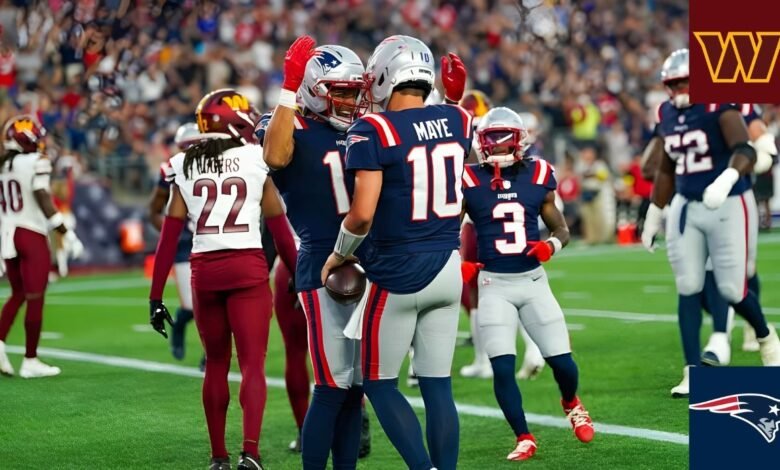
The New England Patriots beat the Washington Commanders 48–18 in a preseason game at Gillette Stadium on August 8, 2025. The score was lopsided, but the team statistics were closer: Washington gained 338 total yards to New England’s 327. The Patriots made more of their scoring chances, while a 100-yard kickoff return helped them take control early. This recap covers the scoring, player performances, and team numbers, with the important context that preseason games feature auditions and changing lineups rather than a full regular-season contest.
Game Context and Final Score
This was the teams’ preseason opener, so the result offered a first look at players competing for roles and roster spots. New England won each quarter, leading 17–0 after the first and 27–3 at halftime. Washington scored 15 points after the break, but the Patriots added 21 more to finish with a 30-point margin. The final score reflects New England’s ability to turn key plays into touchdowns, though it should not be read as a direct measure of how the teams would compare in a regular-season game.
How the Patriots Took Control
The defining play came before New England’s offense had run a snap. Rookie running back TreVeyon Henderson returned the opening kickoff 100 yards for a touchdown, giving the Patriots a 7–0 lead. Drake Maye later scored on a five-yard run, and a 22-yard field goal by Andy Borregales made it 17–0 by the end of the first quarter. That early burst forced Washington to chase the score and gave New England’s reserve units room to play with a lead.
Washington’s First-Half Response
Washington’s first points came on a 37-yard Matt Gay field goal in the second quarter. The Commanders moved the ball on that drive, covering 50 yards over 12 plays, but they did not finish it with a touchdown. New England answered with a short-field sequence that ended in a two-yard Joshua Dobbs rushing score. Parker Romo also made a 57-yard field goal for the Patriots, sending the home team into halftime up 27–3.
Patriots Passing Stats
Three New England quarterbacks appeared in the game. Ben Wooldridge completed nine of 12 passes for 132 yards, one touchdown, and no interceptions. Joshua Dobbs went five for 12 for 45 yards, while Maye completed three of five passes for 12 yards. The passing totals were modest compared with the final score because New England also scored on a kickoff return and several rushing plays. Wooldridge’s efficiency stood out, but one preseason appearance is a limited sample and does not settle questions about a player’s role.
Commanders Passing Stats
Josh Johnson completed 15 of 22 passes for 173 yards, one touchdown, and one interception. Sam Hartman completed nine of 19 attempts for 64 yards and threw one interception. Johnson produced Washington’s most effective passing line, while Hartman saw extended action later in the game. The Commanders finished with 237 passing yards between the two quarterbacks, but the interceptions and limited touchdown production made it harder to close the scoring gap. These numbers describe this game only; preseason rotations and opponent substitutions affect how they should be interpreted.
Patriots Rushing Leaders
Rhamondre Stevenson led the Patriots with 36 yards on seven carries. Lan Larison also carried seven times, gaining 35 yards and scoring a two-yard touchdown late in the fourth quarter. Terrell Jennings added 19 yards and a one-yard rushing score, while Gibson gained 26 yards on six attempts. Henderson’s most memorable play was his kickoff return, but he also had one rushing attempt for 18 yards. The varied contributions helped New England maintain a productive ground attack through different lineup groups.
Commanders Rushing Leaders
Devin Felton led Washington with 42 yards on six carries, including a 28-yard run. Jacory Croskey-Merritt gained 24 yards on seven attempts, and Chris Rodriguez Jr. added 22 yards on six. Jeremy McNichols had 18 rushing yards and scored on a two-yard run in the third quarter. Washington’s backs had useful individual gains, but the team did not produce enough rushing touchdowns to keep pace with New England. Johnson’s two carries resulted in a loss of 11 yards, lowering the combined rushing output.
Patriots Receiving Leaders
Efton Chism III led New England’s receivers with six catches for 50 yards and a 12-yard touchdown from Wooldridge. Jiles caught two passes for 48 yards, and JaQuae Jackson Webb added two catches for 41 yards, including a 33-yard reception. Henderson caught three passes for 12 yards. Chism’s volume and touchdown made him the clearest receiving standout in the box score, while the gains by Jiles and Webb showed that several players contributed to New England’s passing game.
Commanders Receiving Leaders
Javon Brooks topped Washington’s receiving chart with five catches for 59 yards. Tay Martin had three receptions for 36 yards, while Luke Cager recorded two for 35, including a 33-yard gain. Jacoby Jones caught a three-yard touchdown pass from Johnson in the fourth quarter. The Commanders spread the ball among several players, but no Washington receiver reached 60 yards. The distribution fits a preseason setting, when coaches often give multiple receivers opportunities to show how they perform in live action.
Special Teams Shaped the Score
Henderson’s opening 100-yard kickoff return was worth seven points without requiring the offense to move the ball. New England also converted its extra points and made field goals from 22 and 57 yards. Washington’s Gay connected from 37 yards and kicked the extra point after Jones’s touchdown. The special-teams contrast mattered: the long return immediately widened the gap, and Romo’s 57-yarder added points from distance. A box score focused only on offensive yardage would miss how much these plays influenced the final margin.
Turnovers and Field Position
Washington committed two turnovers, compared with one by New England. The turnover total did not tell the whole story of the score, since the Patriots also benefited from Henderson’s return and were more effective at finishing drives. Short fields can turn an average offensive possession into a scoring opportunity, so turnovers matter even when the teams’ total yardage is similar. In this game, New England’s fewer giveaways and better scoring efficiency helped it convert its opportunities into a substantial lead.
Third-Down and Red-Zone Numbers
New England converted seven of 14 third-down attempts, while Washington converted five of 13. The Patriots scored on five of six red-zone trips; Washington scored on two of three. These figures help explain why New England led by 30 despite gaining fewer total yards. The Patriots finished drives more often, while the Commanders left scoring chances with field goals or failed conversions. Because this was a preseason game with rotating units, the figures are useful for describing the performance, but they should not be treated as a full-season measure.
Penalties and Possession
Washington was penalized 13 times for 98 yards, compared with two penalties for 15 yards by New England. That difference disrupted the Commanders’ drives and gave the Patriots a cleaner game. Washington held the ball for 30 minutes and 39 seconds, slightly more than New England’s 29:21, but extra possession did not lead to enough points. Time of possession alone does not show how well a team used each drive; the penalty and red-zone totals give more context for why the Commanders lost by a wide margin.
Quarter-by-Quarter Scoring
New England’s 17-point first quarter set the tone. The Patriots added 10 points in the second, then scored once in the third and twice in the fourth. Washington did not score in the opening quarter, managed a field goal before halftime, and responded with a touchdown and two-point conversion in the third. The Commanders added another touchdown in the fourth. Their second-half offense was more productive, but the early deficit was too large to overcome, especially as New England continued to score.
What the Box Score Says About New England
The Patriots’ strongest indicators were their scoring efficiency, limited penalties, and contributions across several phases. The kickoff-return touchdown supplied an immediate advantage, and multiple players added rushing scores. Wooldridge’s 9-for-12 passing line was efficient, while Chism led the receiving group. At the same time, New England finished with 327 total yards, fewer than Washington. That contrast shows why the score should be read alongside the underlying stats: the Patriots made more of their chances, but did not dominate every category.
What the Box Score Says About Washington
Washington gained more total yards and had more time with the ball, but its offense did not match that yardage with points. The Commanders’ 13 penalties for 98 yards, two turnovers, and lower red-zone output were costly. Johnson’s 173 passing yards and Felton’s 42 rushing yards were positive individual results, while McNichols and Jones scored touchdowns. Still, the team’s slow start made the second-half improvement less consequential. For a preseason opener, the performance points to areas to review rather than firm conclusions about the regular season.
Why Preseason Stats Need Context
Preseason statistics can identify who made plays in a particular game, but they do not show the full picture of a player’s future role. Playing time, competition for roster spots, and lineup changes differ from regular-season conditions. A quarterback’s passing line may reflect only a short stretch against a particular defensive group, while a running back’s production can depend on blocking and field position. The Patriots’ 48 points and Washington’s 18 are the official result, but readers should distinguish this exhibition from a regular-season matchup.
Final Thoughts
The Patriots’ 48–18 win came from an explosive start, a long kickoff return, and stronger red-zone execution. Washington actually gained more total yards, but penalties, turnovers, and missed scoring chances widened the final gap. Wooldridge and Chism led key New England passing contributions; Johnson, Brooks, and Felton were among Washington’s statistical leaders. The game provides a clear record of what happened on August 8, 2025, while its preseason setting limits how much it can say about either team’s regular-season strength.
Frequently Asked Questions
1. Who won the Patriots vs. Commanders game?
The New England Patriots won 48–18. The game was a preseason matchup played at Gillette Stadium on August 8, 2025.
2. Was this a regular-season game?
No. It was a preseason game. Teams use these games to evaluate players and prepare for the regular season, so playing time and lineups can differ.
3. Who led New England in passing yards?
Ben Wooldridge led the Patriots with 132 passing yards. He completed nine of 12 attempts, threw one touchdown, and had no interceptions.
4. Who led Washington in passing yards?
Josh Johnson led the Commanders with 173 passing yards. He completed 15 of 22 passes, with one touchdown and one interception.
5. Who was New England’s leading rusher?
Rhamondre Stevenson led the Patriots in rushing yards, gaining 36 on seven carries. Lan Larison also gained 35 yards and scored a late touchdown.
6. Who led Washington in rushing?
Devin Felton led Washington with 42 yards on six carries. His longest run covered 28 yards.
7. Who led the Patriots in receiving?
Efton Chism III led New England with six catches for 50 yards and a touchdown. JaQuae Jackson Webb had 41 receiving yards.
8. Who led the Commanders in receiving?
Javon Brooks led Washington with five receptions for 59 yards. Tay Martin was next with three catches for 36 yards.
9. How did TreVeyon Henderson score?
Henderson returned the opening kickoff 100 yards for a touchdown. The play gave New England a 7–0 lead before its offense took the field.
10. Which team gained more total yards?
Washington gained 338 total yards, compared with New England’s 327. The Patriots won by converting more of their scoring chances and avoiding as many penalties and turnovers.
Recommended: Best Pulpo a la Gallega Near Me: A Spanish Octopus

One Comment