

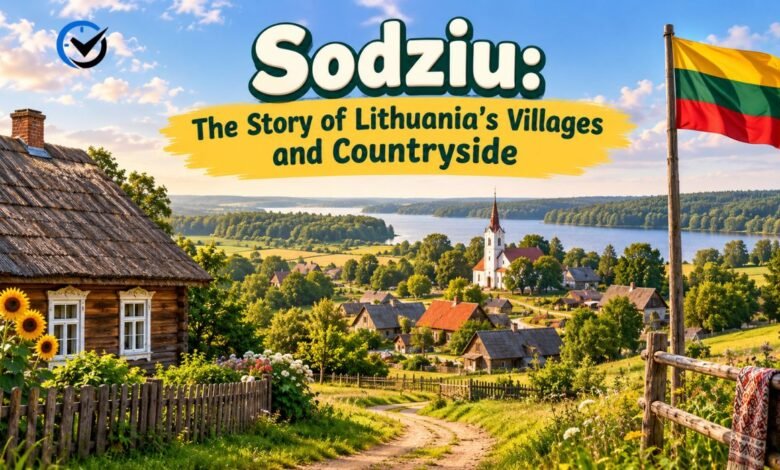
The word “Sodziu” points toward a much larger subject: the history and culture of Lithuania’s villages. It is commonly used online as a simplified spelling of the Lithuanian word sodžius, associated with a village or rural settlement. The spelling without Lithuanian diacritics can blur the original word’s form and meaning, so it is useful to treat it as a doorway into rural heritage rather than the name of one specific village or a single fixed tradition.
What the Word Means
In Lithuanian, kaimas is the familiar modern word for “village.” Sodžius is another word associated with a village or rural settlement, and it also appears in historical and regional contexts. The spelling “Sodziu” leaves out the Lithuanian letter ž, which has a distinct sound. As a result, an online search for the unaccented form may point to different uses or explanations. Context matters: the word is best understood alongside Lithuania’s settlement history and language.
The Countryside Behind the Term
Lithuanian village life developed through a close relationship between people, land, forests, and water. For centuries, most communities depended on farming, animal husbandry, fishing, and the use of nearby natural resources. A village was not only a cluster of homes; it was also a working landscape shaped by fields, roads, pastures, wells, woods, and shared customs. This rural setting helps explain why Lithuania’s countryside remains central to discussions of national history and cultural identity.
How Settlement Patterns Changed
Lithuania’s rural settlements did not all follow one pattern. Some homes and farmsteads stood apart from one another, while other communities formed more compact groups or rows along a road. Settlement layouts shifted as land was divided, cultivated, inherited, or reorganized by political authorities. Geography also mattered: forests, rivers, soil, and access to roads influenced where people built and how they worked. These patterns are part of the story recorded in historic villages and surviving farmsteads.
The Valakų Reform and Village Layouts
A major change came with the land reform known as the Valakų reform, introduced in the Grand Duchy of Lithuania during the 16th century. It organized land into measured holdings and helped establish planned village layouts, including settlements arranged along roads. The reform served political and economic goals as well as agricultural ones, and its effects varied by place. It reshaped how land was used and how some communities were arranged, leaving traces in the rural landscape.
Homes and Farmsteads
A traditional rural homestead often included more than a dwelling. Depending on the household and region, buildings could include a barn, granary, animal shelter, sauna, or other structures needed for work and storage. Their placement reflected daily tasks: where crops were kept, where livestock stayed, and how people moved through the yard. Wood was widely used in rural construction, though building methods and details differed. The arrangement of a homestead offers clues to the practical demands of village life.
Regional Differences Across Lithuania
Lithuania is often described through five ethnographic regions: Aukštaitija, Žemaitija, Dzūkija, Suvalkija, and Lithuania Minor. Their boundaries and identities are cultural rather than simple divisions of rural life, and local variation exists within each region. Differences can be seen in speech, food, music, clothing, crafts, and architecture. Forests and wetlands shaped livelihoods in parts of Dzūkija, for example, while other areas developed their own farming and building traditions. Regional variety is one reason there is no single model of a Lithuanian village.
Farming and the Rhythm of the Year
Agriculture shaped the rural calendar. Planting, haymaking, harvesting, caring for animals, and preparing food followed the seasons and demanded cooperation within households and communities. Work was often physically demanding, and the success of a family could depend on weather, soil, tools, and available labor. Seasonal routines also created occasions for gatherings and customs. Although modern machinery has changed farm work, the older rhythm remains visible in museums, local celebrations, family memories, and the organization of historic farmsteads.
Food, Forests, and Local Knowledge
Rural food traditions grew from what people could raise, gather, preserve, or obtain nearby. Grain, potatoes, dairy products, vegetables, mushrooms, berries, and meat have all played roles in Lithuanian food culture, with recipes varying by region and household. Forests were especially important in areas where foraging formed part of local life. Knowledge about when to gather, how to preserve food, and what grew in a particular landscape passed between generations. These practices connect village heritage to everyday skills, not just special occasions.
Customs, Songs, and Community Life
Village traditions included songs, stories, seasonal celebrations, religious observances, and shared work. Not every custom was practiced everywhere, and traditions changed over time as people moved, technologies spread, and social conditions shifted. Oral culture helped preserve local knowledge and memories, while community events gave people reasons to meet beyond work. Looking at these customs as living practices, rather than as an unchanging picture of the past, gives a more accurate sense of how rural culture has developed.
Cross-Crafting and Village Landmarks
Lithuanian cross-crafting brings together woodwork, metalwork, sculpture, painting, and religious meaning. Crosses and related monuments have stood beside roads, at village entrances, in cemeteries, and at other significant places. Some also served as landmarks that connected a community with its shared memory and faith. The craft varies in form and decoration, and its traditions have been recognized by UNESCO as intangible cultural heritage. Its place in village settings shows how art, belief, and communal identity can meet in the landscape.
Language and Local Identity
Lithuanian dialects and local speech patterns are another part of rural heritage. People in different areas may use distinct words, pronunciations, or expressions, and local speech can carry histories that are not obvious to visitors. Standard Lithuanian is used widely in public life, but regional forms remain important to cultural identity. A word such as sodžius can therefore have a historical or regional feel alongside the more familiar kaimas. Careful spelling and context help readers distinguish a word’s meaning from the broader rural story it evokes.
Change in the Modern Countryside
Lithuania’s villages have been transformed by changes in land ownership, transport, education, employment, and technology. People have moved to towns and cities for work or study, while some rural communities have gained new residents, businesses, or tourism. Farms have also changed in size and methods. These shifts have affected both the number of people living in villages and the ways rural knowledge is passed on. Modern village life is not simply a continuation of an old agricultural system; it reflects changing choices and economic conditions.
The Effects of Twentieth-Century Upheaval
The 20th century brought profound political and economic changes to rural Lithuania. Land ownership and agricultural systems were altered, particularly during the Soviet period, when collective farming and the reorganization of rural settlements changed daily life. These policies affected family farms, community structures, and the use of land. Their impact was not identical in every area, and personal experiences varied. Understanding this period helps explain why today’s countryside contains both older farmsteads and settlements shaped by more recent planning.
Preserving Rural Heritage
Preserving a village involves more than keeping old buildings standing. The surrounding landscape, paths, gardens, field patterns, local crafts, and memories all help explain how a place functioned. Conservation can be challenging when historic homes are privately owned or need costly repairs. It also calls for balance: residents need comfortable, practical homes, while communities may want to protect features that make their villages distinctive. Good heritage work listens to local people and treats them as participants in preservation, not as scenery.
Ethnographic Villages and Open-Air Museums
Open-air museums and protected settlements can help visitors understand rural architecture and daily life. Lithuania’s Rumšiškės open-air museum, for example, presents buildings and objects associated with different parts of the country. Places such as Zervynos and Vaišnoriškės also offer ways to encounter historic village settings. These sites should be read as carefully preserved examples, not as proof that every village looked the same. Their value lies in showing regional differences and giving context to buildings that might otherwise seem like isolated old houses.
How to Explore Lithuania’s Countryside
A thoughtful visit begins with the place itself. Travelers can look at how houses sit along roads, where barns and gardens are positioned, and how a village relates to fields, forests, or water. Local museums, cultural centers, and heritage displays can explain details that are easy to miss. Visitors should also respect private property and residents’ routines: a historic village is often a living community, not an open-air exhibit. Learning a few local place names and regional terms can make the experience more meaningful.
Why the Rural Story Still Matters
Rural heritage is relevant even to people who live far from villages or have no farming background. It shows how communities adapt to their environment, organize work, share knowledge, and respond to political change. It also makes national history more concrete: land reforms, migration, and cultural traditions can be seen in buildings and landscapes rather than only in written records. For Lithuania, the countryside is not a relic separate from modern life. It remains part of how people understand regional identity and the past.
Final Thoughts
“Sodziu” is a useful starting point for exploring Lithuanian villages, but its meaning depends on language and context. The more established Lithuanian forms, including sodžius and kaimas, help clarify the connection to rural settlements. The heritage itself is broader than any one word: it includes village layouts, farmsteads, regional customs, work, crafts, and the changes that shaped the countryside. Seen together, these elements tell a layered story of how Lithuanian communities have lived on and with the land.
Frequently Asked Questions
1. What does “Sodziu” mean?
“Sodziu” is often used online as a spelling without Lithuanian diacritics for a word connected with sodžius, meaning a village or rural settlement. The standard modern Lithuanian word for “village” is kaimas. The intended meaning depends on the original spelling and context.
2. Is Sodziu the name of a specific village?
The word alone does not identify one particular Lithuanian village. It is generally discussed as a term related to rural settlements. If you saw it as a place name, check the original spelling and surrounding information, since the unaccented form may hide distinctions in Lithuanian.
3. What is the difference between sodžius and kaimas?
Both words relate to villages, but they are not always interchangeable in tone or use. Kaimas is the common modern word, while sodžius may appear in historical, regional, or cultural contexts. A Lithuanian dictionary or a full sentence can help establish the intended meaning.
4. What are Lithuania’s ethnographic regions?
The five commonly recognized ethnographic regions are Aukštaitija, Žemaitija, Dzūkija, Suvalkija, and Lithuania Minor. They are associated with distinct cultural features, including dialects, food, crafts, and traditions. Regional boundaries do not mean that every community within a region shares identical customs.
5. What was the Valakų reform?
The Valakų reform was a 16th-century land reorganization in the Grand Duchy of Lithuania. It measured and arranged land to support agricultural and administrative goals, and it contributed to planned village layouts in some areas. Its effects differed across the country and over time.
6. What materials were used in traditional Lithuanian village buildings?
Wood was widely used in rural buildings, reflecting local resources and building traditions. A homestead could include a house and several work or storage buildings. Materials and construction details varied with region, period, household resources, and the purpose of each structure.
7. Why are Lithuanian village crosses culturally important?
Crosses and related monuments combine craftsmanship with religious and community meaning. They have been placed in settings such as roadsides, cemeteries, and village entrances, where they can serve as landmarks and symbols of shared memory. Lithuanian cross-crafting is recognized as intangible cultural heritage.
8. Where can visitors learn about Lithuanian rural life?
Visitors can explore open-air museums, local museums, and historic or ethnographic villages. Rumšiškės presents buildings associated with different regions, while villages such as Zervynos provide examples of historic rural settings. Visitors should remember that many villages remain lived-in communities.
9. Is traditional village life still practiced in Lithuania?
Rural life continues, but it has changed considerably. Modern residents may work in farming, tourism, services, or other fields, and contemporary homes and equipment are common. Historic customs and crafts also continue in some places, though their practice varies by region and community.
10. How can someone research a Lithuanian village’s history?
Start with the village’s correctly spelled Lithuanian name, then consult local museums, municipal heritage information, maps, and historical records. Ask whether a source describes the village itself, the wider region, or a general tradition. That distinction helps avoid treating one local history as representative of all Lithuania.
Recommended: Fascisterne: Meaning, Origins, and Historical Context





One Comment