

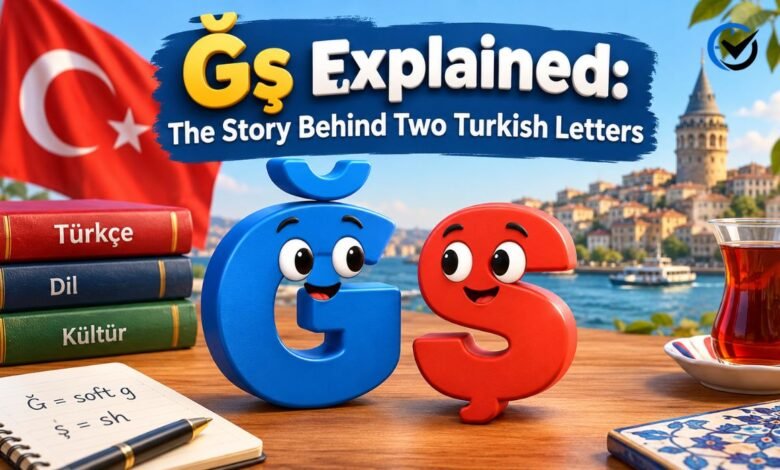
The sequence Ğş can look like a word, an abbreviation, or a name, especially to readers who have not encountered Turkish spelling before. It is made from two letters used in the Turkish alphabet: uppercase Ğ and lowercase ş. By itself, however, the sequence is not a standard Turkish word with a widely recognized meaning.
Understanding it starts with looking at each letter separately. They represent different sounds and play different roles in written Turkish. The first is yumuşak ge, often called “soft g”; the second, ş, is pronounced like the “sh” in ship. Together, the characters make an unusual-looking pair, but they do not form a special expression simply by appearing side by side.
What the Pairing Represents
Two letters, one short sequence
In ordinary text, Ğş is best read as a sequence of characters, not as a vocabulary item. It combines an uppercase letter with a lowercase one, just as “Ab” combines two different letter forms. The capitalization does not give the pair a standard meaning. Its significance depends on where it appears: it might be a fragment, a typed example, a username, or a label created for a particular purpose.
A point about Turkish spelling
The Turkish alphabet has 29 letters and uses several characters that are unfamiliar to many English readers. These include ç, ğ, ı, ö, ş, and ü. They are not decorative marks added to ordinary English letters. Each has a defined place in Turkish spelling, and several represent sounds or pronunciation patterns that English does not express in the same way.
The Letter Ğ
Where it appears in the alphabet
The letter ğ follows g and comes before h in the Turkish alphabet. Its uppercase form is Ğ, while its lowercase form is ğ. The breve-shaped mark above the letter is part of its written form, so it should not be dropped when spelling a Turkish word. Replacing it with a plain g can change how a word is read and, in some cases, which word a reader understands.
Why “soft g” is only a rough guide
The common name yumuşak ge translates roughly as “soft g,” but that description can mislead English speakers into expecting a light version of the g in go. In standard modern Turkish, the letter usually does not act like a separate, firm consonant. Its effect is more often heard in the vowel before it or in the transition between neighboring vowels.
How it affects nearby vowels
What listeners hear depends on the word and its surrounding sounds. In some words, the vowel before ğ is held longer; in others, the letter helps create a smooth transition from one vowel to another. The pronunciation can also vary by region and speaking style. That is why a single English sound cannot serve as a reliable substitute for the letter in every Turkish word.
Examples in familiar words
Consider dağ, meaning “mountain.” The final ğ does not sound like the hard g in English bag. It generally affects the preceding vowel instead. In değil, meaning “not,” the letter appears between vowels and contributes to the flow of the word. These examples show why reading ğ as an ordinary English g often produces an inaccurate pronunciation.
The Letter Ş
A clear “sh” sound
The letter ş is more straightforward for English speakers to approximate. It represents the “sh” sound heard at the beginning of ship or shoe. Turkish uses it in words such as şeker, meaning “sugar,” and şehir, meaning “city.” The mark beneath the letter is called a cedilla, and it distinguishes ş from plain s in both writing and pronunciation.
Why the mark matters
Plain s and ş are separate letters in Turkish, not interchangeable styles. The first usually has the sound heard in English sun; the second has the “sh” sound in ship. A missing cedilla can therefore make a word harder to identify or cause it to be read incorrectly. When writing Turkish names or words, preserving the mark is part of spelling the word accurately.
Uppercase and lowercase forms
The standard uppercase and lowercase forms are Ş and ş. Turkish capitalization follows the spelling of the word and its position in a sentence, just as it does in English, though the details of Turkish capitalization have their own conventions. In the sequence Ğş, only the first letter is uppercase. That mixed capitalization is possible in a label or name, but it is not evidence that the pair has a fixed linguistic definition.
Why the Pair Looks Unusual
A letter that rarely begins native words
In standard Turkish spelling, ğ does not normally begin native Turkish words. It is generally found after a vowel, where it affects the sound pattern around it. That makes Ğş visually unusual: the sequence starts with uppercase Ğ, then places ş immediately after it. It can still be typed or used as a custom label, but its appearance does not make it an ordinary Turkish word.
The letters do not make a known expression
Seeing two Turkish letters together can invite readers to search for a translation or pronunciation. But a pair of characters does not necessarily carry meaning. Without a surrounding sentence or a clear naming context, there is no reliable basis for assigning Ğş a definition. Treating it as a Turkish word would create an interpretation that the spelling alone does not support.
How to Approach Its Pronunciation
Read the letters individually first
If someone needs to say the sequence aloud, the clearest approach is to identify the letters rather than invent a word-like pronunciation. The name of ğ is yumuşak ge; ş is called şe. Pronunciation of these letter names can vary somewhat among speakers and teaching materials, so a learner can listen to a Turkish speaker for a more precise model.
Why there may be no single spoken form
A reader might try to blend Ğ and ş into one syllable, but Turkish pronunciation rules do not provide a normal word pattern for this particular sequence. The first letter usually appears after a vowel, while ş represents a consonant sound. Since the pairing is not a standard word, it has no universally accepted spoken form beyond naming or describing the two letters.
Typing and Displaying the Characters
Turkish keyboard layouts
On a Turkish keyboard, ğ and ş have dedicated keys. On other layouts, writers may need to switch keyboard settings, use a character menu, or enter the letters through a device-specific method. The exact steps vary by operating system and application. For short examples, copying the correctly accented characters can work, but it is worth checking that the text retains them after pasting.
Unicode and digital text
Each character has a distinct identity in digital text. The accented letter is not always treated as the same character as its unaccented counterpart, even when a font makes them look similar at a small size. Most current software handles Turkish characters correctly, but display problems can arise with older systems, incompatible fonts, or incorrect text encoding. A missing mark may be a technical display issue rather than an intentional spelling choice.
Search and data entry
Search tools and databases may handle accented characters differently. Some systems match ş to s in broad searches; others preserve the distinction. Names and Turkish words are easiest to find when entered with their original letters, but trying an unaccented spelling can help when a site or form does not accept them. If the sequence appears in a search result, the surrounding page is more informative than the letters alone.
Understanding It in Context
A useful approach for Turkish learners
For language learners, this pairing is a useful reminder to study unfamiliar letters in real words rather than memorize one English equivalent. Practice ğ in words such as dağ and değil, and ş in words such as şeker. Listening to recordings and repeating full words helps learners notice vowel length, transitions, and consonant sounds that a written description cannot capture fully.
When it appears as a name or label
If Ğş appears as a username, product label, code, or personal name, its meaning belongs to that context. It may be a chosen arrangement of letters, a test string, or a fragment copied from a longer text. It would be inaccurate to claim a particular origin or meaning without evidence from the person or source that uses it. Ask the creator or consult the surrounding material when the interpretation matters.
Final Thoughts
Ğş is not a standard Turkish word simply because it contains Turkish letters. It brings together Ğ, whose pronunciation depends on its position and neighboring vowels, and ş, which represents the familiar “sh” sound. Understanding the characters separately explains why the sequence looks distinctive, while context determines whether it functions as a label, fragment, or personal choice. When accuracy matters, preserve the diacritics and avoid assigning a meaning the source has not established.
Frequently Asked Questions
1. What does Ğş mean in Turkish?
On its own, Ğş has no widely recognized meaning as a standard Turkish word. It is a pairing of two letters. If it appears in a name, username, code, or other specific setting, its intended meaning depends on that source.
2. How is Ğş pronounced?
There is no single standard word pronunciation for the pair. The most reliable way to read it aloud is to name the letters: Ğ is yumuşak ge and ş is şe. A Turkish speaker can provide a natural pronunciation of those letter names.
3. Is Ğş a Turkish word?
No standard Turkish word is commonly spelled Ğş by itself. The sequence is better understood as two characters unless it has a special meaning in a particular name, label, or piece of text.
4. What sound does the letter Ğ make?
The letter ğ usually does not make the hard “g” sound found in English go. Depending on its position and the word, it may lengthen the preceding vowel or help connect neighboring vowels. Its effect is best learned through examples and listening.
5. What sound does the letter ş make?
The letter ş represents the “sh” sound in English ship. It is a separate letter from s, which generally has the sound in sun. The cedilla is part of its spelling and helps distinguish the two.
6. Why does Ğş start with a capital letter?
The uppercase Ğ may be used because the sequence begins a sentence or is formatted as a title, label, or name. Capitalization alone does not make the pair a word or give it a special meaning.
7. Can Ğ begin a Turkish word?
In standard spelling, ğ does not normally begin native Turkish words. It generally appears after a vowel and changes the sound pattern around it. This is one reason the sequence Ğş looks unusual to Turkish readers.
8. How can I type Ğ and ş?
You can switch to a Turkish keyboard layout, use your device’s character picker, or insert the characters through an application’s special-character menu. The exact method depends on your device. Check the result after pasting to make sure the marks display correctly.
9. Are ğ and g interchangeable?
No. Turkish treats ğ and g as different letters with different pronunciation roles. Replacing one with the other can alter a word’s spelling and lead readers to pronounce or understand it differently.
10. Why might a website show Turkish letters incorrectly?
A website may use a font or text encoding that does not display the characters properly. The marks can appear missing, replaced, or garbled. If the spelling matters, compare the text with a reliable source or try viewing it in a modern browser with Turkish character support.
Recommended: Fonendi in Clinical Practice: How This Medical Instrument Supports Auscultation





One Comment