

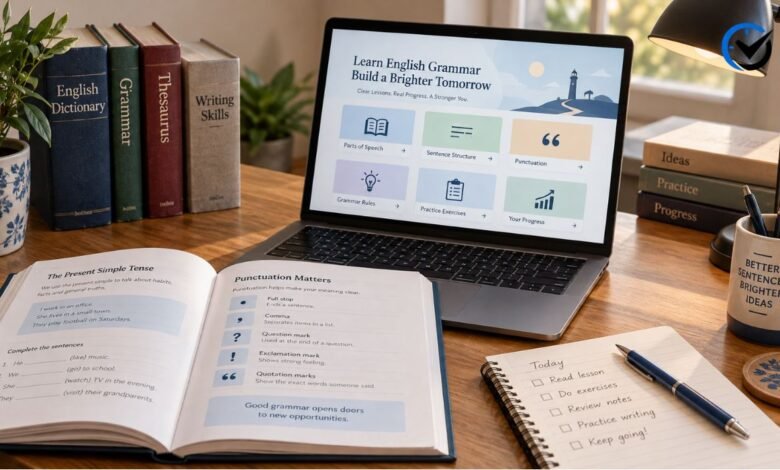
Learning English grammar can feel difficult when rules are presented without useful examples. Learners may understand a definition but still struggle to use it in a real sentence. GrammarVista.com is an online educational resource and publication focused on the English language. It offers a starting point for people who want to understand grammar, improve their writing, and communicate more clearly. This guide explains how readers can approach its educational content, turn individual lessons into practical skills, and build a balanced learning routine. It also explores the major parts of English that deserve attention, from sentence structure and verb forms to punctuation and vocabulary.
Understanding the Purpose of GrammarVista.com
The main purpose of an English learning publication is to make language rules easier to understand and apply. Instead of treating grammar as a list of strict definitions, a useful resource connects each rule with everyday communication. Readers may use the site to review unfamiliar concepts, clarify common doubts, or strengthen areas where they regularly make mistakes. Such material can support students, independent learners, writers, teachers, and professionals. However, its value depends on how thoughtfully a person studies each lesson and practices what they learn afterward.
Who Can Benefit From the Platform?
English learners at different levels may benefit from clear language lessons, although their needs will vary. Beginners usually need help with basic word order, common verb forms, articles, pronouns, and simple sentence patterns. Intermediate learners often focus on tense consistency, prepositions, clauses, and more natural vocabulary choices. Advanced readers may want to refine tone, punctuation, sentence rhythm, and formal writing. Native speakers can also use the publication to review confusing rules or improve professional documents. The material is most useful when readers select topics that match their present ability rather than moving through subjects randomly.
Building Strong Grammar Foundations
A strong foundation begins with understanding how words perform different jobs. Nouns identify people, places, objects, and ideas, while verbs express actions or conditions. Adjectives describe nouns, and adverbs usually add information about actions, descriptions, or other adverbs. Pronouns replace nouns, while conjunctions connect words or ideas. These categories are often called parts of speech, and recognizing them makes later lessons easier. A learner who understands the function of each word can examine a sentence logically instead of relying only on what sounds correct.

Learning How Sentences Work
A complete sentence normally contains a subject and a predicate and expresses a finished thought. The subject tells readers who or what the sentence concerns, while the predicate explains an action, condition, or experience. Once this pattern becomes familiar, learners can begin working with simple, compound, and complex sentences. They can also recognize fragments, run-on sentences, and unclear connections between ideas. GrammarVista.com can be approached as a source of explanations, but readers should reinforce every lesson by creating original examples. Writing three or four sentences for each pattern turns passive reading into active learning.
Understanding Verb Tenses Clearly
Verb tenses show when an action happens and how it relates to another moment. English uses present, past, and future forms, but each time frame includes simple, continuous, perfect, and perfect continuous constructions. Learners often become confused when they memorize names without understanding purpose. It is more helpful to compare meanings. “I studied” describes a completed past action, while “I was studying” presents an action in progress at a particular time. A good study session should focus on one contrast at a time, followed by examples connected to everyday routines, work, travel, or education.
Improving Subject-Verb Agreement
Subject-verb agreement appears simple, but longer sentences can make it surprisingly challenging. A singular subject generally requires a singular verb, while a plural subject takes a plural form. Confusion often occurs when extra words separate the subject from its verb. In the sentence “The collection of old books belongs to the library,” the subject is “collection,” not “books.” Indefinite pronouns, collective nouns, and compound subjects can create further difficulty. Readers should identify the true subject before selecting the verb. This small habit improves accuracy and prevents many common writing errors.
Using Articles and Determiners Naturally
The words “a,” “an,” and “the” carry meanings that may not exist in a learner’s first language. “A” and “an” usually introduce one nonspecific countable noun, while “the” points to something identified or understood by both speaker and listener. The choice between “a” and “an” depends on sound rather than spelling. For example, “an hour” is correct because the initial “h” is silent. Determiners such as “this,” “those,” “some,” “each,” and “many” also clarify quantity or identity. Studying them in complete sentences helps learners understand their natural use.

Mastering Punctuation for Clearer Meaning
Punctuation guides readers through written ideas. A period closes a statement, a comma separates certain elements, and a question mark signals a direct question. Colons, semicolons, apostrophes, quotation marks, and dashes have more specialized purposes. Misusing these marks can change meaning or make a sentence difficult to follow. Learners should study punctuation alongside sentence structure because the two subjects are closely connected. Rather than inserting commas wherever a pause seems natural, writers should learn why a comma is needed. Reading finished sentences aloud can then help confirm whether the punctuation supports a smooth rhythm.
Expanding Vocabulary Through Context
Grammar and vocabulary should be studied together because correct structure cannot communicate much without suitable words. Memorizing isolated terms may produce quick results, but words are easier to remember when they appear in meaningful situations. Readers can record a new word with its definition, grammatical role, common partners, and one original example. For instance, learning “decision” becomes more useful when paired with expressions such as “make a decision” and “final decision.” This method improves both accuracy and fluency. It also helps learners avoid combinations that are technically understandable but unnatural in everyday English.
Turning Lessons Into a Study Routine
Regular practice is more effective than an occasional long session. A practical routine might include reading one focused lesson, writing several examples, checking errors, and reviewing the same concept a few days later. Learners can keep a notebook organized by topic, such as verbs, punctuation, sentence patterns, and vocabulary. It is also helpful to maintain an error log that records repeated mistakes and corrected versions. GrammarVista.com can supply explanations and learning material, but lasting progress requires active use. Even fifteen focused minutes each day can produce meaningful improvement when the routine remains consistent.
Evaluating Online Language Information
Readers should examine any educational publication carefully instead of accepting every statement automatically. A dependable explanation should define the topic clearly, use accurate examples, acknowledge important exceptions, and distinguish formal rules from everyday preferences. Publication dates matter when an article discusses changing usage, digital communication, or modern style conventions. Readers should compare difficult or disputed points with a trusted dictionary, established usage guide, teacher, or recognized educational source. This is especially important because English varies across regions. A form common in American English may differ from standard British usage without either version being inherently wrong.

Applying Grammar to Real Communication
Grammar becomes valuable when it improves communication beyond practice exercises. After studying a lesson, learners can apply it to an email, journal entry, school assignment, social post, or workplace document. They can then review the writing with one clear goal, such as checking verb tense or sentence boundaries. Trying to correct every feature at once can feel overwhelming. Focused editing makes progress easier to notice. Speaking practice also matters because grammar supports conversation as well as writing. Using a new sentence pattern in a real discussion helps move it from short-term understanding into practical knowledge.
Final Thoughts
GrammarVista.com can serve as a practical educational resource for readers who want clearer guidance on English grammar and writing. Its lessons are likely to be most valuable when users study with a purpose, test each idea through original examples, and review mistakes over time. Learners should begin with essential sentence patterns before moving toward advanced structures, while also developing vocabulary, reading, listening, and speaking skills. They should check uncertain claims against trusted language authorities, particularly when regional conventions differ. With steady practice and thoughtful use, clear grammar lessons can support more accurate writing, stronger comprehension, and greater confidence in everyday communication.
Frequently Asked Questions
1. What is GrammarVista.com?
GrammarVista.com is described as an online educational resource and publication centered on the English language. Its subject area may include grammar guidance, writing explanations, vocabulary support, and related language topics. Readers can use this type of publication to explore individual concepts or review rules they have forgotten. It should be treated as one part of a broader learning process rather than a complete replacement for practice, feedback, and conversation. The most useful approach is to select a specific topic, understand the explanation, and immediately apply it in original sentences.
2. Is GrammarVista.com suitable for beginners?
Beginners may find it helpful when lessons use plain definitions, short examples, and a clear order. New learners should begin with sentence basics, common parts of speech, present and past verb forms, pronouns, articles, and everyday punctuation. Moving directly into advanced clauses or rare exceptions may create unnecessary confusion. A beginner should study one small concept at a time and practice it repeatedly. If an explanation feels too difficult, it is reasonable to step back, review the required foundation, and return to the topic later.
3. Can the site help improve writing?
Language lessons can improve writing when readers actively use what they learn. Understanding sentence boundaries, agreement, verb tense, word order, and punctuation makes written ideas easier to follow. However, simply reading articles is unlikely to produce lasting change. Learners should write examples, revise older work, and compare their first draft with the corrected version. It also helps to read strong English writing regularly. The combination of instruction, practice, reading, and thoughtful correction develops clearer writing more effectively than relying on a single method.
4. How often should I study English grammar?
Short and regular study sessions generally work better than irregular periods of intense practice. Many learners can make progress with fifteen to thirty minutes a day, depending on their schedule and goals. A session might include one lesson, several original examples, and a brief review of earlier mistakes. More important than the exact duration is the quality of attention. Studying while distracted produces limited results. A consistent weekly routine also gives the brain time to revisit information, strengthen recall, and connect new rules with previously learned patterns.
5. Should I memorize every grammar rule?
Memorization has a place, but understanding and use matter more. Some basic forms, including irregular verbs and common pronouns, must be remembered. Longer rules become easier when learners understand the meaning behind them and see several contrasting examples. It is not necessary to memorize every rare exception before communicating. Concentrate first on patterns that appear often in speech and writing. As experience grows, less common details can be added. The goal is not to recite definitions but to make accurate choices naturally in real situations.
6. Can grammar lessons improve spoken English?
Yes, grammar knowledge can support clearer speech by helping learners organize ideas and choose suitable verb forms. Still, spoken fluency requires listening and conversation practice in addition to study. People often understand a rule on paper but need time to use it quickly while speaking. Reading examples aloud, answering simple questions, and describing daily activities can bridge that gap. Learners should avoid stopping after every minor mistake because constant self-correction can interrupt communication. Accuracy and fluency can be developed together through patient, repeated practice.
7. What should I do when two grammar sources disagree?
First, check whether the sources are discussing different varieties of English or different levels of formality. American and British conventions sometimes vary, especially in spelling, punctuation, and collective noun agreement. A formal style guide may also recommend a construction that casual speech handles differently. Look for context, examples, and an explanation of the underlying rule. If uncertainty remains, consult an established dictionary or usage guide. Language contains variation, so disagreement does not always mean one source is entirely wrong. The intended audience often determines the best choice.
8. How can I remember new grammar concepts?
Use each concept soon after learning it. Create examples about familiar subjects, transform affirmative sentences into questions, and compare correct forms with common mistakes. Review the lesson after one day, several days, and again the following week. This spaced approach strengthens memory more effectively than repeating everything in one sitting. Keeping an error log is also useful because personal mistakes reveal exactly what requires more attention. A concept becomes memorable when it is connected to meaning, repeated over time, and used in several different situations.
9. Can teachers use GrammarVista.com in lessons?
Teachers may use suitable educational articles as supplementary material for explanations, examples, discussion, or independent review. Before sharing any lesson, an instructor should check its accuracy, difficulty, and relevance to the class. The material can then be paired with original exercises, group correction, or a short writing activity. Teachers should also explain regional differences when necessary. An online publication works best as support for thoughtful teaching, not as an automatic lesson plan. Professional judgment remains important because learners have different goals, backgrounds, and levels of understanding.
10. Is GrammarVista.com enough to become fluent in English?
No single publication can provide every element required for fluency. Grammar instruction builds accuracy, but learners also need vocabulary, listening, pronunciation, reading, writing, and real conversation. Cultural context and exposure to natural language are equally valuable. An English resource can guide study and solve specific problems, yet progress depends on regular application. Learners should combine lessons with books, audio, conversations, and written practice suited to their ability. A balanced routine creates stronger results because it develops both knowledge of the language and confidence using it.
Recommended: Magnexusbuzz Com Safety Check: What Visitors Should Examine First


One Comment