

Solo ET is a term that can be confusing because it does not have one universally accepted definition. In recent technology discussions, it is often used for digital tools, workflows, or systems built around one person rather than a large team. Some writers expand ET as “Experience Technology,” while others use broader phrases such as emerging or enhanced technology. Outside technology, the words can also be read linguistically: “solo” relates to being alone or independent, while “et” means “and” in Latin. The safest approach is therefore to treat Solo ET as a developing, context-dependent concept rather than a single product or fixed technical standard.
What Does Solo ET Mean?
In its technology-focused sense, Solo ET describes systems designed around a single user’s needs. Traditional workplace software often assumes that several people will share projects, approve work, exchange messages, and manage permissions. A solo-centered system begins with a different question: what does one person need to complete a task from start to finish? This can lead to simpler interfaces, personal dashboards, customized settings, automated routines, and fewer features devoted mainly to team coordination. It does not mean avoiding collaboration; it means giving one user more direct control over work that can be handled independently.
Why the Term Can Be Confusing
The term is difficult to define because it is still relatively new and is used inconsistently online. It is not best treated as the name of one universally recognized company, application, or formal technical standard. Different technology writers use ET in different ways, including “Experience Technology,” “Emerging Technology,” and “Enhanced Technology.” These interpretations overlap around modern digital tools but are not identical definitions. There is also a language-based interpretation of the phrase. As a result, the subject should always be understood in the context where the term appears.
The Linguistic Side of Solo ET
The linguistic interpretation is worth knowing because it explains why the phrase can appear outside software discussions. “Solo” is associated with being alone, single, or independent, while the Latin conjunction “et” means “and.” Together, the words can be read as “alone and,” which sounds unfinished and open to interpretation. In creative or philosophical settings, that quality may suggest independence while leaving room for connection, growth, or another idea. This is separate from the technology meaning, but both interpretations share an emphasis on individuality.
How Solo-Focused Technology Developed
The technology concept has developed alongside changes in modern work. Freelancers, independent creators, consultants, remote professionals, students, and small business owners increasingly manage tasks that once depended on larger organizations. Cloud software made advanced tools accessible to individuals, while automation reduced manual work. Artificial intelligence has extended that shift by helping with research, writing, organization, analysis, customer communication, and repetitive processes. Solo ET can therefore be seen as part of a broader movement toward technology that gives individuals capabilities once associated mainly with teams.
How Solo ET Works
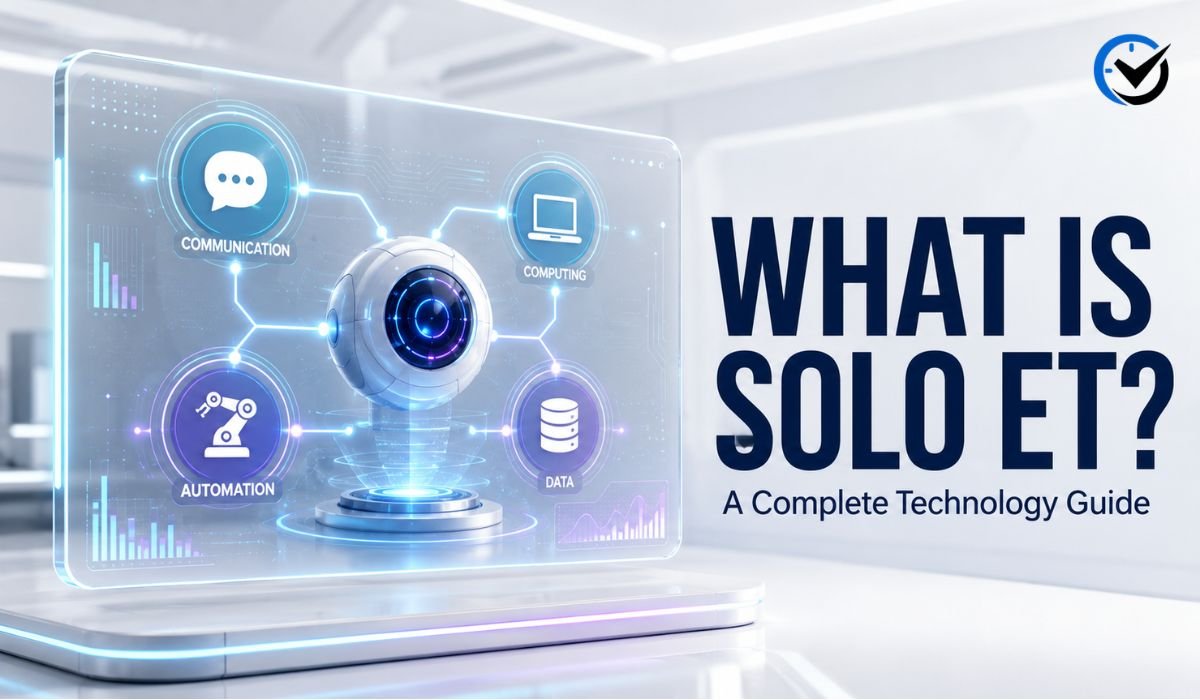
A solo-focused setup usually connects several functions around one person’s workflow. A user might gather information, organize tasks, automate routine actions, review results, and make decisions from a personalized workspace. AI can assist with summaries, drafting, classification, recommendations, or pattern recognition, while automation can move information between services or trigger actions when conditions are met. Analytics can then show progress or problems. Importantly, these functions do not have to exist inside one application. A practical system can combine several familiar tools around the needs of one user.
The Role of Artificial Intelligence
Artificial intelligence is particularly useful because it can act as a support layer for someone working independently. A freelancer might use AI to organize notes, prepare a first draft, summarize documents, or sort customer information. A creator could use it for brainstorming, research organization, or routine production tasks. The value comes from reducing repetitive effort, not from removing human judgment. Important information should still be checked, and users should understand that AI can produce errors. A strong solo workflow keeps the person responsible for final decisions.
Automation and Workflow Design
Automation is another important part of the concept. When one person handles every stage of a process, small repetitive actions can consume a large amount of time. Automation can move data, send standard notifications, organize records, prepare routine reports, or update information. This gives the user more time for work that requires judgment and creativity. However, automation needs testing and monitoring. A badly designed rule can repeat an error many times, so important workflows should include checks and clear points where a person can review the outcome.
Personalization and User Experience
Personalization is what makes many solo-centered systems feel different from general workplace platforms. Instead of designing an interface for many departments or roles, the system can be arranged around one person’s habits and priorities. A user can decide which information appears on a dashboard, how reminders work, and which steps should be automated. This can reduce unnecessary alerts and make common actions easier to reach. The best setup is not necessarily the one with the most features; it is the one that removes friction from the user’s actual work.
Who Can Benefit From Solo ET?
The concept can benefit people who manage substantial work independently. Freelancers may use connected tools for clients, schedules, documents, invoices, and communication. Solo founders can coordinate product development, marketing, research, and customer support with limited staff. Content creators can manage research, production, publishing, and performance data through a personal workflow. Students and independent learners can use similar systems to plan study, organize material, and track progress. The common factor is not a profession but the need to manage meaningful tasks without a large internal team.
Common Uses in Everyday Work
In everyday work, the approach can be quite practical. Someone running a small online business might connect a customer form to a database, automate follow-up messages, and monitor activity through a dashboard. A writer could organize research, drafts, deadlines, and publishing in one workspace. A consultant might automate appointment reminders and routine documents while keeping sensitive decisions under personal review. These examples show that Solo ET does not require futuristic hardware. It can be created from ordinary cloud applications, AI assistants, automation services, databases, and analytics tools.
Benefits of a Solo-Centered Approach
One major benefit is efficiency. When software is organized around one person’s workflow, unnecessary steps can often be removed. Personalization may improve focus, automation can reduce repetitive work, and AI can help with information-heavy tasks. There may also be a financial benefit for independent workers because routine administration can require less outside support. Another advantage is control: the user can decide which processes to automate, what information to share, and how the workflow should operate. These benefits are strongest when the system remains simple enough for one person to understand and maintain.
Privacy and Data Control
Privacy is especially important when a personal system brings business and private information together. A user may store customer details, financial records, private notes, intellectual property, or confidential documents in connected services. Before adopting a tool, it is sensible to understand what data it collects, where that data is stored, and who may access it. Strong passwords, multi-factor authentication, limited permissions, backups, and careful service selection can reduce avoidable risks. Personalization only becomes a real advantage when the user can trust the system handling important information.
Limitations and Risks
Solo-focused technology also has clear limitations. Managing many connected applications can become complicated, particularly when one person must troubleshoot integrations alone. Automation can fail when rules depend on incomplete information, while AI can produce inaccurate results. There is also a risk of depending too heavily on services whose prices, features, or availability may change. Most importantly, efficiency does not eliminate the value of human collaboration. Some decisions, creative projects, and sensitive situations benefit from other people’s knowledge, experience, and independent judgment.
Solo ET Compared With Traditional Team Technology
Compared with traditional team technology, the main difference is the design priority. Team platforms focus on shared work through permissions, roles, approvals, communication, and group reporting. Solo-centered systems emphasize individual control, personal efficiency, and direct execution. Neither model is automatically better. A large organization needs coordination, while an independent designer may not need layers of team management. In real life, both can coexist: a person can use a private workflow for daily tasks while collaborating with clients, contractors, or colleagues when a project requires it.
Is Solo ET a Single Product?
Solo ET should generally not be treated as one universally established software product. In current discussions, it is more often used as a broad concept for individual-centered technology. That distinction matters because someone searching for the term may expect one official application with a fixed set of features. Instead, a solo-oriented system can combine software, automation, AI, analytics, and personal workflows. If a particular company uses “Solo ET” as a product name, that company’s definition should be considered separately from the broader concept described here.
How to Build a Practical Solo ET System
A useful way to build such a system is to start with the work rather than the technology. First identify repeated tasks, information that is frequently needed, and decisions that consume time. Then choose only the tools that solve those problems. A simple setup is usually easier to secure and maintain than a large collection of disconnected services. It also helps to keep a human review step for important actions. This practical approach prevents the idea from becoming a collection of fashionable tools with no clear purpose.
Measuring Whether It Actually Helps
Success should be measured by results rather than the number of automated features. A good system might save time, reduce missed tasks, make information easier to find, or improve consistency. If an automation takes longer to maintain than the manual task it replaces, it may not be worthwhile. The same principle applies to AI: an assistant is useful when it improves the quality or speed of work, not simply because it is available. The most effective solo-centered technology remains closely connected to a real need.
The Future of Solo-Focused Technology
The future of solo-focused technology is closely tied to the growth of AI, automation, and independent digital work. Future systems may become better at learning user preferences, connecting information across applications, and presenting only the data needed at a particular moment. At the same time, privacy, security, accuracy, and human oversight will become more important. The strongest systems are unlikely to be those that automate everything. More useful designs will combine intelligent assistance with clear controls, reliable information, and meaningful human decisions.
Final Thoughts
Solo ET is best understood as an emerging, context-dependent idea rather than a single product with one fixed definition. In technology discussions, it generally points toward systems that help individuals work with greater control through personalization, automation, AI assistance, and connected digital tools. Its broader linguistic interpretation adds another layer, but the practical technology meaning is especially relevant to freelancers, creators, independent professionals, and small operators. The most useful lesson is that technology should serve the person’s workflow instead of forcing the person to adapt to unnecessary complexity. When designed carefully, a solo-centered system can save time and improve organization while still leaving important decisions, privacy choices, and judgment in human hands.
Frequently Asked Questions
1. What is Solo ET in simple terms?
Solo ET can be understood as an approach to technology that puts one person’s needs at the center. It commonly involves personalized tools, automation, AI assistance, and workflows that help an individual complete tasks independently.
2. Does Solo ET have one official definition?
No single definition is universally established. The phrase is used in several ways online, particularly in discussions about individual-focused digital systems. Its exact meaning should therefore be interpreted according to the context.
3. What can ET stand for in Solo ET?
Different sources use ET differently. “Experience Technology” is one common interpretation, while others use terms such as “Emerging Technology” or “Enhanced Technology.” These should be viewed as contextual expansions rather than one fixed definition.
4. Is Solo ET a software application?
Not necessarily. In most contexts, it describes a concept or approach rather than one specific application. A solo-focused workflow can combine several existing applications, AI services, automation tools, and data systems.
5. How does AI fit into Solo ET?
AI can assist with tasks such as summarizing information, drafting material, organizing data, generating ideas, and identifying patterns. Human review remains important whenever accuracy, privacy, or important decisions are involved.
6. Who is most likely to use Solo ET?
Freelancers, independent professionals, creators, solo entrepreneurs, consultants, students, and remote workers can benefit from systems designed around individual workflows. It is especially useful when one person manages many connected responsibilities.
7. Is Solo ET the same as working alone?
No. The concept focuses on individual control and workflow design, not social isolation. Someone can use personalized technology while continuing to work with clients, partners, communities, contractors, or larger teams.
8. What are the main benefits of Solo ET?
Potential benefits include less repetitive work, greater personalization, improved organization, faster access to information, and stronger control over digital workflows. The actual value depends on how well the system fits the user’s needs.
9. What are the main risks?
Common concerns include privacy problems, automation errors, inaccurate AI output, complicated integrations, software dependence, and security weaknesses. Careful tool selection, testing, backups, and human oversight can reduce many of these risks.
10. Is Solo ET likely to become more important?
Its underlying ideas are likely to remain relevant as independent work, AI assistance, and automation continue to grow. Whether the exact term becomes standardized is less certain, but personalized technology is an increasingly important direction.
Recommended: What Is Movirz? Complete Guide to Features, Streaming, Safety, and Legality





One Comment