

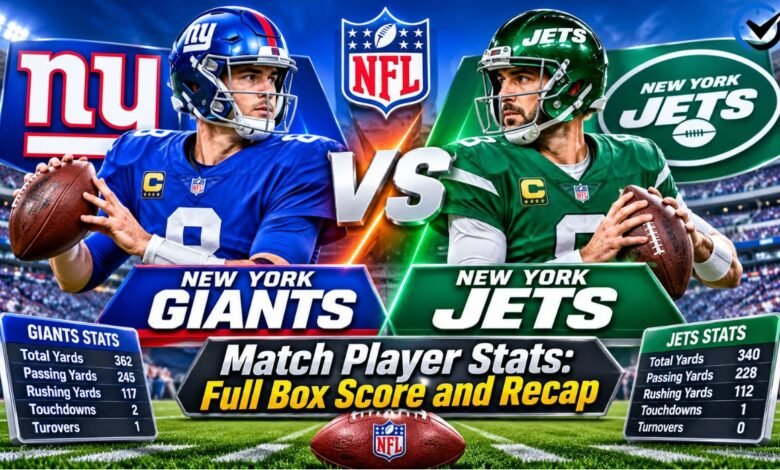
The New York Giants vs New York Jets Match Player Stats tell the story of a game shaped by defense, injuries, field position, and two late kicks. This recap covers the October 29, 2023 regular-season meeting at MetLife Stadium, which the Jets won 13–10 in overtime. It does not combine numbers from preseason games or other seasons. Although the Giants controlled the running game, the Jets produced enough passing plays at the end to escape. Understanding that contrast makes the individual statistics much more useful than the final score alone.
Final Score and Quarter-by-Quarter Recap
The Jets scored seven points in the first quarter, none in the second or third, three in the fourth, and three in overtime. The Giants scored three in the first quarter, none in the second, seven in the third, and none afterward. Graham Gano opened the scoring with a 31-yard field goal. Breece Hall answered with a 50-yard touchdown reception before Tommy DeVito later scored on a six-yard run. Greg Zuerlein supplied the final six points. The result moved the Jets to 4–3 and dropped the Giants to 2–6.
Complete Quarterback Statistics
Zach Wilson completed 17 of 36 passes for 240 yards, one touchdown, and no interceptions, finishing with a 78.5 passer rating. He took four sacks for 47 lost yards. Tyrod Taylor completed four of seven attempts for eight yards before leaving with a rib injury. DeVito completed two of seven for minus-one yard after replacing him. Neither Giants quarterback threw a touchdown or interception. Taylor took two sacks for seven yards, while DeVito lost nine yards on two sacks. These figures explain why the Giants struggled to build drives through the air.
Rushing Box Score and Ground-Game Leaders
Saquon Barkley carried 36 times for 128 yards, including a 34-yard gain, but did not score. Taylor added 33 yards on five carries, Wan’Dale Robinson gained 17 on two, Matt Breida had 13 on five, and DeVito produced 12 on four with one touchdown. For the Jets, Wilson led with 25 yards on four runs. Hall managed 17 on 12 attempts, Garrett Wilson added six on one, Dalvin Cook gained five on two, Xavier Gipson had three on one, and Michael Carter gained two on two. The Giants finished with a clear rushing advantage.
Receiving Box Score and Target Distribution
Garrett Wilson led all receivers with seven catches for 100 yards on 13 targets. Hall caught six of nine targets for 76 yards and the Jets’ only touchdown. Allen Lazard added three receptions for 45 yards on six targets, while C.J. Uzomah caught his only target for 19. Tyler Conklin, Jeremy Ruckert, Gipson, and Michael Carter had no catches. Barkley led the Giants with three receptions but gained zero yards. Darren Waller and Breida each caught one pass for four yards, while Darius Slayton’s lone reception lost one yard. Daniel Bellinger and Robinson finished without catches.
Defensive Standouts, Sacks, and Takeaways
Kayvon Thibodeaux recorded three sacks and forced a fumble, making him a central figure in the Giants’ defensive effort. Jihad Ward and Micah McFadden recovered the Jets’ two lost fumbles. For the Jets, Jermaine Johnson recorded two sacks, Bryce Huff added one, and C.J. Mosley and Quinton Jefferson shared another. Mosley led the Jets with 12 combined tackles, followed by Quincy Williams with 11 and Tony Adams with 10. Neither defense intercepted a pass. The absence of interceptions should not disguise the pressure: both teams repeatedly forced hurried decisions, negative plays, and stalled possessions.
Kicking, Punting, and Return Statistics
Zuerlein made both field-goal attempts, from 35 and 33 yards, and converted his only extra point. Gano made a 31-yard field goal and an extra point but missed attempts from 47 and 35 yards. Thomas Morstead punted 11 times for 529 yards, averaging 48.1 yards, with four kicks inside the 20. Jamie Gillan punted 13 times for 549 yards, averaging 42.2, with five inside the 20. Gipson returned three punts for 20 yards and one kickoff for 22. Gunner Olszewski returned six punts for 56 yards, while Parris Campbell’s kickoff return gained 24.
Team Statistics and Efficiency Comparison
The Jets gained 251 total yards compared with 194 for the Giants, despite losing the rushing comparison 203–58. Both teams earned 12 first downs. The Jets converted two of 15 third downs, while the Giants converted two of 19. Possession favored the Giants, 38:13 to 25:38, but that control generated only 10 points. The Jets committed nine penalties for 85 yards; the Giants committed six for 73. The Giants had no turnovers, while the Jets lost two fumbles. Those contrasts show why possession and turnover advantages cannot explain every result.
How the Giants Built Their Second-Half Lead
The Giants opened the third quarter with an 11-play touchdown possession covering 75 yards, including penalty yardage. Barkley’s 34-yard run supplied a rare burst, and two unnecessary-roughness penalties against the Jets helped extend the drive. DeVito finished it with a six-yard rushing touchdown, putting the Giants ahead 10–7. With Taylor injured and Daniel Jones unavailable because of a neck injury, the offense leaned heavily on the ground game. That approach reduced the passing burden on an inexperienced replacement, but it also left the Giants with limited ways to extend their lead.
The Final Minute and Overtime Finish
Late in regulation, the Giants faced fourth-and-one at the Jets’ 17-yard line and chose a field goal. Gano missed from 35 yards, leaving the Jets 24 seconds and no timeouts. Wilson then completed consecutive 29-yard passes to Garrett Wilson and Lazard before spiking the ball with one second remaining. Zuerlein tied the game as regulation expired. In overtime, the Giants punted after their opening possession. Garrett Wilson converted third-and-10 with an 11-yard catch, and a 30-yard pass-interference penalty against Adoree’ Jackson moved the Jets closer. Zuerlein’s 33-yard kick ended it.
Final Thoughts
The New York Giants vs New York Jets Match Player Stats reveal a narrow win built from late passing execution, reliable finishing kicks, and defensive resistance. The Giants ran effectively and protected possession, while the Jets overcame turnovers and a weak rushing performance. Neither team produced a smooth offensive display. The clearest reading comes from combining the individual box score with third-down results, sack losses, field position, and the final possessions. For this October 2023 meeting, that wider view explains how a team trailing with 24 seconds remaining eventually left with the victory.
Frequently Asked Questions
1. Which Giants vs Jets game does this article cover?
This article covers the regular-season matchup played on October 29, 2023, during Week 8. The date matters because the Giants and Jets also meet in preseason, when player availability, substitutions, and coaching priorities can differ considerably. A box score from another meeting may feature different quarterbacks and a completely different result. For accurate comparisons, keep the date, competition type, and final score together rather than treating every Giants–Jets game as part of one statistical record.
2. Who was the leading offensive player for each team?
Barkley was the Giants’ main offensive contributor, carrying the ball 36 times for 128 yards. For the Jets, Garrett Wilson led the receiving group with 100 yards, while Hall supplied their only touchdown and added 76 receiving yards. There is no single measure that settles the comparison. Barkley handled the largest rushing workload, Garrett Wilson gained the most receiving yards, and Hall produced the longest scoring play. Each led a different part of his team’s attack.
3. Why did the Giants finish with negative passing yards?
The Giants gained seven yards on completed passes but lost 16 yards through four sacks. Subtracting those sack losses produces minus-nine net passing yards. Individual quarterback passing totals and team net passing totals measure different things, so both figures are correct. Taylor’s eight passing yards and DeVito’s minus-one combine to make seven before the sack adjustment. This distinction is especially important in a game where a few negative plays outweighed almost all gains through completed throws.
4. Did Saquon Barkley score a touchdown?
Barkley did not score a rushing or receiving touchdown in this matchup. The Giants’ touchdown came from DeVito’s six-yard run in the third quarter. Barkley still helped create that score through his work on the ground, including the drive’s longest run. His performance shows why touchdown totals alone can understate a running back’s contribution. A player can carry much of an offense’s workload and help move it into scoring position without receiving the final scoring opportunity.
5. How did Breece Hall contribute despite limited rushing yards?
Hall’s receiving work was much more productive than his rushing output. He gained only 17 yards on the ground but turned six catches into 76 yards, including a 50-yard touchdown. Together, those categories gave him 93 yards from scrimmage. That combined figure provides a clearer picture of his afternoon than his rushing average alone. When evaluating a running back who catches passes, separating ground production from receiving production helps explain how the player affected the game.
6. Why did the game feature so many punts?
The teams combined for 24 punts because neither offense consistently converted third downs or sustained drives. The Giants’ limited passing game made long-yardage situations difficult, while the Jets struggled to establish their running game and lost substantial yardage to sacks. Strong defense repeatedly pushed both offenses into punting situations. The punt totals also explain why starting field position mattered throughout the afternoon: forcing an opponent to travel farther made an already difficult scoring task even harder.
7. Were injuries important to the result?
Injuries affected the options available to both offenses. The Giants began without Jones, lost Taylor during the game, and also lost Waller to a hamstring injury. The Jets dealt with injuries to offensive linemen Connor McGovern and Wes Schweitzer, requiring further changes in front of Wilson. Those disruptions help explain the uneven offensive play, but they do not establish what would have happened with healthy lineups. The most useful assessment considers the players who actually participated and the conditions they faced.
8. Did the team with fewer turnovers win?
No. The Giants avoided turnovers, while the Jets lost two fumbles, yet the Jets still won. Turnovers create opportunities rather than guaranteed points. An offense must turn the resulting possession into a meaningful scoring advantage, and its defense must still protect any lead. This matchup illustrates that relationship clearly: the Giants benefited from takeaways but could not create enough separation. The Jets remained close enough for a short burst of late passing success to change the outcome.
9. Why did a field goal end overtime?
The Giants received the opening overtime possession and punted without scoring. Once that possession ended, a Jets field goal could win under the regular-season overtime rules in effect for this game. Zuerlein therefore needed only to convert after the Jets moved into range. The order of possessions is essential to understanding the finish. Applying rules from another season or assuming that the kick came on overtime’s opening possession would give readers an inaccurate explanation of why play stopped.
10. What is the difference between offensive yards and penalty yards?
Offensive yards come from recorded rushing and passing plays, with sack losses included in team net passing figures. Penalty yards are tracked separately, even when they move the ball a substantial distance. The Jets’ winning overtime possession included a 30-yard pass-interference penalty, but those yards did not become passing yards for Wilson or receiving yards for Malik Taylor. This distinction helps explain why the distance covered by a scoring drive may exceed the offensive yardage credited to its players.
Recommended: Speed Dating Events Near Me: How to Find, Compare, and Book Events



One Comment